Opening the book…
In aqueous solutions, phenols are weakly acidic and lower the pH of a solution. Sodium hydroxide can be used to fully deprotonate a phenol.
Phenols are about a million times more acidic than alcohols (Table \(\PageIndex{1}\)). The reason for this increasing acidity is the stability of the conjugate base through resonance effects. An excellent example of this effect is seen in phenol, which is roughly a million times more acidic than cyclohexanol.

Acidity of Phenols
Compounds like alcohols and phenol, which contain an -OH group attached to a hydrocarbon, are very weak acids. Alcohols are so weakly acidic that, for normal lab purposes, their acidity can be virtually ignored. However, phenol is sufficiently acidic for it to have recognizably acidic properties - even if it is still a very weak acid. A hydrogen ion can break away from the -OH group and transfer to a base. For example, in a solution in water:
Phenols are more acidic than alcohols because the phenoxide anion is resonance-stabilized. The increased acidity of phenol is caused by the negative charge and a set of lone pair electrons from the phenoxide's oxygen atom being delocalized by resonance to three different carbons on the aromatic ring. As a result, the negative charge is no longer entirely localized on the oxygen, but is spread throughout the whole ion, allowing it to be highly stabilized.

Phenol is acidic enough to be deprotonated by weaker bases, such as sodium hydroxide (NaOH), to form the phenoxide ion. They are therefore soluble in dilute aqueous NaOH and can often be separated from a mixture simply by basic extraction into aqueous solution, followed by re-acidification.
Comparing the Acidity of Alcohols with Phenols
Why is phenol a much stronger acid than cyclohexanol? To answer this question, we must evaluate how an oxygen substituent interacts with the benzene ring. As noted in our earlier treatment of electrophilic aromatic substitution reactions, an oxygen substituent enhances the reactivity of the ring and favors electrophile attack at ortho and para sites. It was proposed that resonance delocalization of an oxygen non-bonded electron pair into the pi-electron system of the aromatic ring was responsible for this substituent effect. Formulas illustrating this electron delocalization will be displayed when the "Resonance Structures" button beneath the previous diagram is clicked. A similar set of resonance structures for the phenolate anion conjugate base appears below the phenol structures.

The resonance stabilization in these two cases is very different. An important principle of resonance is that charge separation diminishes the importance of canonical contributors to the resonance hybrid and reduces the overall stabilization. The contributing structures to the phenol hybrid all suffer charge separation, resulting in very modest stabilization of this compound. On the other hand, the phenolate anion is already charged, and the canonical contributors act to disperse the charge, resulting in a substantial stabilization of this species. The conjugate bases of simple alcohols are not stabilized by charge delocalization, so the acidity of these compounds is similar to that of water. An energy diagram showing the effect of resonance on cyclohexanol and phenol acidities is shown on the right. Since the resonance stabilization of the phenolate conjugate base is much greater than the stabilization of phenol itself, the acidity of phenol relative to cyclohexanol is increased. Supporting evidence that the phenolate negative charge is delocalized on the ortho and para carbons of the benzene ring comes from the influence of electron-withdrawing substituents at those sites.
Acidity of Substituted Phenols
Substituted phenols can be either more acidic or less acidic than phenol itself, depending on whether the substituent is electron-withdrawing or electron-donating. Phenols with an electron-donating substituent are less acidic because these substituents concentrate the charge.
Phenols with an electron-withdrawing substituent, such as a nitro or carbonyl on the aromatic ring, are more acidic because these substituents delocalize the negative charge. For the conjugate base of the phenol derivative below, an additional resonance contributor can be drawn in which the negative formal charge is placed on the carbonyl oxygen.

Now the negative charge on the conjugate base can be spread out over two oxygens (in addition to three aromatic carbons). The phenol acid therefore has a pKa similar to that of a carboxylic acid, where the negative charge on the conjugate base is also delocalized to two oxygen atoms. The ketone group on the aromatic ring is acting as an electron-withdrawing group and 'pulling' electron density towards itself, through both inductive and resonance effects.
The acidifying effect of an electron-withdrawing substituent is particularly noticeable in phenols with a nitro group at the ortho or para position.
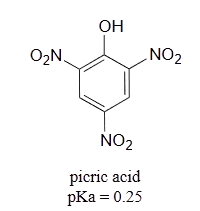
It is noteworthy that the influence of a nitro substituent is over ten times stronger in the para-location than it is meta, despite the fact that the latter position is closer to the hydroxyl group. This occurs since nitro groups at the meta position cannot accept the negative charge through resonance. Furthermore additional nitro groups have an additive influence if they are positioned ortho or para locations to the hydroxide. The trinitro compound shown at the lower right is a very strong acid called picric acid.
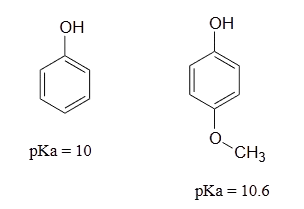
Lastly, if an electron donating group is attached to aromatic ring, as in p-methoxyphenol, the phenoxide ion is destabilized which causes a decrease in acidity in the corresponding phenol.

Is p-hydroxybenzaldehyde more acidic or less acidic than phenol?
Strategy
Identify the substituent on the aromatic ring, and decide whether it is electron-donating or electron-withdrawing. Electron-withdrawing substituents make the phenol more acidic by stabilizing the phenoxide anion, and electron-donating substituents make the phenol less acidic by destabilizing the anion.
Solution
We saw in Section 16.4 that a carbonyl group is electron-withdrawing. Thus, p-hydroxybenzaldehyde is more acidic (pKa = 7.9) than phenol (pKa = 9.89).

Using resonance structures, please explain why 4-methoxyphenol is less acidic than phenol.
- Answer
-
The methoxy group is an electron-donating group by resonance. A resonance contributor can be drawn in which a formal negative charge is placed on the carbon adjacent to the negatively-charged phenolate oxygen.

Because of like-charge repulsion, this destabilizes the negative charge on the phenolate oxygen, making the corresponding phenol less acidic.
Predict which compound is more soluble in water and explain your reasoning: Phenol or cyclohexanol.
- Answer
-
Phenol is more soluble in water than cyclohexanol because of the more polar character of its ring. Phenol is able to interact with water better than cyclohexanol due to the conjugated pi-system of electrons in its ring, which gives it a more ionic character.
The position of the electron-withdrawing substituent relative to the phenol hydroxyl is very important in terms of its effect on acidity. Which of the two substituted phenols below is more acidic? Use resonance drawings to explain your answer.

- Answer
-
The para-substituted phenol is more acidic because the negative charge on the conjugate base can be delocalized to the aldehyde oxygen. This is not possible when the aldehyde group is in the meta position.

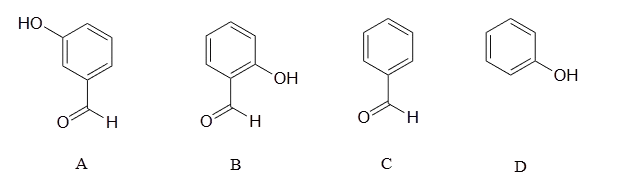
Rank the four compounds below from most acidic to least.
- Answer
-
Compound B is the strongest acid due to electron-withdrawing resonance effects-the negative charge on the conjugate base can be delocalized to the aldehyde oxygen. Compound A is the 2nd strongest acid -while the negative charge on the conjugate base cannot be delocalized to the aldehyde oxygen due to the meta-position, the aldehyde none the less has a stabilizing, electron-withdrawing inductive effect. Compound D is ranked #3 -it is phenol, and does not have any electron-withdrawing substituents on the ring as do B and A. Compound C is the least acidic -neither the phenyl group nor the aldehyde are even slightly acidic.
Rank the following substances in order of increasing acidity:
- \(\ce{(CH3)2CHOH}\), \(\ce{HC≡CH}\), \(\ce{(CF3)2CHOH}\), \(\ce{CH3OH}\)
- Phenol, p-methylphenol, p-(trifluoromethyl)phenol
- Benzyl alcohol, phenol, p-hydroxybenzoic acid
- Answer
-
- \(\ce{HC≡CH < (CH3)2CHOH < CH3OH < (CF3)2CHOH}\)
- p-Methylphenol < Phenol < p-(Trifluoromethyl)phenol
- Benzyl alcohol < Phenol < p-Hydroxybenzoic acid
p-Nitrobenzyl alcohol is more acidic than benzyl alcohol, but p-methoxybenzyl alcohol is less acidic. Explain.
- Answer
-
The electron-withdrawing nitro group stabilizes an alkoxide ion, but the electron-donating methoxyl group destabilizes the anion.
Use a resonance argument to explain why picric acid has such a low pKa.
- Answer
-
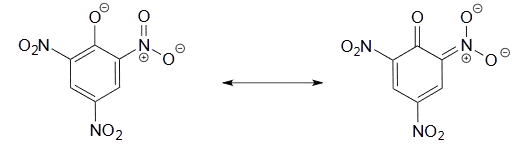
The negative charge on the conjugate base of picric acid can be delocalized to oxygen atoms on all threeof the nitro groups. One such resonance contributor is shown below. This extensive delocalization means that the conjugate base is very stable, and the conjugate acid is thus a very strong acid.
Exercise \(\PageIndex{7}\)
1. Arrange the following compounds in order of decreasing acidity when they are in solution.

2. Specify the base needed to deprotonate each reactant.

- Answer
-
1. B > C > A
2. a) NaH or NaNH2 b) NaOH, KOH, or LiOH
2.2: Acidity of Phenols is shared under a CC BY-NC-SA license and was authored, remixed, and/or curated by LibreTexts.
The book could not be loaded just now.