Opening the book…
After completing this section, you should be able to
- write an equation to illustrate the three‑step Stork enamine reaction.
- write a detailed mechanism for each of the three steps of the Stork enamine reaction.
- identify the product formed, and the various intermediates (i.e., the enamine, the Michael‑type adduct), in a given Stork enamine reaction.
- identify the reagents needed to synthesize a given compound by a Stork enamine reaction.
- Stork enamine reaction
If we try to use a monoketone as a donor molecule in a Michael reaction, we will obtain a poor yield. An alternative route to the product that would be expected from such a synthesis is via the Stork enamine reaction. You may wish to review the formation of enamines (from ketones and secondary amines) before you proceed with this section; if so, review Section 5.9.
Synthesis of Enamines
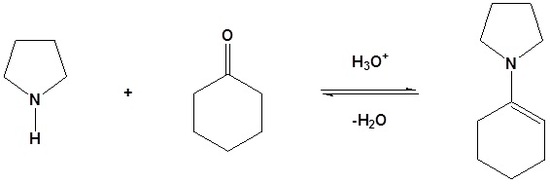
In addition to enolate ions, other kinds of carbon nucleophiles also add to α,β-unsaturated acceptors in Michael-like reactions. Among the most important and useful of such nucleophiles, particularly in biological chemistry, are enamines, which are readily prepared by reaction between a ketone and a secondary amine (Section 19.8). For example:.
Typically, the following 2o amines are used for enamine reactions:

Enamines have resonance structures similar to enolates. The lone pair electrons on the nitrogen are conjugated with the double bond and can donate electron density to the α-carbon. This allows the α-carbon of enamines to be nucleophilic in much the same fashion as enolates. An electrostatic potential map of N,N-dimethylaminoethylene shows this shift of electron density (red) toward the α position. This is analogous to the increased electron density of the α-carbon of an enolate.
Enamines behave in much the same way as enolate ions and enter into many of the same kinds of reactions. In the Stork enamine reaction, named for its discoverer, Gilbert Stork of Columbia University, for example, an enamine adds to an α,β-unsaturated carbonyl acceptor in a Michael-like process. The initial product is then hydrolyzed by aqueous acid to yield a 1,5-dicarbonyl compound. The overall reaction is thus a three-step sequence of:
- enamine formation from a ketone,
- Michael addition to an α,β-unsaturated carbonyl compound, and
- enamine hydrolysis back to a ketone.
The net effect of the Stork enamine reaction is the Michael addition of a ketone to an α,β-unsaturated carbonyl compound. For example, cyclohexanone reacts with the cyclic amine pyrrolidine to yield an enamine; further reaction with an enone such as 3-buten-2-one yields a Michael adduct; and aqueous hydrolysis completes the sequence to give a 1,5-diketone (Figure \(\PageIndex{1}\)).
Michael Reaction Using Enamines: The Stork Reaction
Enamines add to α, β-unsaturated carbonyls in a Michael-like reaction. The net reaction is the addition of a ketone to a α, β-unsaturated carbonyl to product a 1,5 dicarbonyl compound as the end product. This reaction is commonly known as the Stork enamine reaction after Gilbert Stork of Columbia University who originated the work.

Mechanism of the Stork Reaction
Step 1: Formation of the enamine |
|
Step 2: Nucleophilic attack on the carbon β to the carbonylAfter formation, the enamine adds to the electrophilic alkene carbon of the a α, β-unsaturated carbonyl form an iminium bond. The pi electrons of the alkene are pushed onto the oxygen through conjugation to form an alkoxide as an intermediate. |
|
Step 3: ProtonationProtonation of the alkoxide forms an enol. |
|
Step 4: TautomerizationThe enol undergoes tautomerization to reform the ketone. |
|
Step 5: Reform the carbonyl by hydrolysisIn the last step of the mechanism, the iminium bond is hydrolyzed to reform the carbonyl to create a 1,5-dicarbonyl compound as the product of a Michael-like reaction. |
Planning a Synthesis Using the Stork Enamine Synthesis
Planning a synthesis using a Stork enamine reaction is very similar to that of a Michael reaction (Section 9-11). A target molecule can possibly be made using a Stork enamine reaction if it contains a 1,5-dicarbonyl. Like the Michael reaction, the key bond cleavage is a C-C bond between beta and gamma carbons from a carbonyl-like group. The fragment with the Y group loses an alpha-hydrogen and then forms a C=C bond between the alpha and beta carbon. The carbon of the other fragment gains a hydrogen. This fragment should possess an acidic alpha-hydrogen and should be made up of Michael donor fragments.
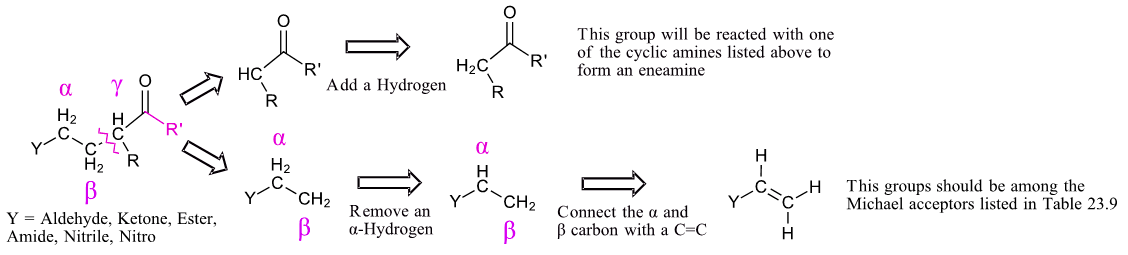
How could the following molecule be made using a Michael Reaction?

Strategy
The 1,5-dicarbonyl product is the overall result of an enamine (donor) addition to an α,β-unsaturated carbonyl compound (acceptor). The C–C bond formed in the Michael addition step is the one between the α carbon of the enamine donor and the β-carbon of the α,β-unsaturated acceptor.
Pathway 1

Solution

Alkylation of an Enamine
Enamines undergo an SN2 reaction with reactive alkyl halides to give the iminium salt. The iminium salt can be hydrolyzed back into the carbonyl. The individual steps are below.

Mechanism on Enamine Alkylation
Step 1: Formation of the enamine
|
 |
Step 2: AlkylationNucleophilic attack (SN2) on the carbon with the Living Group |
 |
Step 3: Acidic WorkupReform the carbonyl by hydrolysis. |
 |
Acylation of Enamines
Acylation of Enamines involves the addition of an acyl group (\(\ce{RCO-}\)) to an enamines. Enamines can add to acid halides to form 1,3-diketones and α, β-unsaturated Michael acceptors to form 1,5-dicarbonyls. Resulting in the formation of an α-acylated product.

Mechanism on Enamine Acylation
Step 1 Formation of the enamineThe mechanism starts with the formation of an enamine. |
 |
Step 2: Nucleophilic attackThe enamine adds to the electrophilic carbonyl carbon of the acid halide to form an iminium bond with tetrahedral alkoxide as an intermediate. |
 |
Step 3: Leaving group removalThe alkoxide reforms the carbonyl bond and eliminates a halide anion as a leaving group. |
 |
Step 4: Reform the carbonyl by hydrolysisThe iminium bond is then hydrolyzed to reform the carbonyl to create a 1,3-dicarbonyl compound as a nucleophilic acyl substitution product. |
 |
What products would result after hydrolysis from reaction of the enamine prepared from cyclopentanone and pyrrolidine, and the following molecules.
 b.
 c.

- Answer
-
 b.
 c.

What starting materials are necessary to make the following molecules during a Stork enamine reaction? (in addition to pyrrolidine)
a.  b.
 c.

- Answers
-
a.

b.
 c.

This page titled 9.11: Carbonyl Condensations with Enamines - The Stork Reaction was last modified on Tue, 18 Mar 2025 02:12:06 GMT and is shared under a CC BY-NC-SA 4.0 license and was authored, remixed, and/or curated by Sol Parajon Puenzo (Cañada College) .
The book could not be loaded just now.