Opening the book…
After completing this section, you should be able to
- write an equation to illustrate the Michael reaction.
- write a detailed mechanism for a given typical Michael reaction.
- identify the product formed in a given Michael reaction.
- identify the reagents necessary to synthesize a given compound by a Michael reaction.
- Michael reaction
Before studying this section in detail, you should review conjugate addition to α,β‑unsaturated carbonyl compounds (Section 5.14).
Notice the wide variety of compounds that can take part in a Michael reaction. As usual, you should not feel overwhelmed by the number of different compounds that can be used, just keep in mind that in all cases the mechanism is essentially the same.
Michael Reaction
Certain nucleophiles undergo conjugate addition with the alkene of an α, β-unsaturated carbonyl compounds rather than undergo direct nucleophilic addition with the carbonyl. During conjugate addition, a nucleophile adds to the electrophilic β-alkene carbon to form a C-Nuc bond. If the starting materials contain an ester, the corresponding alkoxide is used as the base in the reaction. Otherwise, a hydroxide base, such as sodium or potassium hydroxide, is commonly used.
When enolate nucleophiles undergo conjugate addition with an α, β-unsaturated carbonyl the process is called a Michael Reaction. The Michael reaction works best with particularly acidic enolate donors such as malonic esters, β-keto esters, etc. Enolates which are weaker acids tend to undergo nucleophilic addition to the carbonyl rather than conjugate addition. For example, malonic ester’s acidic α-hydrogens can be easily deprotonated by sodium ethoxide to form an enolate. The enolate adds to propenal to form the conjugate addition product.

Mechanism of Michael Reaction
During a Michael reaction, the enolate acts as a nucleophilic donor, and the α, β-unsaturated carbonyl acts as the electrophilic acceptor. The mechanism is a mixture of an alpha-substitution for the enolate and a conjugate addition for the α, β-unsaturated carbonyl.
Notice that the Michael Reaction does not require the deprotonation of the product to push the reaction toward completion. The reaction is thermodynamically favorable because the C-C bond formed in the product is stronger than the C=C bond in the starting material. This means that, unlike the Claisen condensation, this reaction only requires a catalytic amount of reaction base.
Step 1: DeprotonationThe alkoxide base removes an alpha-hydrogen to form an enolate nucleophile. |
 |
Step 2: Nucleophilic attack on the carbon β to the carbonylThe enolate nucleophile then adds to the electrophilic β-carbon of the α, β-unsaturated carbonyl. Conjugation pushes the C=C pi bond electrons onto the carbonyl oxygen, forming a new enolate enolate. |
 |
Step 3: ProtonationThe alkoxide is protonated, forming an enol. |
 |
Step 4: TautomerizationTautomerization converts the enol back into a carbonyl, forming the neutral conjugate addition product. |
 |
Predicting the Product of a Michael Reaction
During the reaction the C=C pi bond of the α, β-unsaturated carbonyl is broken. An C-H bond is formed on the carbon in the α-position from the carbonyl. An acidic hydrogen is removed from the nucleophile and then it is used to form a C-C bond with the carbon in the beta position from the carbonyl.

- In the first step, remove the double bond and add two single bonds
- Add hydrogen to the bond adjacent to the carbonyl
- Add the nucleophile to the other end of the double bond (remember to remove a hydrogen from the nucleophile)
What would be the product of the following conjugate addition?

Strategy
- Break the double bond and add two single bonds
- Add a hydrogen to the bond adjacent to the carbonyl
- Remove a hydrogen from the nucleophile.
- Add the nucleophile to the other end of the double bond.
Solution

Michael Acceptors and Michael Donors
The Michael reaction can be performed with a wide variety of α, β-unsaturated carbonyl electrophilic acceptors and enolate donors. Michael acceptors such as α, β-unsaturated ketones, aldehydes, esters, amides, and nitro compounds can all participate in this reaction. Michael donors with particularly acidic α-hydrogens, such as β-diketones, β-keto esters, β-keto nitriles, α-nitro ketones, malonic esters, and nitro compounds can be used.
| Michael acceptors | Michael donors | ||
|---|---|---|---|
|
CH2=CH-CH=O |
Propenal α,β-unsaturated aldehyde |
 |
β-Diketone |
 |
3-Buten-2-one α,β-unsaturated ketone |
 |
β-Keto ester |
 |
Ethyl propenoate α,β-unsaturated ester |
 |
Diethyl malonate |
 |
Propenamide α,β-unsaturated amide |
 |
β-Keto nitrile |
 |
Propenenitrile α,β-unsaturated nitrile |
 |
Nitro compound |
 |
Nitroethylene | ||
Stereochemical Consideration of Micheal Reactions
During a Michael reaction, two sp2 hybridized carbons are converted to sp3 hybridization. Both of them have the possibility of creating a chiral carbon. Michael reactions are often performed using an α, β-unsaturated carbonyl with only hydrogen substituents on the alkene to prevent the formation of chiral carbons. If either carbon in the alkene has an alkyl substituent it will likely form a chiral carbon in the Michael reaction product. The α-carbon of the enolate donor also has the possibility of forming a chiral carbon as discussed in Section 9-7.

Planning a Synthesis Using a Michael Reaction
The true utility of the Michael reaction is seen when considering it use in a synthesis. The reaction can be used to prepare aldehydes, ketones, esters, amides, nitriles, and nitro compounds. A target molecule can possibly be made using a Michael reaction if it contains one of these functional groups and an alkyl chain at least three carbons long. The key bond cleavage is a C-C bond between β and gamma carbons from a carbonyl-like group. The fragment with the Y group loses an α-hydrogen and then forms a C=C bond between the α and beta carbon. The carbon of the other fragment gains a hydrogen. This fragment should possess an acidic α-hydrogen and should be made up of Michael donor fragments such as those listed in Table \(\PageIndex{1}\). In some cases, there may be more than one fragmentation variation. Each variation should be investigated and the possible starting materials compared for viability.

How might you obtain the following compound using a Michael reaction?

Strategy
A Michael reaction involves the conjugate addition of a stable enolate ion donor to an α,β-unsaturated carbonyl acceptor, yielding a 1,5-dicarbonyl product. Usually, the stable enolate ion is derived from a β-diketone, β-keto ester, malonic ester, or similar compound. The C–C bond formed in the conjugate addition step is the one between the α carbon of the acidic donor and the β carbon of the unsaturated acceptor.
Solution

How could the following molecule be synthesized using a Michael Reaction?

Strategy
Pathway 1

Starting Materials 1

Pathway 2

Starting Material 2

Solution
When comparing the two sets of possible starting materials pathway 1 is preferred. The Michael enolate donor is particularly acidic because its conjugate base is stabilized by two carbonyls. The Michael enolate donor for pathway 2 does not have the same acidity. Consequently, the enolate would preferably undergo nucleophilic addition rather than conjugate addition. This makes the starting materials of pathway 1 preferred for synthesizing the starting material.

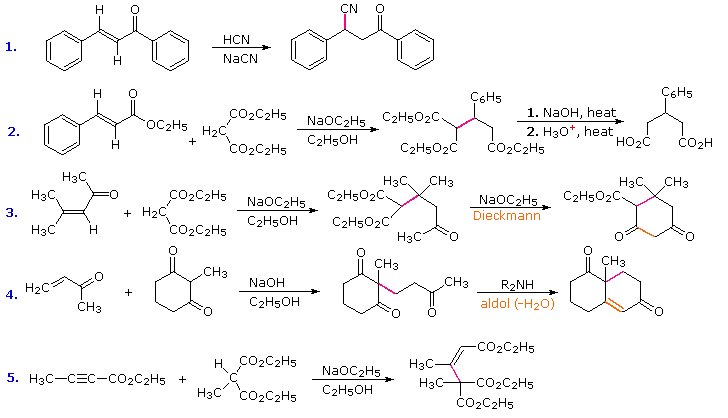
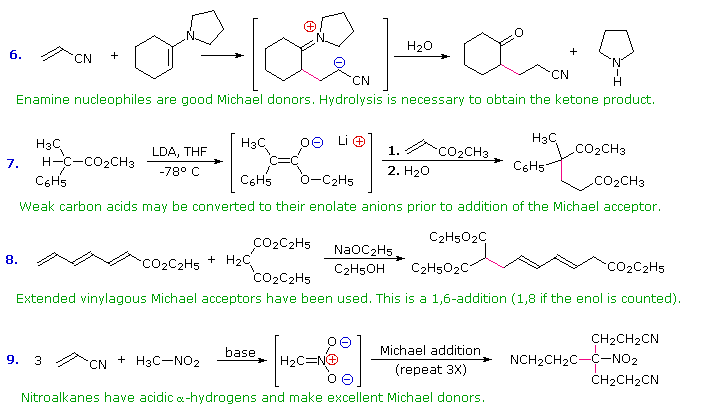
In combination with alkylations and condensations, the Michael reaction may be used to construct a wide variety of complex molecules from relatively simple starting materials. The carbon nucleophiles used in the following examples include cyanide ion, sodium diethylmalonate and the conjugate base of cyclohexane-1,3-dione. These anions are sufficiently stable that their addition reactions may be presumed reversible. If this is so, the thermodynamic argument used for hetero-nucleophile additions would apply here as well, and would indicate preferential formation of 1,4-addition products. Cyanide addition does not always follow this rule, and aldehydes often give 1,2-products (cyanohydrins). In each case the initial reaction is a Michael addition, and the new carbon-carbon bond is colored magenta. Any subsequent bonds that are formed by other reactions are colored orange.
What product would you obtain from a base-catalyzed Michael reaction of 2,4-pentanedione with each of the following α,β-unsaturated acceptors?
- 2-Cyclohexenone
- Propenenitrile
- Ethyl 2-butenoate
- Answer
- a.
 b.
 c.

What product would you obtain from a base-catalyzed Michael reaction of 3-buten-2-one with each of the following nucleophilic donors?
 b.

- Answer
-
 b.

What would be the starting materials required to make the following molecules using a Michael reaction? Red = Oxygen, Grey = Carbon, White = Hydrogen, Blue = Nitrogen.
a.  b.

- Answers
-
a.
 b. CH3CH2COCH═CH2 + CH3CH2NO2
This page titled 9.10: Conjugate Carbonyl Additions - The Michael Reaction was last modified on Tue, 18 Mar 2025 01:10:58 GMT and is shared under a CC BY-NC-SA 4.0 license and was authored, remixed, and/or curated by Sol Parajon Puenzo (Cañada College) .
The book could not be loaded just now.