Opening the book…
After completing this section, you should be able to
- identify a terpene from a given list of organic structures.
- analyze the structure of a given terpene in terms of the isoprene rule.
- classify a given terpene structure according to the number of isoprene units present; that is, determine whether a given terpene is a monoterpene, sesquiterpene, diterpene, etc.
- identify and draw the structure of the precursors of isopentenyl diphosphate: (R) mevalonate or 1‑deoxy‑D‑xylulose 5‑phosphate.
Make certain that you can define, and use in context, the key terms below.
- isoprene rule
- terpenoid
- terpene
You are not expected to memorize all the details of the synthetic mechanisms for terpenoids. However, you should know the overall general synthetic pathway illustrated under “Terpenoid Biosynthesis.” As you read through the details of these mechanisms, realize that they may be complex, but they are based on experimental evidence. You should also note the important role of enzymes in many natural systems transformations. Finally, you will recognize that essentially, individual steps are often reactions you have already encountered in previous sections.
The terpenoids (aka isoprenoids) are a large (estimated 60% of known natural products) and diverse group of lipids derived from five-carbon isoprene units assembled in thousands of combinations. Although formally a terpenoid contains oxygen, while a hydrocarbon is called a terpene, we’ll use the term terpenoid to refer to both for simplicity.

Despite their apparent structural differences, all terpenoids contain a multiple of five carbons and are derived biosynthetically from the five-carbon precursor isopentenyl diphosphate (Figure \(\PageIndex{1}\)).
Isoprene Rule
Compounds classified as terpenes constitute what is arguably the largest and most diverse class of natural products. A majority of these compounds are found only in plants, but some of the larger and more complex terpenes (e.g. squalene & lanosterol) occur in animals. Terpenes that incorporate the most common functional groups are known, so this does not provide a useful means of classification. Instead, the number and structural organization of carbons are definitive characteristics. Terpenes may be considered to be made up of isoprene (more accurately isopentane) units, an empirical feature known as the isoprene rule. Because of this, terpenes usually have \(5n\) carbon atoms (\(n\) is an integer), and are subdivided as follows:
| Classification | Isoprene Units | Carbon Atoms |
|---|---|---|
| monoterpenes | 2 | C10 |
| sesquiterpenes | 3 | C15 |
| diterpenes | 4 | C20 |
| sesterterpenes | 5 | C25 |
| triterpenes | 6 | C30 |
Isoprene itself, a C5H8 gaseous hydrocarbon, is emitted by the leaves of various plants as a natural byproduct of plant metabolism. Next to methane, it is the most common volatile organic compound found in the atmosphere. Examples of C10 and higher terpenes, representing the four most common classes, are shown in the following diagrams. Most terpenes may be structurally dissected into isopentane segments. How this is done can be seen in the diagram directly below.


The isopentane units in most of these terpenes are easy to discern and are defined by the shaded areas. In the case of the monoterpene camphor, the units overlap to such a degree that it is easier to distinguish them by coloring the carbon chains. This is also done for alpha-pinene. In the case of the triterpene lanosterol we see an interesting deviation from the isoprene rule. This thirty-carbon compound is clearly a terpene, and four of the six isopentane units can be identified. However, the ten carbons in the center of the molecule cannot be dissected in this manner. Evidence indicates that the two methyl groups circled in magenta and light blue have moved from their original isoprenoid locations (marked by small circles of the same color) to their current positions. This rearrangement is described in the biosynthesis section. Similar alkyl group rearrangements account for other terpenes that do not strictly follow the isoprene rule.

Polymeric isoprenoid hydrocarbons have also been identified. Rubber is undoubtedly the best known and most widely used compound of this kind. It occurs as a colloidal suspension called latex in a number of plants, ranging from the dandelion to the rubber tree (Hevea brasiliensis). Rubber is a polyene, and exhibits all the expected reactions of the C=C function. Bromine, hydrogen chloride, and hydrogen all add with a stoichiometry of one molar equivalent per isoprene unit. Ozonolysis of rubber generates a mixture of levulinic acid, CH3-CO-CH2-CH2-CO2H, and the corresponding aldehyde. Pyrolysis of rubber produces the diene isoprene along with other products.

The double bonds in rubber all have a Z-configuration, which causes this macromolecule to adopt a kinked or coiled conformation. This is reflected in the physical properties of rubber. Despite its high molecular weight (about one million), crude latex rubber is a soft, sticky, elastic substance. Chemical modification of this material is normal for commercial applications. Gutta-percha (structure above) is a naturally occurring E-isomer of rubber. Here, the hydrocarbon chains adopt a uniform zigzag or rod-like conformation, producing a more rigid and tough substance. Uses of gutta-percha include electrical insulation and the covering of golf balls.
Terpenoid Biosynthesis
While we can identify isoprene units within a terpenoid structure and use that in its classification, the building block for terpenoid synthesis in nature is isopentenyl diphosphate (formerly called isopentenyl pyrophosphate and abbreviated IPP). There are two major routes to the synthesis of IPP; namely (1) the mevalonate pathway and (2) the 1-deoxyxylulose pathway.

Mevalonate Pathway
Step 1 - Claisen Condensation
An early step in the biosynthesis of cholesterol and other ‘isoprenoid’ compounds is a Claisen condensation between two acetyl-CoA molecules. An initial trans-thioesterase process transfers the acetyl group of the first acetyl CoA to an enzymatic cysteine (Reaction 1). In the Claisen condensation phase of the reaction, the alpha-carbon of a second acetyl-CoA is deprotonated, forming an enolate (Reaction 2).

The enolate carbon attacks the electrophilic thioester carbon, forming a tetrahedral intermediate (Reaction 3) which quickly collapses to expel the cysteine thiol (Reaction 4) and produce acetoacetyl CoA.
Step 2 - Aldol Condensation
Acetyl CoA then reacts with the acetoacetyl CoA in an aldol-like addition. Subsequent hydrolysis produces (3S)-3-hydroxy-3-methylglutaryl CoA (HMG-CoA).

Generating HMG-CoA
Step 3 - Reduction of the Thioester
The thioester is reduced first to an aldehyde, then to a primary alcohol by two equivalents of NADPH, producing (R)-mevalonate. The enzyme catalyzing this reaction is the target of the statin family of cholesterol-lowering drugs.

Generating (R)-Mevalonate
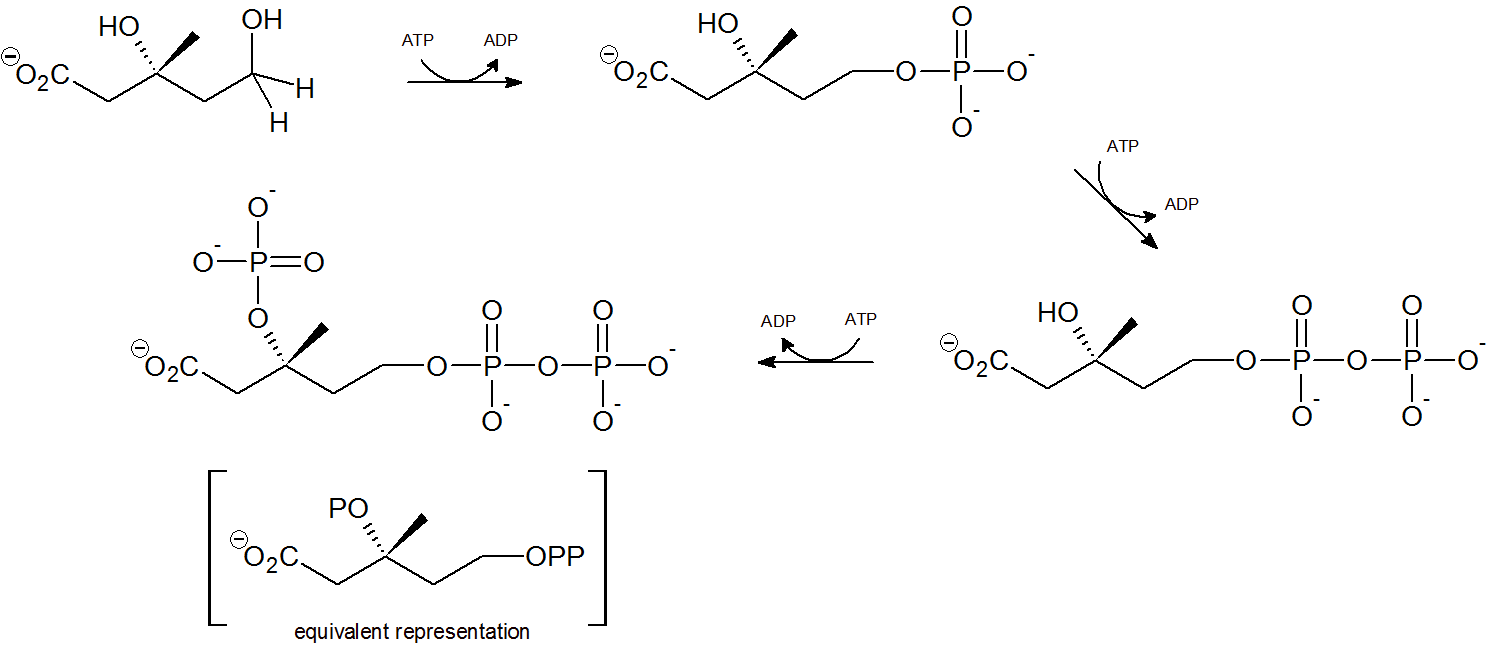
Step 4 - Mevalonate Phosphorylation
Two phosphorylations by adenosine triphosphate (ATP) occur at the terminal hydroxyl/phosphorus group through nucleophilic substitution, followed by a third ATP phosphorylation of the tertiary hydroxyl group.
Step 5 - Decarboxylation
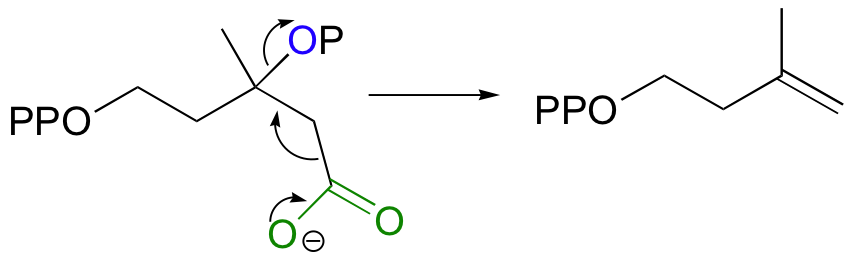
Finally, isopentenyl diphosphate (IPP), the 'building block' for all isoprenoid compounds, is formed from a decarboxylation-elimination reaction.
Conversion of Isopentenyl Diphosphate to Terpenoids
The conversion of isopentenyl diphosphate (IPP) to terpenoids begins with its isomerization to dimethylallyl diphosphate, abbreviated DMAPP and formerly called dimethylallyl pyrophosphate. These two C5 building blocks then combine to give the C10 unit geranyl diphosphate (GPP). The corresponding alcohol, geraniol, is itself a fragrant terpenoid that occurs in rose oil.
Further combination of GPP with another IPP gives the C15 unit farnesyl diphosphate (FPP), and so on, up to C25. Terpenoids with more than 25 carbons—that is, triterpenoids (C30) and tetraterpenoids (C40)—are synthesized by dimerization of C15 and C20 units, respectively (Figure \(\PageIndex{4}\)). Triterpenoids and steroids, in particular, arise from dimerization of farnesyl diphosphate to give squalene.
The isomerization of isopentenyl diphosphate to dimethylallyl diphosphate is catalyzed by IPP isomerase and occurs through a carbocation pathway. Protonation of the IPP double bond by a hydrogen-bonded cysteine residue in the enzyme gives a tertiary carbocation intermediate, which is deprotonated by a glutamate residue as base to yield DMAPP. X-ray structural studies on the enzyme show that it holds the substrate in an unusually deep, well-protected pocket to shield the highly reactive carbocation from reaction with solvent or other external substances.
Both the initial coupling of DMAPP with IPP to give geranyl diphosphate and the subsequent coupling of GPP with a second molecule of IPP to give farnesyl diphosphate are catalyzed by farnesyl diphosphate synthase. The process requires Mg2+ ion, and the key step is a nucleophilic substitution reaction in which the double bond of IPP behaves as a nucleophile in displacing diphosphate ion leaving group (PPi) or DMAPP. Evidence suggests that the DMAPP develops a considerable cationic character and that spontaneous dissociation of the allylic diphosphate ion in an SN1-like pathway probably occurs (Figure \(\PageIndex{5}\)).
Cholesterol Precursor
In this section, we will briefly examine the reaction catalyzed by an enzyme called squalene synthase, an important enzymatic transformation that involves some very interesting and unusual electrophilic additions, rearrangements, and reactive intermediates. This particular enzyme is also of interest because it represents a potential new target for cholesterol-lowering drugs.
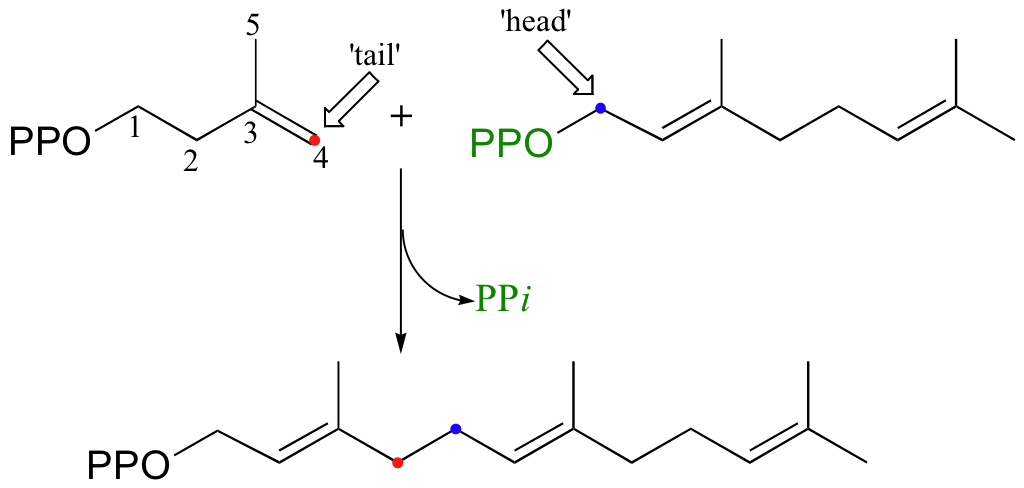
Cholesterol, as we discussed earlier in this chapter, is derived from a 30-carbon isoprenoid molecule called squalene. Squalene, in turn, is derived from the condensation of two molecules of farnesyl diphosphate (FPP), a 15-carbon isoprenoid. You may recall that FPP is the product of the C4 to C1, or 'head to tail' electrophilic condensation of isoprenoid chains:
Monoterpenoids
Further conversion of geranyl diphosphate into monoterpenoids typically involves carbocation intermediates and multistep reaction pathways that are catalyzed by terpene cyclases. Monoterpene cyclases function by first isomerizing geranyl diphosphate to its allylic isomer linalyl diphosphate (LPP), a process that occurs by spontaneous SN1-like dissociation to an allylic carbocation, followed by recombination. The effect of this isomerization is to convert the C2–C3 double bond of GPP into a single bond, thereby making cyclization possible and allowing E/Z isomerization of the double bond.
Further dissociation and cyclization by electrophilic addition of the cationic carbon to the terminal double bond then gives a cyclic cation, which might either rearrange, undergo a hydride shift, be captured by a nucleophile, or be deprotonated to give any of the several hundred known monoterpenoids. As just one example, limonene, a monoterpenoid found in many citrus oils, arises by the biosynthetic pathway shown in Figure \(\PageIndex{7}\).
Exercises
Identify the Isoprene Units in the following terpenoids:


- Answers
-
a- 2. b- 3. c- 2.
Farnesyl diphosphate (FPP) is synthesized by adding another five-carbon building block to geranyl diphosphate. What is this building block - IPP or DMAPP? Draw a mechanism for the formation of FPP.

- Answer
-
IPP is the five-carbon species added to geranyl diphosphate to make the 15-
carbon farnesyl diphosphate.
Propose a likely mechanism for the following transformation, which is the first stage in a somewhat complex reaction in the synthesis of an isoprenoid compound in plants. (Science 1997, 277, 1815)

- Answer
-

This page titled 14.5: Terpenoids was last modified on Mon, 11 May 2026 20:18:52 GMT and is shared under a CC BY-NC-SA 4.0 license and was authored, remixed, and/or curated by Sol Parajon Puenzo (Cañada College) .
The book could not be loaded just now.