Opening the book…
Overview
We use the word soluble to describe a solute that dissolves in a particular solvent, and the word insoluble for a solute that does not dissolve in a solvent. Thus, we say that sodium chloride is soluble in water but insoluble in hexane (C6H14). If the solute and the solvent are both liquids and soluble in any proportion, we use the word miscible, and the word immiscible if they are not.
There is usually a limit to how much solute will dissolve in a given amount of solvent. This limit is called the solubility of the solute. Some solutes have a very small solubility, while other solutes are soluble in all proportions. Table \(\PageIndex{1}\) lists the solubilities of various solutes in water. Solubilities vary with temperature, so Table \(\PageIndex{1}\) includes the temperature at which the solubility was determined.
| Substance | Solubility (g in 100 mL of H2O) |
|---|---|
| AgCl(s) | 0.019 |
| C6H6(ℓ) (benzene) | 0.178 |
| CH4(g) | 0.0023 |
| CO2(g) | 0.150 |
| CaCO3(s) | 0.058 |
| CaF2(s) | 0.0016 |
| Ca(NO3)2(s) | 143.9 |
| C6H12O6 (glucose) | 120.3 (at 30°C) |
| KBr(s) | 67.8 |
| MgCO3(s) | 2.20 |
| NaCl(s) | 36.0 |
| NaHCO3(s) | 8.41 |
| C12H22O11 (sucrose) | 204.0 (at 20°C) |
If a solution contains so much solute that its solubility limit is reached, the solution is said to be saturated, and its concentration is known from information contained in Table \(\PageIndex{1}\). If a solution contains less solute than the solubility limit, it is unsaturated. Under special circumstances, more solute can be dissolved even after the normal solubility limit is reached; such solutions are called supersaturated and are not stable. If the solute is solid, excess solute can easily recrystallize. If the solute is a gas, it can bubble out of solution uncontrollably, like what happens when you shake a soda can and then immediately open it (Figure \(\PageIndex{1}\)).


The Effects of Temperature on Solubility
Experimentally, it is found that the solubility of most compounds depends strongly on temperature. For most ionic and molecular solids, solubility generally increases as temperature increases. The dependence of solubility on temperature for a number of solids in water is shown by the solubility curves in Figure \(\PageIndex{2}\). Reviewing these data indicates a general trend of increasing solubility with temperature, although there are exceptions, as illustrated by the ionic compound cerium sulfate.

Figure \(\PageIndex{2}\): This graph illustrates how the solubility of different solid solutes changes with temperature. Most solids, such as sugar and potassium nitrate (KNO₃), become more soluble as temperature increases. However, cerium(III) sulfate [Ce₂(SO₄)₃] is an exception, with decreasing solubility as the temperature rises. (CC BY 4.0; contributing authors via OpenStax). Detailed Description of Figure \(\PageIndex{2}\).
The temperature dependence of solubility can be exploited to prepare supersaturated solutions of certain compounds. A solution may be saturated with the compound at an elevated temperature (where the solute is more soluble) and subsequently cooled to a lower temperature without precipitating the solute. The resultant solution contains solute at a concentration greater than its equilibrium solubility at the lower temperature (i.e., it is supersaturated) and is relatively stable. Precipitation of the excess solute can be initiated by adding a seed crystal or by mechanically agitating the solution. Some hand warmers, such as the one pictured in Figure \(\PageIndex{3}\), take advantage of this behavior.

Figure \(\PageIndex{3}\): This hand warmer demonstrates the exothermic crystallization of a supersaturated sodium acetate solution. When the internal metal disc is clicked, it triggers rapid crystal formation, releasing heat and turning the solution from clear to opaque. This process illustrates how supersaturated solutions can release energy upon returning to a stable solid state. (CC BY 4.0; contributing authors via OpenStax). Detailed Description of Figure \(\PageIndex{3}\).
The solubility of gases in liquids decreases with increasing temperature, as shown in Figure \(\PageIndex{4}\). When a gas dissolves in a liquid, weak attractions form between the gas molecules and the solvent, releasing some heat. Heating the solution adds energy to the system, which weakens these attractions. As temperature rises, the kinetic energy of the gas particles increases, causing more of them to escape into the gas phase. As a result, fewer gas molecules stay dissolved in the liquid at higher temperatures.
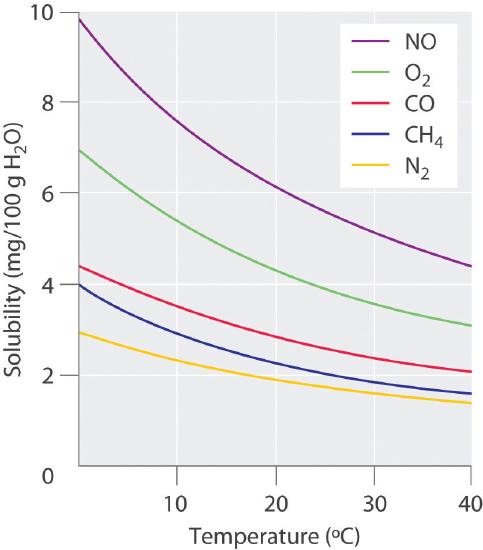
Figure \(\PageIndex{4}\): This graph shows that the solubility of gases in water decreases with increasing temperature. As temperature rises, gas molecules gain kinetic energy and are more likely to escape into the gas phase, reducing their concentration in solution. (CC BY-NC-SA 3.0; anonymous via General Chemistry: Principles, Patterns, and Applications (v. 1.0)). Detailed Description of Figure \(\PageIndex{4}\).
As the temperature of rivers, lakes, or streams increases, the solubility of oxygen in the water decreases. This reduction in dissolved oxygen can have serious consequences for aquatic ecosystems. Warmer water holds less oxygen, and when oxygen levels drop too low, marine and freshwater organisms may not receive the amount they need to survive. In extreme cases, this can lead to widespread die-offs of fish and other aquatic life, severely disrupting the balance of the ecosystem (Figure \(\PageIndex{5}\)).

Figure \(\PageIndex{5}\): When oxygen levels in water drop too low, often due to rising temperatures or pollution, aquatic life cannot survive. This image shows a fish kill, a dramatic consequence of oxygen depletion in a body of water. (CC BY 4.0; OpenStax via U.S. Fish and Wildlife Service). Detailed Description of Figure \(\PageIndex{5}\).
The Effects of Pressure on Solubility
External pressure has very little effect on the solubility of liquids and solids. In contrast, the solubility of gases increases as the partial pressure of the gas above a solution increases. This point is illustrated in Figure \(\PageIndex{6}\), which shows the effect of increased pressure on the dynamic equilibrium that is established between the dissolved gas molecules in solution and the molecules in the gas phase above the solution. Because the concentration of molecules in the gas phase increases with increasing pressure, the concentration of dissolved gas molecules in the solution at equilibrium is also higher at higher pressures.

Figure \(\PageIndex{6}\): Diagram showing how increasing gas pressure shifts the equilibrium so that more gas dissolves in the liquid before a new dynamic equilibrium is reached. (CC BY-NC-SA 3.0; anonymous via General Chemistry: Principles, Patterns, and Applications (v. 1.0)). Detailed Description of Figure \(\PageIndex{6}\).
The relationship between pressure and the solubility of a gas is described quantitatively by Henry’s law, which is named for its discoverer, the English physician and chemist, William Henry (1775–1836):
\[\mathrm{C\: = k\: \times P_{gas}\:} \]
where
- C is the concentration of dissolved gas at equilibrium,
- P is the partial pressure of the gas, and
- k is the Henry’s law constant, which must be determined experimentally for each combination of gas, solvent, and temperature.
When the partial pressure of a gas above a solution changes while the temperature remains constant, the resulting change in gas solubility can be determined using a simple relationship. Since the ratio C/P remains constant at a fixed temperature, Henry’s law can be expressed in a form that clearly shows how a change in one variable affects the other, as shown in the equation:
\[\frac{\mathrm{C}_1}{\mathrm{P}_1} = \frac{\mathrm{C}_2}{\mathrm{P}_2} \]
Thus, the higher the pressure, the higher the solubility of a gas in a solvent. Henry’s law has important applications. For example, bubbles of CO2 form as soon as a carbonated beverage is opened because the drink was bottled under CO2 at a pressure greater than 1 atm. When the bottle is opened, the pressure of CO2 above the solution drops rapidly, and some of the dissolved gas escapes from the solution as bubbles. Henry’s law also explains why scuba divers have to be careful to ascend to the surface slowly after a dive if they are breathing compressed air. At the higher pressures under water, more N2 from the air dissolves in the diver’s internal fluids. If the diver ascends too quickly, the rapid pressure change causes small bubbles of N2 to form throughout the body, a condition known as “the bends.” These bubbles can block the flow of blood through the small blood vessels, causing great pain and even proving fatal in some cases.
Key Takeaways
- Solubility is the maximum amount of solute that can dissolve in a solvent at a given temperature.
- Solutions can be saturated, unsaturated, or supersaturated depending on how much solute is present. Supersaturated solutions are unstable and can crystallize easily.
- Solid solubility usually increases with temperature, though this depends on the specific substance. Gas solubility decreases with increasing temperature and increases with pressure.
- Henry’s law explains how gas solubility relates to pressure at constant temperature.
This page titled 10.4: Solubility was last modified on Mon, 18 May 2026 01:43:27 GMT and is shared under a CC BY-NC-SA 4.0 license and was authored, remixed, and/or curated by Burçak Artun, Gorkem Ermut, and Semere Bairu.
The book could not be loaded just now.