Opening the book…
Overview
We normally experience carbon dioxide (\(\ce{CO2}\)) as a gas, but if it were cooled down to about −78°C, it would become a solid. The everyday term for solid carbon dioxide is dry ice.
Why “dry” ice? Solid carbon dioxide is called dry ice because it converts from a solid to a gas directly, without going through the liquid phase, in a process called sublimation. Thus, there is no messy liquid phase to worry about. Although it is a novelty, dry ice has some potential dangers. Because it is so cold, it can freeze living tissues very quickly, so people handling dry ice should wear special protective gloves. The cold carbon dioxide gas is also heavier than air (because it is cold and more dense), so people in the presence of dry ice should be in a well-ventilated area.
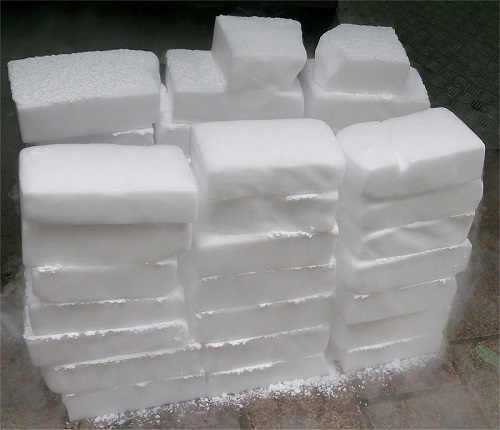
Dry ice has several common uses. Because it is so cold, it is used as a refrigerant to keep other things cold or frozen (for example, meats or ice cream). In the medical field, dry ice is used to preserve medical specimens, blood products, and drugs. It also has dermatological applications (for example, freezing off warts). Organs for transplant are kept cool with dry ice until the recipient of the new organ is ready for surgery. In this respect, carbon dioxide is much like water—more than one phase of the same substance has significant uses in the real world.
This page titled 9.1: Prelude to Solids, Liquids, and Gases was last modified on Sat, 09 May 2026 07:25:48 GMT and is shared under a CC BY-NC-SA 4.0 license and was authored, remixed, and/or curated by Burçak Artun, Gorkem Ermut, and Semere Bairu.
The book could not be loaded just now.