Opening the book…
Overview
In this section, we will explore the fundamental gas laws that describe how gases behave under different conditions. These laws—Boyle’s Law, Charles’s Law, Gay-Lussac’s Law, Avogadro’s Law, the Combined Gas Law, and Dalton’s Law—each explain the relationships between pressure, volume, temperature, and the number of moles of gas. We will examine them one by one to understand how changes in these variables affect gases.
Boyle’s Law - The Relation between Volume and Pressure
When seventeenth-century scientists began studying the physical properties of gases, they noticed some simple relationships between some of the measurable properties of the gas. Take pressure (P) and volume (V), for example. Scientists noted that for a given amount of a gas (usually expressed in units of moles [n]), if the temperature (T) of the gas was kept constant, pressure and volume were related: As one increases, the other decreases. As one decreases, the other increases. We say that pressure and volume are inversely related.
There is more to it, however: pressure and volume of a given amount of gas at constant temperature are numerically related. If you take the pressure value and multiply it by the volume value, the product is a constant (k) for a given amount of gas at a constant temperature:
\[P \times V=k\; (at\; constant\; n\; and\; T)\nonumber \]
If either volume or pressure changes while amount and temperature stay the same, then the other property must change so that the product of the two properties still equals that same constant. That is, if the original conditions are labeled P1 and V1 and the new conditions are labeled P2 and V2, we have
\[P_{1}V_{1}= k = P_{2}V_{2}\; \nonumber \]
where the properties are assumed to be multiplied together. Leaving out the middle part, we have simply
\[P_{1}V_{1}= P_{2}V_{2}\; (at\; constant\; n\; and\; T)\nonumber \]
This equation is an example of a gas law. A gas law is a simple mathematical formula that allows you to model, or predict, the behavior of a gas. This particular gas law is called Boyle's law, after the English scientist Robert Boyle, who first announced it in 1662. Figure \(\PageIndex{1}\) shows two representations of how Boyle's law works.
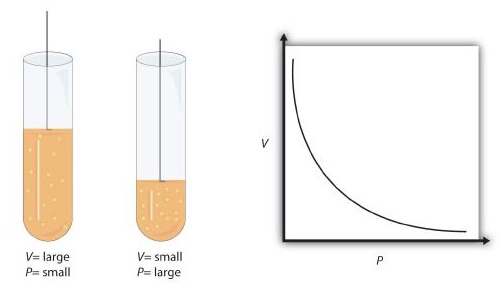
Boyle's law is an example of a second type of mathematical problem we see in chemistry—one based on a mathematical formula. Tactics for working with mathematical formulas are different from tactics for working with conversion factors. First, most of the questions you will have to answer using formulas are word-type questions, so the first step is to identify what quantities are known and assign them to variables. Second, in most formulas, some mathematical rearrangements (i.e., algebra) must be performed to solve for an unknown variable. The rule is that to find the value of the unknown variable, you must mathematically isolate the unknown variable by itself and in the numerator of one side of the equation. Finally, units must be consistent. For example, in Boyle's law there are two pressure variables; they must have the same unit. There are also two volume variables; they also must have the same unit. In most cases, it won't matter what the unit is, but the unit must be the same on both sides of the equation.
A sample of gas has an initial pressure of 2.44 atm and an initial volume of 4.01 L. Its pressure changes to 1.93 atm. What is the new volume if temperature and amount are kept constant?
Solution
First, determine what quantities we are given. We are given an initial pressure and an initial volume, so let these values be P1 and V1:
P1 = 2.44 atm and V1 = 4.01 L
We are given another quantity, final pressure of 1.93 atm, but not a final volume. This final volume is the variable we will solve for.
P2 = 1.93 atm and V2 = ? L
Substituting these values into Boyle's law, we get
(2.44 atm)(4.01 L) = (1.93 atm)V2
To solve for the unknown variable, we isolate it by dividing both sides of the equation by 1.93 atm—both the number and the unit:
\[\frac{(2.44\, atm)(4.01\, L)}{1.93\, atm}=\frac{(1.93\, atm)\, V_{2}}{1.93\, atm}\nonumber \]
Note that, on the left side of the equation, the unit atm is in the numerator and the denominator of the fraction. They cancel algebraically, just as a number would. On the right side, the unit atm and the number 1.93 are in the numerator and the denominator, so the entire quantity cancels:
\[\frac{(2.44\, \cancel{atm})(4.01\, L)}{1.93\, \cancel{atm}}=\frac{(1.93\, \cancel{atm})\, V_{2}}{1.93\, \cancel{atm}}\nonumber \]
What we have left is
\[\frac{(2.44)(4.01\, L)}{1.93}=V_{2}\nonumber \]
Now we simply multiply and divide the numbers together and combine the answer with the \(L\) unit, which is a unit of volume. Doing so, we get \(V_2 = 5.07\, L\)
Does this answer make sense? We know that pressure and volume are inversely related; as one decreases, the other increases. Pressure is decreasing (from 2.44 atm to 1.93 atm), so volume should be increasing to compensate, and it is (from 4.01 L to 5.07 L). So the answer makes sense based on Boyle's law.
As mentioned, you can use any units for pressure or volume, but both pressures must be expressed in the same units, and both volumes must be expressed in the same units.
A sample of gas has an initial pressure of 722 torr and an initial volume of 88.8 mL. Its volume changes to 0.663 L. What is the new pressure?
Solution
We can still use Boyle's law to answer this, but now the two volume quantities have different units. It does not matter which unit we change, as long as we perform the conversion correctly. Let us change the 0.663 L to milliliters:
\[0.663\, L\times \frac{1000\, ml}{1\, L}=663\, ml\nonumber \]
Now that both volume quantities have the same units, we can substitute into Boyle's law:
\[(722\, torr)(88.8\, ml)=P_{2}(663\, ml)\nonumber \]
\[\frac{(722\, torr)(88.8)\, ml}{(663\, ml)}=P_{2}\nonumber \]
The mL units cancel, and we multiply and divide the numbers to get P2 = 96.7 torr
The volume is increasing, and the pressure is decreasing, which is as expected for Boyle's law.
Freshly-baked bread is light and fluffy as a result of the action of yeast on sugar. The yeast converts the sugar to carbon dioxide, which at high temperatures causes the dough to expand. The end result is an enjoyable treat, especially when covered with melted butter.
Charles's Law
French physicist Jacques Charles (1746-1823) studied the effect of temperature on the volume of a gas at constant pressure. Charles's Law states that the volume of a given mass of gas varies directly with the absolute temperature of the gas when pressure is kept constant. The absolute temperature is temperature measured with the Kelvin scale. The Kelvin scale must be used because zero on the Kelvin scale corresponds to a complete stoppage of molecular motion.
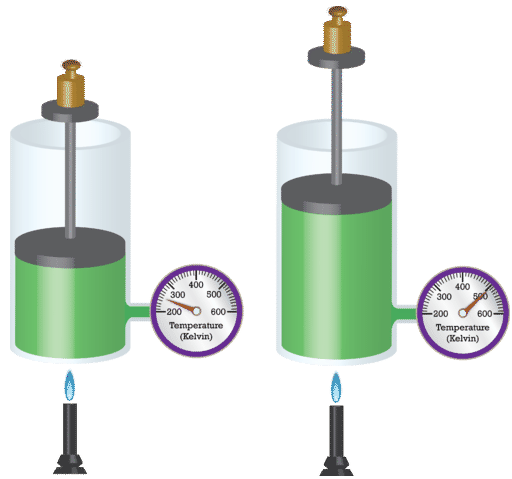
Mathematically, the direct relationship of Charles's Law can be represented by the following equation:
\[\frac{V}{T} = k\nonumber \]
As with Boyle's Law, \(k\) is constant only for a given gas sample. The table (Table \(\PageIndex{1}\)) below shows temperature and volume data for a set amount of gas at a constant pressure. The third column is the constant for this particular data set and is always equal to the volume divided by the Kelvin temperature.
| Temperature \(\left( \text{K} \right)\) | Volume \(\left( \text{mL} \right)\) | \(\frac{V}{T} = k\) \(\left( \frac{\text{mL}}{\text{K}} \right)\) |
|---|---|---|
| 50 | 20 | 0.40 |
| 100 | 40 | 0.40 |
| 150 | 60 | 0.40 |
| 200 | 80 | 0.40 |
| 300 | 120 | 0.40 |
| 500 | 200 | 0.40 |
| 1000 | 400 | 0.40 |
When this data is graphed (Figure \(\PageIndex{3}\)), the result is a straight line, indicative of a direct relationship, shown in the figure below.
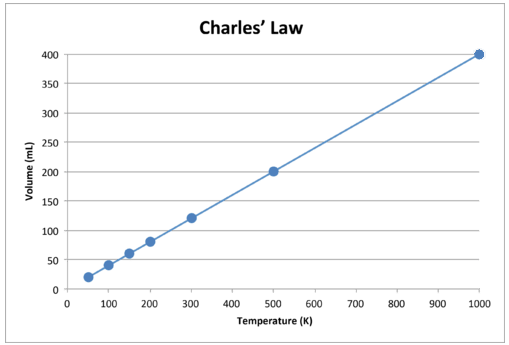
Notice that the line goes exactly toward the origin, meaning that as the absolute temperature of the gas approaches zero, its volume approaches zero. However, when a gas is brought to extremely cold temperatures, its molecules would eventually condense into the liquid state before reaching absolute zero. The temperature at which this change into the liquid state occurs varies for different gases.
Charles's Law can also be used to compare changing conditions for a gas. Now we use \(V_1\) and \(T_1\) to stand for the initial volume and temperature of a gas, while \(V_2\) and \(T_2\) stand for the final volume and temperature. The mathematical relationship of Charles's Law becomes:
\[\frac{V_1}{T_1} = \frac{V_2}{T_2}\nonumber \]
This equation can be used to calculate any one of the four quantities if the other three are known. The direct relationship will only hold if the temperatures are expressed in Kelvin. Temperatures in Celsius will not work. Recall the relationship that \(\text{K} = \: ^\text{o} \text{C} + 273\).
A balloon is filled to a volume of \(2.20 \: \text{L}\) at a temperature of \(22^\text{o} \text{C}\). The balloon is then heated to a temperature of \(71^\text{o} \text{C}\). Find the new volume of the balloon.
Step 1: List the known quantities and plan the problem.
Known
- \(V_1 = 2.20 \: \text{L}\)
- \(T_1 = 22^\text{o} \text{C} = 295 \: \text{K}\)
- \(T_2 = 71^\text{o} \text{C} = 344 \: \text{K}\)
Unknown
Use Charles's Law to solve for the unknown volume \(\left( V_2 \right)\). The temperatures have first been converted to Kelvin.
Step 2: Solve.
First, rearrange the equation algebraically to solve for \(V_2\).
\[V_2 = \frac{V_1 \times T_2}{T_1}\nonumber \]
Now substitute the known quantities into the equation and solve.
\[V_2 = \frac{2.20 \: \text{L} \times 344 \: \text{K}}{295 \: \text{K}} = 2.57 \: \text{L}\nonumber \]
Step 3: Think about your result.
The volume increases as the temperature increases. The result has three significant figures
Gay-Lussac's Law- The Relationship Between Pressure and Temperature
A third gas law may be derived as a corollary to Boyle's and Charles's laws. Suppose we double the thermodynamic temperature of a sample of gas. According to Charles’s law, the volume should double. Now, how much pressure would be required at the higher temperature to return the gas to its original volume? According to Boyle’s law, we would have to double the pressure to halve the volume. Thus, if the volume of gas is to remain the same, doubling the temperature will require doubling the pressure. This law was first stated by the Frenchman Joseph Gay-Lussac (1778 to 1850). According to Gay-Lussac’s law, for a given amount of gas held at constant volume, the pressure is proportional to the absolute temperature. Mathematically,
\[P\propto T\ce{\:or\:} P=k×T\ce{\:or\:} \dfrac{P}{T}=k \nonumber \]
where \(\propto\) means “is proportional to,” and k is a proportionality constant that depends on the identity, amount, and volume of the gas.
In terms of two sets of data: \(\dfrac{P_1}{T_1}=\dfrac{P_2}{T_2}\). This equation is useful for pressure-temperature calculations for a confined gas at constant volume. Note that temperatures must be on the kelvin scale for any gas law calculations (0 on the kelvin scale and the lowest possible temperature is called absolute zero). (Also note that there are at least three ways we can describe how the pressure of a gas changes as its temperature changes: We can use a table of values, a graph, or a mathematical equation.)
A container is designed to hold a pressure of 2.5 atm. The volume of the container is 20.0 cm3, and it is filled with air at room temperature (20°C) and normal atmospheric pressure. Would it be safe to throw the container into a fire where temperatures of 600°C would be reached?
Solution
Using the common-sense method, we realize that the pressure will increase at the higher temperature, and so:
\[P_{\text{2}}=\text{1}\text{.0 atm }\times \frac{\text{(273}\text{.15 + 600) K}}{\text{(273}\text{.15 + 20) K}}=\text{3}\text{.0 atm} \nonumber \]
This would exceed the safe strength of the container. Note that the volume of the container was not needed to solve the problem.
This concept works in reverse, as well. For instance, if we subject a gas to lower temperatures than their initial state, the external atmosphere can actually force the container to shrink. The following video demonstrates how a sample of hot gas, when cooled will collapse a container. A syringe barrel is filled with hot steam (vaporized water) and a plunger placed to cap off the end. The syringe is then placed in a beaker of ice water to cool the internal gas. When the temperature of the water vapor decreases, the pressure exerted by the vapor decreases as well. This leads to a difference in pressure between the vapor inside the barrel and the atmosphere. Atmospheric pressure then pushes the plunger into the barrel.
Combined Gas Law
One thing we notice about all gas laws, collectively, is that volume and pressure are always in the numerator, and temperature is always in the denominator. This suggests that we can propose a gas law that combines pressure, volume, and temperature. This gas law is known as the Combined Gas Law, and its mathematical form is:
\[\frac{P_{1}V_{1}}{T_{1}}=\frac{P_{2}V_{2}}{T_{2}}\; at\; constant\; n\nonumber \]
This allows us to follow changes in all three major properties of a gas. Again, the usual warnings apply about how to solve for an unknown algebraically (isolate it on one side of the equation in the numerator), units (they must be the same for the two similar variables of each type), and units of temperature must be in kelvins.
Notice that each of the previous gas laws introduced, can be derived from the combined gas law:
\(\text{At constant T,}\; \frac{P_{1}V_{1}}{T_{1}}=\frac{P_{2}V_{2}}{T_{2}}\; gives\; \text{Boyle's Law:}\; P_{1}V_{1}=P_{2}V_{2}\;\)
\(\text{At constant P,}\; \frac{P_{1}V_{1}}{T_{1}}=\frac{P_{2}V_{2}}{T_{2}}\; gives\; \text{Charles's Law:}\; \frac{V_{1}}{T_{1}}=\frac{V_{2}}{T_{2}}\;\)
\(\text{At constant V,}\; \frac{P_{1}V_{1}}{T_{1}}=\frac{P_{2}V_{2}}{T_{2}}\; gives\; \text{Gay-Lussac's Law:}\; \frac{P_{1}}{T_{1}}=\frac{P_{2}}{T_{2}}\;\)
In other words, if you know the equation for the combined gas law, you can calculate relationships between pressure, volume, or temperature of a fixed amount of gas.
A sample of gas at an initial volume of 8.33 L, an initial pressure of 1.82 atm, and an initial temperature of 286 K simultaneously changes its temperature to 355 K and its volume to 5.72 L. What is the final pressure of the gas?
Solution
We can use the combined gas law directly; all the units are consistent with each other, and the temperatures are given in Kelvin. Substituting,
\[\frac{(1.82\, atm)(8.33\, L)}{286\, K}=\frac{P_{2}(5.72\, L)}{355\, K}\nonumber \]
We rearrange this to isolate the P2 variable all by itself. When we do so, certain units cancel:
\[\frac{(1.82\, atm)(8.33\, \cancel{L})(355\, \cancel{K})}{(286\, \cancel{K})(5.72\, \cancel{L})}=P_{2}\nonumber \]
Multiplying and dividing all the numbers, we get
\[P_2 = 3.29\, atm \nonumber\]
Ultimately, the pressure increased, which would have been difficult to predict because two properties of the gas were changing.
Avogadro’s Law - The Relation between Volume and Molar Amount
We can demonstrate the relationship between the volume and the amount of a gas by filling a balloon; as we add more gas, the balloon gets larger. The specific quantitative relationship was discovered by the Italian chemist Amadeo Avogadro, who recognized the importance of Gay-Lussac’s work on combining volumes of gases. In 1811, Avogadro postulated that, at the same temperature and pressure, equal volumes of gases contain the same number of gaseous particles (Figure \(\PageIndex{4}\)). This is the historic “Avogadro’s hypothesis.”
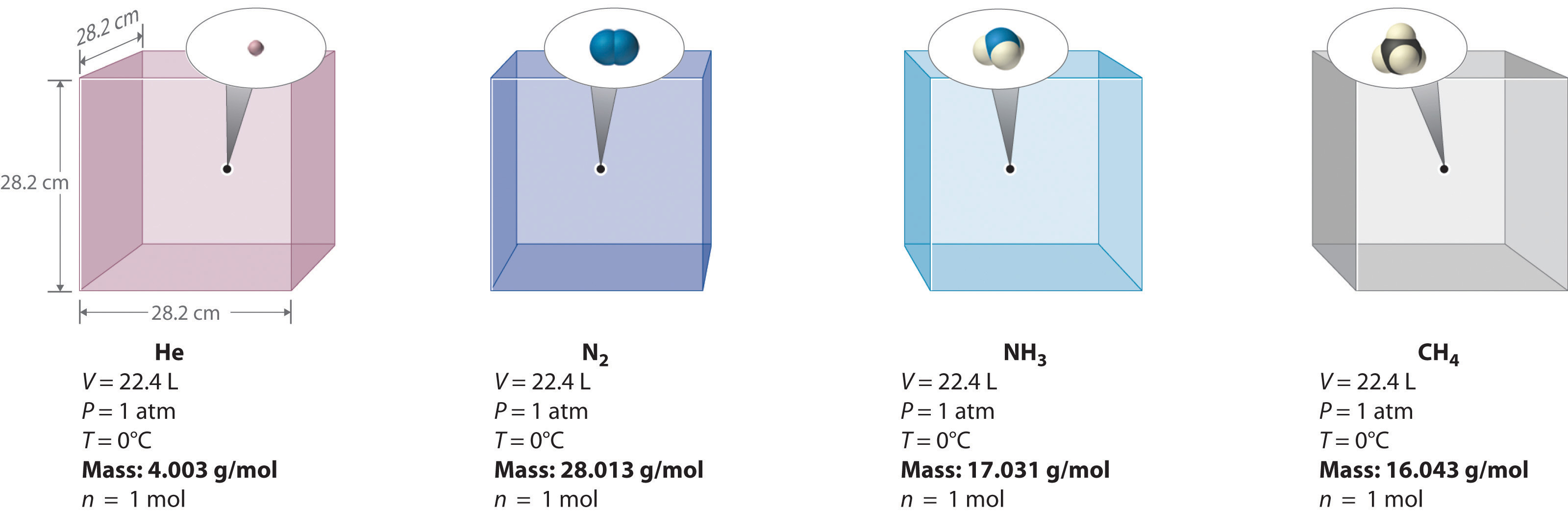
Because the number of particles is related to the number of moles (1 mol = 6.022 × 10²³ particles), Avogadro's law essentially states that equal volumes of different gases, at the same temperature and pressure, contain the same amount (moles, particles) of gas. At constant temperature and pressure, the volume (V) of a sample of gas is directly proportional to the number of moles (n) of gas in the sample. Stated mathematically,
\[V\propto n\ce{\:or\:} V=k×n\ce{\:or\:} \dfrac{V}{n}=k \nonumber \]
where \(\propto\) means “is proportional to,” and k is a proportionality constant that is the same for all gases.
In terms of two sets of data: \(\dfrac{V_1}{n_1}=\dfrac{V_2}{n_2}\).
This relationship is valid for most gases at relatively low pressures, but deviations from strict linearity are observed at elevated pressures. Mathematical relationships can also be determined for the other variable pairs, such as P versus n, and n versus T.
At constant temperature and pressure, 5.00 L of nitrogen gas contains 0.200 mol. What volume would 0.500 mol of nitrogen gas occupy under the same conditions?
Solution
Use the formula:
V1n1=V2n2\frac{V_1}{n_1} = \frac{V_2}{n_2}n1V1=n2V2Substitute the known values:
5.00 L0.200 mol=V20.500 mol\frac{5.00\ \text{L}}{0.200\ \text{mol}} = \frac{V_2}{0.500\ \text{mol}}0.200 mol5.00 L=0.500 molV2Solve for V2V_2V2:
V2=5.00 L0.200 mol×0.500 mol=12.5 LV_2 = \frac{5.00\ \text{L}}{0.200\ \text{mol}} \times 0.500\ \text{mol} = 12.5\ \text{L}V2=0.200 mol5.00 L×0.500 mol=12.5 L
Standard Temperature and Pressure
It should be obvious by now that some physical properties of gases depend strongly on the conditions. What we need is a set of standard conditions so that properties of gases can be properly compared to each other. Standard Temperature and Pressure (STP) is defined as exactly 100 kPa of pressure (0.986 atm) and 273 K (0°C). For simplicity, we will use 1 atm as standard pressure. Defining STP allows us to more directly compare the properties of gases that differ from one another.
One property shared among gases is a molar volume. The molar volume is the volume of 1 mol of a gas. At STP, the molar volume of a gas can be easily determined by using the ideal gas law:
\[(1\, atm)V=(1\, mol) \left(0.08205\dfrac{L.atm}{mol.K}\right)(273\, K)\nonumber \]
All the units cancel except for L, the unit of volume. So V = 22.4 L
Note that we have not specified the identity of the gas; we have specified only that the pressure is 1 atm and the temperature is 273 K. This makes for a very useful approximation: any gas at STP has a volume of 22.4 L per mole of gas; that is, the molar volume at STP is 22.4 L/mol (Figure \(\PageIndex{1}\)). This molar volume makes a useful conversion factor in stoichiometry problems if the conditions are at STP. If the conditions are not at STP, a molar volume of 22.4 L/mol is not applicable. However, if the conditions are at STP, the combined gas law can be used to calculate what the volume of the gas would be if at STP; then the 22.4 L/mol molar volume can be used.
How many moles of \(\ce{Ar}\) are present in 38.7 L at STP?
Solution
We can use the molar volume, 22.4 L/mol, as a conversion factor, but we need to reverse the fraction so that the L units cancel and mol units are introduced. It is a one-step conversion:
\[38.7\, \cancel{L}\times \frac{1\, mol}{22.4\cancel{L}}=1.73\, mol\nonumber \]
What volume of \(\ce{H2}\) is produced at STP when 55.8 g of \(\ce{Zn}\) metal react with excess \(\ce{HCl}\)?
\[\ce{Zn(s) + 2HCl(aq) → ZnCl2(aq) + H2(g)} \nonumber \]
Solution
This is a stoichiometry problem with a twist: we need to use the molar volume of a gas at STP to determine the final answer. The first part of the calculation is the same as in a previous example:
\[55.8\cancel{g\, Zn}\times \frac{1\cancel{mol\, Zn}}{65.41\cancel{g\, Zn}}\times \frac{1\, mol\, H_{2}}{1\cancel{mol\, Zn}}=0.853\, H_{2}\nonumber \]
Now we can use the molar volume, 22.4 L/mol, because the gas is at STP:
\[0.853\cancel{mol\, H_{2}}\times \frac{22.4\, L}{1\cancel{mol\, H_{2}}}=19.1\, L\, H_{2}\nonumber \]
Alternatively, we could have applied the molar volume as a third conversion factor in the original stoichiometry calculation.
Ideal Gas Law
So far, the gas laws we have considered have all required that the gas change its conditions; then we can predict a resulting change in one of its properties. Are there any gas laws that relate the physical properties of a gas at any given time? Consider a further extension of the combined gas law to include n. By analogy to Avogadro's law, n is positioned in the denominator of the fraction, opposite the volume. So,
\[\frac{PV}{nT}=constant\nonumber \]
Because pressure, volume, temperature, and amount are the only four independent physical properties of a gas, the constant in the above equation is truly a constant. Indeed, because we do not need to specify the identity of a gas to apply the gas laws, this constant is the same for all gases. We define this constant with the symbol R, so the previous equation is written as
\[\dfrac{PV}{nT}=R\nonumber \]
which is usually rearranged as
\[PV = nRT\nonumber \]
This equation is called the ideal gas law. It relates the four independent properties of a gas at any time. The constant \(R\) is called the ideal gas law constant. Its value depends on the units used to express pressure and volume.
| Numerical Value | Units |
|---|---|
| 0.08205 | \(\dfrac{L \cdot atm}{mol \cdot K}\) |
| 62.36 | \(\dfrac{L \cdot torr}{mol \cdot K}=\dfrac{L \cdot mmHg}{mol \cdot K}\) |
| 8.314 | \(\dfrac{J}{mol \cdot K}\) |
The ideal gas law is used like any other gas law, with attention paid to the unit and expression of the temperature in kelvin. However, the ideal gas law does not require a change in the conditions of a gas sample. The ideal gas law implies that if you know any three of the physical properties of a gas, you can calculate the fourth property.
A 4.22 mol sample of \(\ce{Ar}\) has a pressure of 1.21 atm and a temperature of 34°C. What is its volume?
Solution
The first step is to convert temperature to kelvins:
\[34 + 273 = 307\, \ce{K} \nonumber\]
Now we can substitute the conditions into the ideal gas law:
\[(1.21atm)(V)=(4.22\, mol)\left(0.08205\dfrac{L.atm}{mol.K}\right)(307\, K)\nonumber \]
The atm unit is in the numerator of both sides, so it cancels. On the right side of the equation, the mol and K units appear in the numerator and the denominator, so they cancel as well. The only unit remaining is L, which is the unit of volume that we are looking for. We isolate the volume variable by dividing both sides of the equation by 1.21:
\[V=\dfrac{(4.22)(0.08205)(307)}{1.21}L\nonumber \]
Then solving for volume, we get V = 87.9 L
At a given temperature, 0.00332 g of Hg in the gas phase has a pressure of 0.00120 mmHg and a volume of 435 L. What is its temperature?
Solution
We are not given the number of moles of Hg directly, but we are given a mass. We can use the molar mass of Hg to convert to the number of moles.
\[0.00332\cancel{g\, Hg}\times \frac{1\, mol\, Hg}{200.59\cancel{g\, \, Hg}}=0.0000165\, mol=1.65\times 10^{-5}mol\nonumber \]
Pressure is given in units of millimeters of mercury. We can either convert this to atmospheres or use the value of the ideal gas constant that includes the mmHg unit. We will take the second option. Substituting into the ideal gas law,
\[(0.00332\, mm\, Hg)(435\, L)=(1.65\times 10^{-5}mol)(62.36\frac{L.mmHg}{mol.K})T\nonumber \]
The mmHg, L, and mol units cancel, leaving the K unit, the unit of temperature. Isolating T on one side, we get
\[T=\frac{(0.00332)(435)}{(1.65\times 10^{-5})(62.36)}K\nonumber \]
Then solving for K, we get T = 1,404 K.
The ideal gas law can also be used in stoichiometry problems.
What volume of \(\ce{H2}\) is produced at 299 K and 1.07 atm when 55.8 g of \(\ce{Zn}\) metal react with excess \(\ce{HCl}\)?
\[\ce{Zn(s) + 2HCl(aq) -> ZnCl2(aq) + H2(g)}\nonumber \]
Solution
Here we have a stoichiometry problem where we need to find the number of moles of H2 produced. Then we can use the ideal gas law, with the given temperature and pressure, to determine the volume of gas produced. First, the number of moles of H2 is calculated:
\[55.8\cancel{g\, Zn}\times \frac{1\cancel{mol\, Zn}}{65.41\cancel{g\, Zn}}\times \dfrac{1\, mol\, H_{2}}{1\cancel{mol\, Zn}}=0.853\, H_{2}\nonumber \]
Now that we know the number of moles of gas, we can use the ideal gas law to determine the volume, given the other conditions:
\[(1.07atm)V=(0.853\, mol)\left(0.08205\dfrac{L.atm}{mol.K}\right)(299\, K)\nonumber \]
All the units cancel except for L, for volume, which means V = 19.6 L
Partial Pressure and Dalton's Law
One of the properties of gases is that they mix with each other. When they do so, they become a solution—a homogeneous mixture. Some of the properties of gas mixtures are easy to determine if we know the composition of the gases in the mix.
In gas mixtures, each component in the gas phase can be treated separately because, according to the kinetic theory of gases, there are little to no attractive or repulsive forces between particles. Each component of a gas mixture shares the same temperature and volume, (remember that gases expand to fill the volume of their container; gases in a mixture continue to do that as well). However, each individual gas will have its own pressure within a mixture. This is called the partial pressure of a gas, \(P_i\). Partial pressures are expressed in torr, millimeters of mercury, or atmospheres like any other gas pressure; however, we use the term pressure when talking about pure gases and the term partial pressure when we are talking about the individual gas components in a mixture.
Dalton's law of partial pressures states that the total pressure of a gas mixture, \(P_{tot}\), is equal to the sum of the partial pressures of the components, \(P_i\):
which is expressed algebraically as
\[P_{total}=P_1+P_2+P_3 ... = \sum_i P_i \nonumber \]
or, equivalently
\[ P_{total} = \dfrac{RT}{V} \sum_i n_i \nonumber \]
where \(i\) counts over all gases in mixture.
Although this law may seem trivial, it reinforces the idea that gases behave independently of each other.
A mixture of H2 at 2.33 atm and N2 at 0.77 atm is in a container. What is the total pressure in the container?
Solution
Dalton's law of partial pressures states that the total pressure is equal to the sum of the partial pressures. We simply add the two pressures together:
Ptot = 2.33 atm + 0.77 atm = 3.10 atm
A 2.00 L container with 2.50 atm of H2 is connected to a 5.00 L container with 1.90 atm of O2 inside. The containers are opened, and the gases mix. What is the final pressure inside the containers?
Solution
Because gases act independently of each other, we can determine the resulting final pressures using Boyle's law and then add the two resulting pressures together to get the final pressure. The total final volume is 2.00 L + 5.00 L = 7.00 L. First, we use Boyle's law to determine the final pressure of H2:
(2.50 atm)(2.00 L) = P2(7.00 L)
Solving for P2, we get P2 = 0.714 atm = partial pressure of H2.
Now we do that same thing for the O2:
(1.90 atm)(5.00 L) = P2(7.00 L)P2 = 1.36 atm = partial pressure of O2
The total pressure is the sum of the two resulting partial pressures:
Ptot = 0.714 atm + 1.36 atm = 2.07 atm
Dalton’s law states that in a gas mixture (\(P_{total}\)) each gas will exert a pressure independent of the other gases (\(P_n\)) and each gas will behave as if it alone occupies the total volume. By extension, the partial pressure of each gas can be calculated by multiplying the total pressure (\(P_{total}\)) by the gas percentage (%).
\[P_{Total} = P_1 + P_2 + P_3 + P_4 + ... + P_n \nonumber \]
or
\[P_n = \dfrac{\text{% of individual gas}_n}{P_{Total}} \nonumber \]
| Gas | Partial Pressure (mm Hg) | Percentage (%) |
|---|---|---|
| Nitrogen, (N_2\) | \(P_{N_2}\) = 594 | 78 |
| Oxygen, \(O_2\) | \(P_{O_2}\)= 160 | 21 |
| Carbon Dioxide, \(CO_2\) | \(P_{CO_2}\) = 0.25 | 0.033 |
| Water Vapor, \(H_2O\) | \(P_{H_2O}\) = 5.7 | 0.75 |
| Other trace gases | \(P_{Other}\) = 0.05 | 0.22 |
| Total air | \(P_{Total}\) = 760 | 1 |
Oxygen gas was collected over water as shown above. The atmospheric pressure was 754 torr, the temperature was 22°C, and the volume of the gas was 155 mL. The vapor pressure of water at 22°C is 19.8 torr. Use this information to estimate the number of moles of \(O_2\) produced.
Solution
From Dalton's law,
\[P_{O_2} = P_{total} – P_{H_2O} = 754 – 19.8 = 734 \; torr = 0.966\; atm \nonumber \]
Now use the Ideal Gas Law to convert to moles
\[ n =\dfrac{PV}{RT} = \dfrac{(0.966\; atm)(0.155\;L)}{(0.082\; L atm mol^{-1} K^{-1})(295\; K)}= 0.00619 \; mol \nonumber \]
Carbonated beverages—sodas, beer, sparkling wines—have one thing in common: they have \(\ce{CO2}\) gas dissolved in them in such sufficient quantities that it affects the drinking experience. Most people find the drinking experience pleasant—indeed, in the United States alone, over 1.5 × 10⁹ gal of soda are consumed each year, which is almost 50 gal per person! This figure does not include other types of carbonated beverages, so the total consumption is probably significantly higher.
All carbonated beverages are made in one of two ways. First, the flat beverage is subjected to a high pressure of \(\ce{CO2}\) gas, which forces the gas into solution. The carbonated beverage is then packaged in a tightly-sealed package (usually a bottle or a can) and sold. When the container is opened, the \(\ce{CO2}\) pressure is released, resulting in the well-known hiss of an opening container, and \(\ce{CO2}\) bubbles come out of solution. This must be done with care: if the \(\ce{CO2}\) comes out too violently, a mess can occur!

The second way a beverage can become carbonated is by the ingestion of sugar by yeast, which then generates \(\ce{CO2}\) as a digestion product. This process is called fermentation. The overall reaction is\[\ce{C6H12O6(aq) → 2C2H5OH(aq) + 2CO2(aq)}\nonumber \]
When this process occurs in a closed container, the \(\ce{CO2}\) produced dissolves in the liquid, only to be released from solution when the container is opened. Most fine sparkling wines and champagnes are turned into carbonated beverages this way. Less-expensive sparkling wines are made like sodas and beer, with exposure to high pressures of \(\ce{CO2}\) gas.
Henry’s Law
Henry's law is one of the gas laws formulated by William Henry in 1803. It states: "At a constant temperature, the amount of a given gas that dissolves in a given type and volume of liquid is directly proportional to the partial pressure of that gas in equilibrium with that liquid." An equivalent way of stating the law is that the solubility of a gas in a liquid is directly proportional to the partial pressure of the gas above the liquid.
To explain this law, Henry derived the equation:
\[ C =k P_{gas} \nonumber \]
where
Henry’s Law tells us that the greater the pressure of gas above the surface of a liquid, the higher the concentration of the gas in the liquid. Also, Henry’s law tells us that gases diffuse from areas of high gas concentration to areas of low gas concentration.
- Henry's law only works if the molecules are at equilibrium.
- Henry's law does not work for gases at high pressures (e.g., \(N_{2\;(g)}\) at high pressure becomes very soluble and harmful when in the blood supply).
- Henry's law does not work if there is a chemical reaction between the solute and solvent (e.g., \(HCl_{(g)}\) reacts with water by a dissociation reaction to generate \(H_3O^+\) and \(Cl^-\) ions).
Application of Henry's Law: Scuba diving
Our respiratory systems are designed to maintain the proper oxygen concentration in the blood when the partial pressure of O2 is 0.21 atm, its normal sea-level value. Below the water surface, the pressure increases by 1 atm for each 10.3 m increase in depth; thus a scuba diver at 10.3 m experiences a total of 2 atm pressure pressing on the body. In order to prevent the lungs from collapsing, the air the diver breathes should also be at about the same pressure.


But at a total pressure of 2 atm, the partial pressure of \(O_2\) in ordinary air would be 0.42 atm; at a depth of 100 ft (about 30 m), the \(O_2\) pressure of 0.8 atm would be far too high for health. For this reason, the air mixture in the pressurized tanks that scuba divers wear must contain a smaller fraction of \(O_2\). This can be achieved most simply by raising the nitrogen content, but high partial pressures of N2 can also be dangerous, resulting in a condition known as nitrogen narcosis. The preferred diluting agent for sustained deep diving is helium, which has very little tendency to dissolve in the blood even at high pressures.
Certain diseases—such as emphysema, lung cancer, and severe asthma—primarily affect the lungs. Respiratory therapists help patients with breathing-related problems. They can evaluate, help diagnose, and treat breathing disorders and even help provide emergency assistance in acute illness where breathing is compromised.
Most respiratory therapists must complete at least two years of college and earn an associate’s degree, although therapists can assume more responsibility if they have a college degree. Therapists must also pass state or national certification exams. Once certified, respiratory therapists can work in hospitals, doctor’s offices, nursing homes, or patient’s homes. Therapists work with equipment such as oxygen tanks and respirators, may sometimes dispense medication to aid in breathing, perform tests, and educate patients in breathing exercises and other therapy.
Because respiratory therapists work directly with patients, the ability to work well with others is a must for this career. It is an important job because it deals with one of the most crucial functions of the body.
Key Takeaways
- Boyle’s Law: At constant temperature, pressure (P) and volume (V) are inversely related. P ∝ 1/V (T constant). P1V1 = P2V2
- Charles’s Law: At constant pressure, volume (V) and temperature (T) are directly related. V ∝ T ( P constant). T1V2 = T2V1
- Gay-Lussac’s Law: At constant volume, pressure (P) and temperature (T) are directly related. P ∝ T (V constant). P1T2 = P2T1
- Avogadro’s Law: At constant temperature and pressure, volume (V) is directly proportional to the number of moles (n). V ∝ n (T and P constant). V1n2 = V2n1
- Combined Gas Law: Combines Boyle’s, Charles’s, and Gay-Lussac’s Laws to describe changes in P, V, and T. P1V1 / T1 = P2V2 / T2
- Ideal Gas Law: Relates pressure, volume, temperature, and amount of gas in one equation: PV = nRT; Where R is the gas constant.
- Dalton’s Law of Partial Pressures: The total pressure of a gas mixture equals the sum of the partial pressures of each individual gas. Ptotal = P1 + P2 + P3 + …
- The solubility of a gas in a liquid increases with its partial pressure, and this relationship is defined by Henry's Law, where the constant k depends on the gas, solvent, and temperature. C = kPg
This page titled 9.5: Gas Laws was last modified on Mon, 18 May 2026 03:29:13 GMT and is shared under a CC BY-NC-SA 4.0 license and was authored, remixed, and/or curated by Burçak Artun, Gorkem Ermut, and Semere Bairu.
The book could not be loaded just now.