Opening the book…
Three Broad Categories of Chemical Bonds
- Covalent
- Ionic
- Metallic
To distinguish these we need introduce the concept of electronegativity (\(\chi\)), which is a measure of how much an electron is attracted to an atom in a bond, and is covered in section 8.7 of this Chapter. In that section we will see that Fluorine is the most electronegative element with a value of 4, while Francium and Cesium are the least electronegative with a value of 0.7. A "rule of thumb" is that ionic bonds occur when \(\Delta \chi\) is greater than 2, and either covalent or metallic occurs when it is less than 0.5, with Metallic occurring when the average is less than 2 and covalent when the average is greater than two. This can be explained by the van Arkel-Ketelaar diagram.
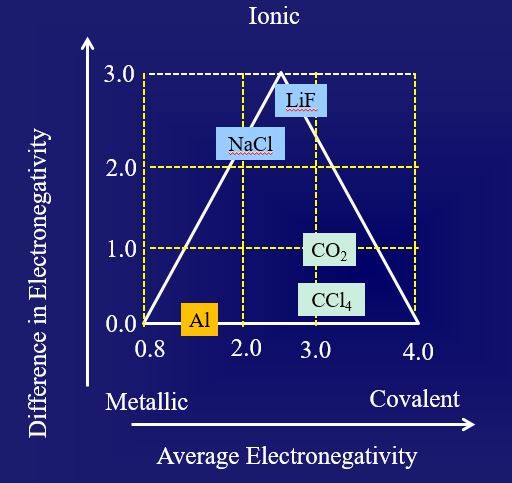
Figure \(\PageIndex{1}\): Van Arkel-Ketelaar diagram showing how electronegativity can be used to distinguish the three types of chemical bonds. The three corners of the diagram represent the extremes
- Bottom Left: Metallic bonds occur between atoms of low electronegativty
- Bottom right: Covalent bonds occur between atoms of high electronegativity
- Top middle: Ionic bonds occur between an atom of high and an atom of low electronegativity.
It needs to be understood that real bonds can be a mixture of these. For example, many covalent bonds are polar covalent, and we will cover this in section 8.7.
Most of this Chapter deals with covalent bonds, but it is important to realize that there are also ionic and metallic. In all of these cases, we consider the bonds to occur through interactions of the valence shell electrons, and that core electrons are held too tight to the parent nucleus to be involved with bonding.
This page titled 9.1: Chemical Bond Formation- An Introduction was last modified on Tue, 18 Jun 2024 19:59:58 GMT and is shared under a CC BY-NC-SA 4.0 license and was authored, remixed, and/or curated by Robert Belford.
The book could not be loaded just now.