Opening the book…
We’ve seen that the metal-ligand bond is generally polarized toward the ligand, making the ligand nucleophilic. The ligand is especially nucleophilic in the case of X-type (anionic) ligands. When a nucleophilic, X-type ligand is positioned cis to a neutral, unsaturated ligand (L) in an organometallic complex, a migratory insertion reaction can occur. In a migratory insertion reaction, an anionic ligand (\(\ce{X^-}\)) and a neutral unsaturated ligand (L) couple to form a new anionic ligand (\(\ce{^- LX}) that is attached to the same metal (Figure \(\PageIndex{1}\)). The overall result is that an M-X bond is broken and M and X are added across a \(\pi\) bond of L. There is no change in oxidation state at the metal (unless the ligand is an alkylidene/alkylidyne), but the total electron count of the complex decreases by two during the actual insertion event.
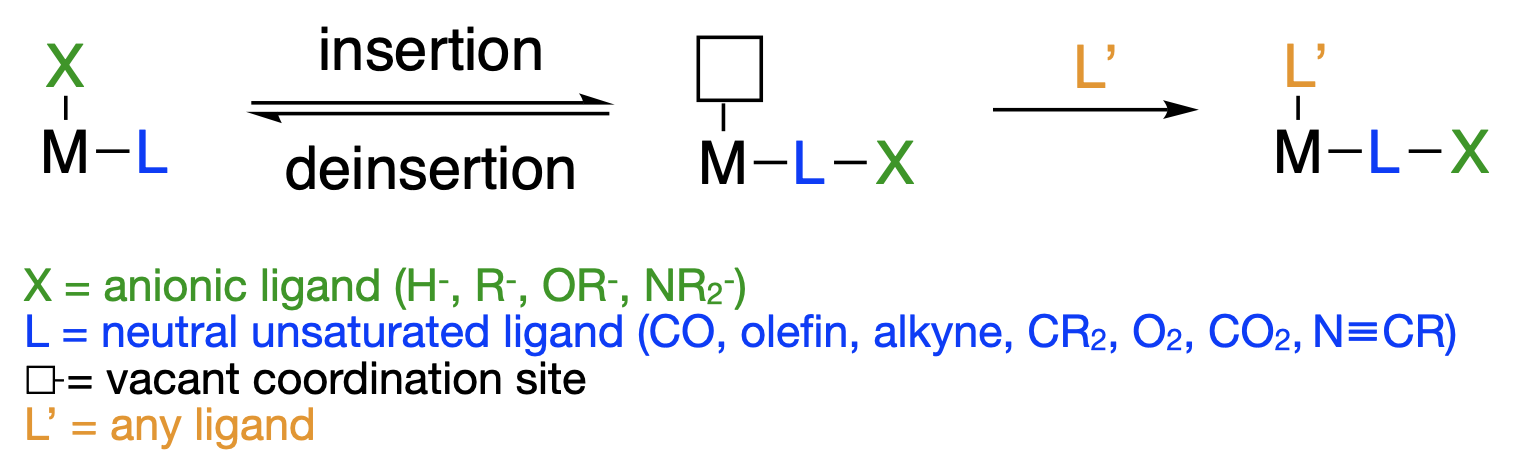
The migratory insertion results in a decrease in coordination number and the creation of an open coordination site on the complex. The open coordination site can be filled by an added ligand (L') (Figure \(\PageIndex{1}\)). The reverse of the insertion reaction is called a deinsertion. To drive the chemical equilibrium in the forward (insertion) direction, the reactant neutral ligand (or another neutral ligand) can be added in excess so that the neutral ligand fills the vacancy in the product complex and prevents the reverse (deinsertion) reaction. Typical neutral, unsaturated ligands are CO, olefins, alkynes, carbenes, dioxygen, carbon dioxide, and nitriles. Typical anionic ligands are hydrido, alkyl, aryl, alkoxy, and amido-ligands Figure \(\PageIndex{1}\).
The open site may appear where the unsaturated ligand was or where the X-type ligand was, depending on which group actually moved (see below). It is more common that the anionic X ligand moves (Figure \(\PageIndex{2}\)).

We can distinguish between two types of insertions, which differ in the number of atoms in the unsaturated ligand involved in the step. Insertions of CO, carbenes, and other η1 unsaturated ligands are called 1,1-insertions because the X-type ligand moves from its current location on the metal to one spot over, on the atom bound to the metal. η2 ligands like alkenes and alkynes can also participate in migratory insertion; these reactions are called 1,2-insertions because the X-type ligand slides two atoms over, from the metal to the distal atom of the unsaturated ligand (Figure \(\PageIndex{4}\)).

This is really starting to look like the addition of M and X across a π bond! However, we should take care to distinguish this completely intramolecular process from the attack of a nucleophile or electrophile on a coordinated π system, which is a different beast altogether. Confusingly, chemists often jumble up all of these processes using words like “hydrometalation,” “carbometalation,” “aminometalation,” etc. Another case of big words being used to obscure ignorance! We’ll look at nucleophilic and electrophilic attack on coordinated ligands in separate posts.
This page titled 7.2.1: Introduction to Insertion was last modified on Tue, 06 Aug 2024 16:52:51 GMT and is shared under a CC BY-NC-SA 4.0 license and was authored, remixed, and/or curated by Kathryn Haas.
The book could not be loaded just now.