Opening the book…
- Describe the arrangement of electrons using the shell model.
Building Atoms: Main Shells
An electron shell is the outside part of an atom around the atomic nucleus. It is a group of atomic orbitals with the same value of the principal quantum number \(n\). Electron shells have one or more electron subshells, or sublevels. The name for electron shells comes from the Bohr model, in which groups of electrons were believed to go around the nucleus at certain distances, so that their orbits formed "shells".
An electron shell may be thought of as an orbit followed by electrons around an atom nucleus. Because each shell can contain only a fixed number of electrons, each shell is associated with a particular range of electron energy, and thus each shell must fill completely before electrons can be added to an outer shell. The electrons in the outermost shell determine the chemical properties of the atom (see Valence shell). For an explanation of why electrons exist in these shells see electron configuration.
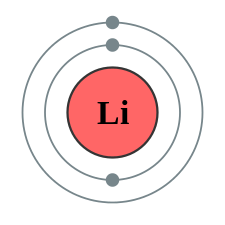
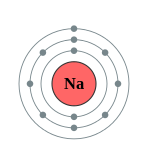
Figure \(\PageIndex{10}\) A shell diagram of lithium (left) and Sodium (right)
The electron shells are labeled K, L, M, N, O, P, and Q; or 1, 2, 3, 4, 5, 6, and 7; going from innermost shell outwards. Electrons in outer shells have higher average energy and travel farther from the nucleus than those in inner shells. This makes them more important in determining how the atom reacts chemically and behaves as a conductor, because the pull of the atom's nucleus upon them is weaker and more easily broken. In this way, a given element's reactivity is highly dependent upon its electronic configuration.
Video \(\PageIndex{1}\) How to draw the shell model for sulfur.
Note: The number of electrons that can occupy each energy level are 2 (first level), 8 (2nd level), 18 (3rd level), and 32 (4th level) based on the formula: # of electrons = 2(n)2, wherein n = principle energy level.
Table \(\PageIndex{1}\) shows the number of electrons that fill each shell for neutral atoms of several elements. As mentioned earlier, the innermost shell (corresponding to lowest energy) is filled first and only a fixed number of electrons is allowed in each shell. The only electron in hydrogen (Z=1) goes to the first shell. In lithium atom (Z=3), the two electrons fill the first shell, and the third electron goes to the second shell. An argon atom (Z=18) has 18 electrons. The 10 electrons fill the first and second shells, and the remaining 8 electrons go to the third shell. The electron configuration for elements pass argon are covered in more detail in section 3.7.
|
Element Symbol |
Atomic Number* (Z) |
First Shell n=1 (2 electrons allowed) |
Second Shell n=2 (8 electrons allowed) |
Third Shell n=3 (18 electrons allowed) |
|---|---|---|---|---|
| H | 1 | 1 | ||
| He | 2 | 2 | ||
| C | 6 | 2 | 4 | |
| N | 7 | 2 | 5 | |
| Na | 11 | 2 | 8 | 1 |
| Mg | 12 | 2 | 8 | 2 |
| Cl | 17 | 2 | 8 | 7 |
| Ar | 18 | 2 | 8 | 8 |
Note:* In a neutral atom he number of protons is equal to the number of electrons.
Summary
- The shell model is a good representation of electron arrangement only for elements 1-18.
Contributors and Attributions
- Connections (John Hutchinson)
- Wikipedia
Henry Agnew (UC Davis)
2.3.1.1: The Bohr Model of Atoms is shared under a mixed 4.0 license and was authored, remixed, and/or curated by LibreTexts.
The book could not be loaded just now.