Opening the book…
In the laboratory, alkenes are often hydrated by the oxymercuration–demercuration procedure, which involves electrophilic addition of Hg2+ to the alkene on reaction with mercury(II) acetate [(CH3CO2)2Hg]. The intermediate organomercury compound is then treated with sodium borohydride, NaBH4, and demercuration occurs to produce an alcohol. For example:
Alkene oxymercuration is closely analogous to halohydrin formation. The reaction is initiated by electrophilic addition of Hg2+ (mercuric) ion to the alkene to give an intermediate mercurinium ion, whose structure resembles that of a bromonium ion (Figure \(\PageIndex{1}\)). Nucleophilic addition of water as in halohydrin formation, followed by the loss of a proton, then yields a stable organomercury product. The final step, demercuration of the organomercury compound by reaction with sodium borohydride, is complex and involves radicals. Note that the regiochemistry of the reaction corresponds to Markovnikov addition of water; that is, the −OH group attaches to the more highly substituted carbon atom, and the −H attaches to the less highly substituted carbon. The hydrogen that replaces mercury in the demercuration step can attach from either side of the molecule depending on the exact circumstances.
What products would you expect from oxymercuration–demercuration of the following alkenes?


- Answer
-
- 2-Pentanol
- 2-Methyl-2-pentanol
From what alkenes might the following alcohols have been prepared?
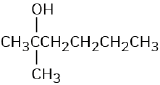

- Answer
-
- Oxymercuration of 2-methyl-1-hexene or 2-methyl-2-hexene
- Oxymercuration of cyclohexylethylene or hydroboration of ethylidenecyclohexane
This page titled 8.6: Hydration of Alkenes - Addition of H₂O by Oxymercuration was last modified on Thu, 10 Oct 2024 20:44:45 GMT and is shared under a CC BY-NC-SA 4.0 license and was authored, remixed, and/or curated by Sol Parajon Puenzo (Cañada College) via source content that was edited to the style and standards of the LibreTexts platform.
The book could not be loaded just now.