3.8: Names of Alkyl Halides

CHEM 231: Organic Chemistry I Textbook · LibreTexts

0%

Contents

    Text

    Size
    100%
    Theme
    Typeface
    Line length
    Spacing

    Read aloud

    How

    Speed: 1×
    Light up
    Highlight

    Symbols: Mulberry Symbols, © 2018–2026 Steve Lee, CC BY-SA 4.0 (licence, the set), the site's own copies.

    From LibreTexts, under CC BY-NC-SA 4.0, as the source states it; its equations are written in TeX, which the PDF shows typeset. This page at LibreTexts.

    3.8: Names of Alkyl Halides

    Although commonly called alkyl halides, halogen-substituted alkanes are named systematically as haloalkanes, treating the halogen as a substituent on a parent alkane chain. There are three steps:

    STEP 1

    Find the longest chain, and name it as the parent. If a double or triple bond is present, the parent chain must contain it.

    STEP 2

    Number the carbons of the parent chain beginning at the end nearer the first substituent, whether alkyl or halo. Assign each substituent a number according to its position on the chain.

    The structures of 5-bromo-2,4-dimethylheptane and 2-bromo-4,5-dimethylheptane in which the carbon chain is numbered and halogen and methyl substituents are highlighted in red and green respectively.

    If different halogens are present, number each one and list them in alphabetical order when writing the name.

    The structure of 1-bromo-3-chloro-4-methylpentane in which the carbon chain is numbered and bromine, chlorine, and methyl substituents are highlighted in red, blue, and green respectively.

    STEP 3

    If the parent chain can be properly numbered from either end by step 2, begin at the end nearer the substituent that has alphabetical precedence.

    The structure of 2-bromo-5-methylhexane in which the carbon chain is numbered and halogen and methyl substituents are highlighted in red and green respectively.

    In addition to their systematic names, many simple alkyl halides are also named by identifying first the alkyl group and then the halogen. For example, CH3I can be called either iodomethane or methyl iodide. Such names are well entrenched in the chemical literature and in daily usage, but they won’t be used in this book.

    The structures of iodomethane (or methyl iodide), 2-chloropropane (or isopropyl chloride), and bromocyclohexane (or cyclohexyl bromide) with halogens highlighted in red.

    Exercises

    Exercise \(\PageIndex{1}\)

    a. The name of the molecule on the left is 2-chlorobutane. What is the name of Molecule A?

    2-chlorobutane: Figure \(\PageIndex{2}\).svg

    olecule A: Figure \(\PageIndex{3}\).svg

    b. The name of the molecule on the left is 2-fluoro-3-methylpentane. What are the names of Molecule B and C?

    2-fluoro-3-methylpentane: Figure \(\PageIndex{4}\).svg

    Molecule B: Figure \(\PageIndex{5}\).svg

    Molecule C: Figure \(\PageIndex{6}\).svg

    c. The name of the molecule on the left is 1-chloro-2-butene. What is the name of Molecule D?

    1-chloro-2-butene: Figure \(\PageIndex{7}\).svg

    5-fluoro-2-hexadiene: Figure \(\PageIndex{8}\).svg

    Molecule D: Figure \(\PageIndex{9}\).svg

    d. The name of the molecule on the left is 5-fluoro-1,3-cyclohexadiene. What is the name of the molecule in the right: Molecule E?

    5-fluoro-1,3-cyclohexadiene: Figure \(\PageIndex{10}\).svg

    Molecule E: Figure \(\PageIndex{11}\).svg

    Exercise \(\PageIndex{2}\)

    Give IUPAC names for the following alkyl halides:

    1. The structure of 1-iodobutane.
    2. The structure of 1-chloro-3-methylbutane.
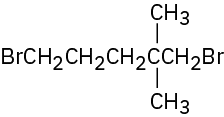
    3. The structure of 1,5-dibromo-2,2-dimethylpentane.
    1. The structure of 1,3-dichloro-3-methylbutane.
    2. The structure of 1-chloro-3-ethyl-4-iodopentane.
    3. The structure of 2-bromo-5-chlorohexane.
    Answer
    1. 1-Iodobutane
    2. 1-Chloro-3-methylbutane
    3. 1,5-Dibromo-2,2-dimethylpentane
    1. 1,3-Dichloro-3-methylbutane
    2. 1-Chloro-3-ethyl-4-iodopentane
    3. 2-Bromo-5-chlorohexane
    Exercise \(\PageIndex{3}\)

    Draw structures corresponding to the following IUPAC names:

    1. 2-Chloro-3,3-dimethylhexane
    2. 3,3-Dichloro-2-methylhexane
    3. 3-Bromo-3-ethylpentane
    1. 1,1-Dibromo-4-isopropylcyclohexane
    2. 4-sec-Butyl-2-chlorononane
    3. 1,1-Dibromo-4-tert-butylcyclohexane
    Answer
    1. A six-carbon chain with a chlorine on C 2 and two methyl groups on C 3.
    2. A six-carbon chain with a methyl group on C 2 and two chlorines on C 3.
    3. A five-carbon chain with an ethyl group and a bromine on C 3.
    1. The structure of 1,1-dibromo-4-isopropylcyclohexane.
    2. A nine-carbon chain with a chlorine on C 2 and a four-carbon chain, connected at the second carbon, on C 4.
    3. The structure of 1,1-dibromo-4-tert-butylcyclohexane.

    This page titled 3.8: Names of Alkyl Halides was last modified on Tue, 12 Aug 2025 02:37:13 GMT and is shared under a CC BY-NC-SA 4.0 license and was authored, remixed, and/or curated by OpenStax via source content that was edited to the style and standards of the LibreTexts platform.