Opening the book…
Alcohols occupy a central position in organic chemistry. They can be prepared from many other kinds of compounds (alkenes, alkyl halides, ketones, esters, and aldehydes, among others), and they can be transformed into an equally wide assortment of compounds (Figure \(\PageIndex{1}\)).
We’ve already seen several methods of alcohol synthesis:
Alcohols from Substitution Reactions
Methyl and primary alkyl halides can be converted to alcohols by using an SN2 reaction with OH- as a nucleophile (Section 11.5). Also, secondary and tertiary alkyl halides can be converted to alcohols by an SN1 reaction using water as the nucleophile (and it can even be the solvent). Recall that SN1 reactions are promoted in polar, protic solvents (Section 11.7).
The Synthesis of Methanol Using an SN2 Reaction
Alcohols from Alkenes
- Alcohols can be prepared by hydration of alkenes. Because the direct hydration of alkenes with aqueous acid is generally a poor reaction in the laboratory, two indirect methods are commonly used. Hydroboration–oxidation yields the syn, non-Markovnikov hydration product (Section 8.5), whereas oxymercuration–demercuration yields the Markovnikov hydration product (Section 8.4).
Diols from Alkenes
- 1,2-Diols can be prepared either by direct hydroxylation of an alkene with OsO4 followed by reduction with NaHSO3 or by acid-catalyzed hydrolysis of an epoxide (Section 8.7). The OsO4 reaction occurs with syn stereochemistry to give a cis diol, and epoxide opening occurs with anti stereochemistry to give a trans diol.
Predict the products of the following reactions:
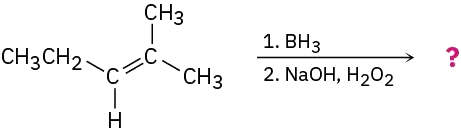


- Answer
-
- 2-Methyl-3-pentanol
- 2-Methyl-4-phenyl-2-butanol
- meso-5,6-Decanediol
This page titled 12.2: Preparation of Alcohols- A Review was last modified on Tue, 21 Oct 2025 04:40:08 GMT and is shared under a CC BY-NC-SA 4.0 license and was authored, remixed, and/or curated by Sol Parajon Puenzo (Cañada College) via source content that was edited to the style and standards of the LibreTexts platform.
The book could not be loaded just now.