Opening the book…
Introduction
E2, bimolecular elimination, was proposed in the 1920s by British chemist Christopher Kelk Ingold. E2 reactions are typically seen with secondary and tertiary alkyl halides, in the presence of a base (OH-, RO-, R2N-). For a primary halide to undergo an E2 reaction, a strong sterically hindered base is usually required. The products of an E2 reaction follow Zaitsev's rule, the most substituted alkene is usually the major product.

E2 Mechanism
The E2 mechanism takes place in a single concerted step. The rate at which this mechanism occurs follows second-order kinetics and depends on the concentration of both the base and alkyl halide. The base removes a hydrogen from a carbon adjacent to the carbon with the leaving group. The electrons of the broken H-C bond move to form the pi bond of the neutral product alkene. In doing this, the C-X bond is broken, causing the removal of the leaving group. Overall, during this reaction, an electron pair is transferred from the base to the leaving group.
Like the SN2 reaction, the E2 reaction takes place in one step without intermediates. As the base begins to abstract H+ from a carbon next to the leaving group, the C–H bond begins to break, a \(\ce{C=C}\) bond begins to form, and the leaving group begins to depart, taking with it the electron pair from the C–X bond.
Evidence
Among the pieces of evidence supporting this mechanism is the fact that E2 reactions show second-order kinetics and follow the rate law: rate = k × [RX] × [Base]. That is, both the base and alkyl halide take part in the rate-limiting step.
Further evidence for the predicted mechanism for the E2 reaction was provided by experiments involving the deuterium isotope effect (DIE). The deuterium isotope effect (DIE) is a phenomenon associated with molecules that have had hydrogen (H) atoms isotopically substituted with deuterium (D) atoms, exhibiting different reaction rates. The bond dissociation energy for C-D bonds is about 5 kJ/mol stronger than the bond dissociation energy of C-H bonds. This difference in energy results in a reduction in the rate of reaction if the deuterium replacement occurs at a site of bond breaking in the rate-determining step of a reaction. So if the rate-limiting step involves a breaking of this bond, as it does at the E2 transition state, there will be a substantial decrease in reaction rates when comparing deuterated and non-deuterated analogues. Indeed, the reaction of 2-bromopropane with sodium ethoxide (NaOEt) is 6.7 times faster than its deuterated counterpart, providing evidence that the C-H bond is broken during the rate-determining step of the E2 mechanism. This is consistent with the predicted mechanism of the E2 reaction, consisting of a single concerted step. If the rate-determining step was the leaving group bond breaking first (as in an E1 reaction) the deuterium substitution would not have caused an observable change in reaction rate.

Another piece of mechanistic evidence involves the stereochemistry of E2 eliminations. As shown by a large number of experiments, E2 reactions occur with periplanar geometry, meaning that all four reacting atoms—the hydrogen, the two carbons, and the leaving group—lie in the same plane. Two such geometries are possible: syn-periplanar geometry, in which the H and the X are on the same side of the molecule, and anti periplanar geometry, in which the H and the X are on opposite sides of the molecule. Of the two, anti-periplanar geometry is energetically preferred because it allows the substituents on the two carbons to adopt a staggered relationship, whereas syn geometry requires that the substituents be eclipsed.

Periplanar Geometry
What’s so special about periplanar geometry? Because the sp3 σ orbitals in the reactant C–H and C–X bonds must overlap and become p π orbitals in the alkene product, there must also be some overlap in the transition state. This can occur most easily if all the orbitals are in the same plane to begin with—that is, if they’re periplanar (Figure \(\PageIndex{2}\)).

Think of E2 elimination reactions with periplanar geometry as being similar to SN2 reactions with 180° geometry. In an SN2 reaction, an electron pair from the incoming nucleophile pushes out the leaving group on the opposite side of the molecule. In an E2 reaction, an electron pair from a neighboring C–H bond also pushes out the leaving group on the opposite side of the molecule.
Anti-periplanar geometry for E2 eliminations has specific stereochemical consequences that provide strong evidence for the proposed mechanism. To take just one example, meso-1,2-dibromo-1,2-diphenylethane undergoes E2 elimination on treatment with base to give only the E alkene. None of the isomeric Z alkene is formed because the transition state leading to the Z alkene would have to have syn-periplanar geometry and would thus be higher in energy.
Predicting the Stereochemical Product of E2 Reactions
E2 reactions have the requirements of a leaving group and a hydrogen on a carbon adjacent to the leaving group carbon. For non-ringed compounds, the C-C can usually undergo free rotation to place the C-X and C-H bonds anti-periplanar to each other. Stereochemical considerations usually come into play when both of the carbons in the C-C bond are chiral. When these carbons are achiral but contain the other requirements for an E2 reaction, products lacking stereochemistry are usually produced.
When both of the carbons in the C-C bond are chiral, one carbon will have a leaving group, and the other carbon will have a single hydrogen. To consider the stereochemistry of an E2 product, start by creating a Newman projection looking down the C-C bond. Then rotate the C-C bond until the C-X and C-H bonds are in the anti position. The Newman projection now shows the relative positioning of the substituents on the C-C bond as they will appear in the double bond formed. It should be noted that if syn elimination were possible, a positional isomer of the double bond would be created. Consider the elimination products for (2R, 3R)-2-bromo-3-methylpentane.

First, locate hydrogens on carbons adjacent to the leaving group. The compound used in this example has two unique sets of hydrogens.

Because the adjacent hydrogen colored fuchsia is attached to a chiral carbon it require special consideration. Convert the structure into a Newman projection along the C-C bond that will for the alkene elimination product. The C-C bond can be view down either direction and still product the correct product.

Then rotate such the the adjacent H and the leaving group are in the anti position.

This Newman projection shows the relative positioning of the substituents on the double bond formed. Note, none of the Z isomers is formed because it would require syn orientation of the H and Br.

Lastly, consider the products made by other adjacent hydrogens and apply Zaitsev's rule to predict the preferred product.

Determining Cis and Trans Products in an Elimination Reaction
Understanding that E2 reactions require an anti-periplanar geometry can explain why cis and trans alkene isomers can form as products. This occurs as an important exception to the rule that stereoisomers only form as elimination products when both of the carbons in the C-C bond forming the alkene are chiral. When considering the E2 reaction products of (R)-2-butane, there are two groups of hydrogens on carbons adjacent to the leaving group a CH3 and a CH2.

The carbon in the CH2 group is achiral so both the H's appear to be equivalent. However, when the anti-periplanar geometry requirement is applied each hydrogen will produce its own unique product. Once the reactant is converted into a Newman projection it can be seen that the Br leaving group and the hydrogen colored blue are in the anti orientation and are ready to be eliminated. It should also be noted that the two CH3 groups are also in the anti position which gives them the least amount of steric interaction possible. Because the CH3 groups are on opposite sides of the Newman projection the CH3 groups will be on opposite sides of the alkene thus creating the product trans-2-butene. When the Newman projection is rotated such that the fuchsia colored hydrogen is anti to the Br leaving group, the two CH3 groups are now on the same. This orientation creates the isomer cis-2-butene. However, to obtain this orientation the two CH3 groups must overcome the steric strain associated with a gauche conformation. This makes the transition state leading the cis isomer higher in energy and more difficult to form. Because of this, the trans isomer will be the major product. It is clear that the two hydrogens of the CH2 group are not equivalent despite their not being attached to a chiral carbon.

After considering all the products made during this E2 reaction the preferred product can be determined. The cis and trans isomer both have two alkene substituents while the third product only has one. Of the cis and trans isomer, the trans isomer is expected to be easier to form. Zaitsev's rule says that trans-2-butene will be the major product of this reaction.

What stereochemistry do you expect for the alkene obtained by E2 elimination of (1S,2S)-1,2-dibromo-1,2-diphenylethane?
Strategy
Draw (1S,2S)-1,2-dibromo-1,2-diphenylethane so that you can see its stereochemistry and so that the –H and –Br groups to be eliminated are anti periplanar. Then carry out the elimination while keeping all substituents in approximately the same positions, and see what alkene results.
Solution
Anti periplanar elimination of HBr gives (Z)-1-bromo-1,2-diphenylethylene.

What stereochemistry do you expect for the alkene obtained by E2 elimination of (1R,2R)-1,2-dibromo-1,2-diphenylethane? Draw a Newman projection of the reacting conformation.
- Answer
-
(Z)-1-Bromo-1,2-diphenylethylene
What stereochemistry do you expect for the trisubstituted alkene obtained by E2 elimination of the following alkyl halide on treatment with KOH? (reddish brown = Br.)

- Answer
-
(Z)-3-Methyl-2-pentene
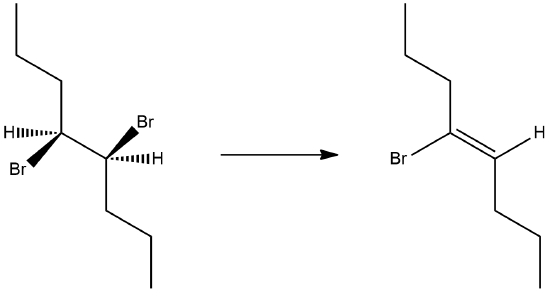
What is the product of the following molecule in an E2 reaction? What is the stereochemistry?

- Answer
-
The stereochemistry is (Z) for the reaction.
This page titled 11.8: The E2 Reaction and Mechanism was last modified on Mon, 20 Oct 2025 19:52:27 GMT and is shared under a CC BY-NC-SA 4.0 license and was authored, remixed, and/or curated by Sol Parajon Puenzo (Cañada College) via source content that was edited to the style and standards of the LibreTexts platform.
The book could not be loaded just now.