Opening the book…
Introduction
Next to water, proteins are the most abundant substances in nearly all cells. They account for about 15% of the cells overall mass. Proteins are one of the three major classes of foods. Carbohydrates and fats are the others. Proteins differ from carbohydrates and fats not only in their functions in the living organism, but also in elemental composition. In addition to carbon, hydrogen and oxygen, which are present in carbohydrates and fats, proteins contain nitrogen. Most proteins also contain sulfur; sulfur is present in proteins due to the amino acids, cysteine and methionine. Additional elements such as phosphorus, iron, copper, zinc and iodine also occur in certain complex proteins. These elements are not part of the primary protein structure but are generally constituents of non-protein substances called prosthetic groups which combined with proteins.
Amino acids
An amino acid is an organic compound that contains both an amine (-NH2) functional group and a carboxylic acid (-COOH) group. Amino acids are building blocks for proteins. The amino acids found in proteins are always a-amino acids. The two functional groups are separated by one carbon atom and hence the symbol alpha (a). There are twenty common a-amino acids. Human beings cannot synthesize ten of them and they are called essential amino acid that must be supplied in the diet.
The general structural formula for an a-amino acid is:
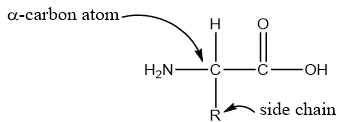
The group represented by R is the side chain. The side chain may be polar or nonpolar. For example, shown below are two amino acids. Phenylalanine has a nonpolar aromatic ring and serine contains a polar alcohol functional group in the side chain.

Acid-Base Properties of Amino Acids
The carboxylic acid functional group (-COOH) tend to donate protons (H+) producing the carboxylate anion (-COO-). The amine functional group (-NH2) tend to accept protons (H+) producing the quaternary ammonium cation (-NH3+). An internal acid-base reaction results in the formation of a zwitterion meaning “double ion”. A zwitterion has a positive charge on one atom and a negative charge on another atom. The zwitterion has no net charge.

Proteins and Peptide bond
Proteins are high molecular weight compounds made of amino acids. In a protein the amino acids are linked together by a series of peptide bonds. A peptide bond is an amide functional group obtained by elimination of a water molecule followed by condensation between two adjacent amino acids. Shown below is a dipeptide made of the two amino acids, Alanine and Glycine. The dipeptide called Ala-Gly is made via dehydration followed by synthesis reaction.

Protein structure
The primary structure of a protein refers to the order in which the amino acids are linked together by means of peptide bonds.
The three-dimensional configuration of segments of the protein chain is called its secondary structure, Common secondary structures are the a-helix and the b-sheet. The secondary structure is formed when amino acids hydrogen bond to other amino acids farther along the polypeptide chain.
The tertiary structure is the three-dimensional shape of the entire polypeptide chain. Globular proteins, for example, are very tightly folded into a compact spherical form. This folding result from interactions or bonds between the side chains of amino acids. The interactions involve hydrogen bond, and hydrophobic interactions. Covalent bonds such as disulfide bonds and ionic bonds called salt bridges allow the protein to maintain it 3o structure.
When proteins contain more than one chain, they have a quaternary structure. The manner in which the several peptide chains fit together describes a protein's quaternary structure. An example of a protein that has a 4o structure is hemoglobin.
Denaturation of proteins
If the secondary, tertiary or quaternary structures of a protein are disrupted, the protein loses its biological activity and is said to be denatured. Denaturation usually results in precipitation of the protein from solution. The factors that may cause the denaturation of proteins are changes in pH, heat, alcohols, heavy metal ions, soaps, and detergents. In this experiment you will study the denaturation of albumin, the protein found in egg white. Casein is the name for a family of related proteins found in mammalian milk. Casein is not denatured with heat. This protein can be denatured by addition of acids during the process of making cheese.
Biuret test
The biuret test is used for predicting the presence of peptide bonds. The biuret test relies on the reaction between copper (II) ions and peptide bonds in a high pH solution. A violet color indicates the presence of proteins. Proteins give a strong biuret reaction because they contain a large number of peptide bonds. Dipeptides do not give a positive biuret test.
This page titled 9.2: Introduction was last modified on Tue, 17 Feb 2026 16:31:59 GMT and is shared under a CC BY-NC 4.0 license and was authored, remixed, and/or curated by Deboleena Roy.
The book could not be loaded just now.