Opening the book…
Types of Compounds
Inorganic chemical compounds generally fall into one of two broad categories: ionic compounds and covalent compounds. Ionic compounds are always solid at room temperature. They have high melting points, over 350oC and often as high as 1000oC. Ionic compounds always conduct an electric current when dissolved in water or when heated to the liquid state.
Covalent compounds are also called molecular compounds. Although some are solids at room temperature, many are liquids or gases. Their melting points are low, less than 350oC. Few molecular compounds are conductors of electricity.
Metal/Nonmetal Technique
It is possible to predict whether a compound will be ionic or covalent by first classifying the elements as metals or nonmetals. A bond between a metal and a nonmetal will generally be an ionic bond and the compound that results will be named an ionic compound. A bond between two nonmetals will be a covalent bond and the compounds that result will be named molecular compounds.
Electron Dot Formulae
| 1A | 2A | 3A | 4A | 5A | 6A | 7A | 8A |
|---|---|---|---|---|---|---|---|
 |
 |
||||||
 |
|
 |
 |
 |
 |
 |
 |
 |
|
 |
 |
 |
 |
 |
 |
 |
 |


The electron dot formulae of some of the main group elements are shown. The number of dots in the electron dot formula of the element is equal to the number of valence electrons. The group number of the main group elements is the number of the valence electrons.
Octet Rule
The octet rule states that atoms tend to gain, lose or share electrons in order to end up with the same electron configuration of one of the noble gases. All of the noble gases have eight valence electrons-except for helium, which has two valence electrons. Hydrogen is the exception to the rule of eight; this nonmetal is usually placed above the alkali metals on the periodic table because it too has one valence electron that it can lose to form a cation. Unlike the alkali metals, hydrogen atoms tend to gain or share electrons to end up with two valence electrons (Duet Rule).
Metal atoms can satisfy the Octet Rule by losing one or more electrons to become positively charged ions or cations. It is easy to predict the charge of the ions of the alkali metals, the alkaline earth metals, aluminum and a few other metals that always form the same ion. The group number of the representative elements is the number of the valence electrons. These metals lose all their valence electrons. The group number of representative metals is the positive charge of the ion. Exceptions are Pb, Sn and Bi.
| Group | Charge of Ion | Example |
|---|---|---|
| 1A | 1+ | Na+ sodium ion |
| 2A | 2+ | Ca2+ calcium ion |
| 3A | 3+ | Al3+ aluminum ion |
Nonmetal atoms can satisfy the Octet Rule in two ways:
(1) By sharing electrons with another nonmetal to form a covalent bond, or
(2) By gaining one or more electrons to form negatively charged ions or anions.
It is easy to predict the charge of nonmetal anions. The group number is the number of valence electrons, subtract the group number from 8 to find the negative charge of the nonmetal monoatomic ion. Names of nonmetal monoatomic ions always end with an –ide suffix.
| Group | Charge of Ion | Example |
|---|---|---|
| 5A | 3- | N3- nitride ion |
| 6A | 2- | O2- oxide ion |
| 7A | 1- | Cl- chloride ion |
Formulae of Ionic Compounds
Binary ionic compounds contain only two elements and their formulas are easily predicted using the periodic table. Consider the compound calcium chloride, which is used to melt ice on sidewalks. Calcium is a metal in group 2A, therefore it has two valence electrons and so calcium ion has a 2+ charge, Ca2+. The nonmetal chlorine is a group 7A element and has seven valence electrons. Chlorine atom needs to gain one electron to satisfy the Octet Rule and so chloride ion has a charge of 1-, Cl-. To balance out the charges you need one Ca2+ ion and two Cl- ions. So, the formula for calcium chloride is CaCl2. Subscripts of 1 are not written; when an atom does not have a subscript, it means there is one atom of calcium.
Once you have used the periodic table to predict the charge of the metal cation and the nonmetal anion, list the positive ion first and the negative ion second. For more complex examples simply criss-cross the charges to determine the subscripts of the compound formula. Let us look at the example of aluminum sulfide. The charge of aluminum (3) becomes the subscript of sulfur (2). So, the formula of aluminum sulfide is Al2S3.
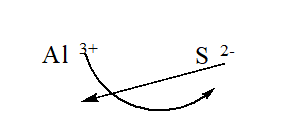
This “criss-cross” method works in all cases except where the subscripts are equal. Formulas of ionic compounds are always written as whole-number ratios. For example, the correct formula of calcium oxide is CaO. The names of binary ionic compounds list metal name first, followed by the nonmetal name with an –ide suffix.
This page titled 2.2: Discussion was last modified on Thu, 20 Jun 2024 17:10:13 GMT and is shared under a CC BY-NC 4.0 license and was authored, remixed, and/or curated by Deboleena Roy (American River College).
The book could not be loaded just now.