Opening the book…
- Explain how electron shielding and penetration affect the effective nuclear charge, \(Z_{eff} \), across different subshells.
- Describe how orbital energy levels are determined in many-electron atoms.
- Write the electron configuration of any element and relate it to the element’s position on the periodic table.
In hydrogen atoms, the energy of an electron orbital depends solely on the principal quantum number \(n\). However, in many-electron atoms, orbital energy is influenced by additional quantum numbers - \(n\), \(l\), and \(m_l\). This results in significant differences in energy levels compared to hydrogen. For example, while the 3s and 3p orbitals in hydrogen have the same energy (they are degenerate), they differ in energy in atoms with more than one electron.
This difference arises due to two key concepts: electron shielding and penetration. These effects alter the effective nuclear charge \(Z_{eff} \) experienced by electrons in different subshells. For instance, electrons in the 3s orbital experience a higher \(Z_{eff} \) than those in 3p because they penetrate closer to the nucleus and are less shielded. Radial probability density functions are useful tools for visualizing how penetration varies among orbitals.
Introduction to Shielding and Penetration
Electrons, being negatively charged, are attracted to the positively charged nucleus. However, they also repel each other. The balance between these attractive and repulsive forces leads to shielding—where inner electrons partially block the nuclear charge from being fully felt by outer electrons.
The specific orbital and subshell an electron occupies determine how close it can get to the nucleus. This ability to approach the nucleus is called penetration. The closer an electron can get, the stronger the electrostatic attraction it experiences from the nucleus.
This concept can be described using Coulomb’s Law:
\[ F=k \dfrac{q_i \cdot q_j}{r^2} \label{1}\]
Here, \(F\) is the electrostatic force between two charges, \( q_i \) and \( q_j \) , separated by a distance \( r\) and \( k \) is Coulomb’s constant. In atoms, this means that the force experienced by an electron depends on its distance from other charges (electrons or the nucleus) and the magnitude of those charges.
In an idealized model, all electrons would experience the full nuclear charge equally. For example, in a lithium atom (Li), each of its three electrons might be thought to feel the full +3 charge from the nucleus. In reality, the inner (core) electrons shield the outer (valence) electrons, reducing the nuclear charge they effectively experience. This reduced attraction is referred to as the effective nuclear charge, or \(Z_{eff} \) .
Core electrons, being closer to the nucleus, experience a \(Z_{eff} \) close to the actual nuclear charge. Valence electrons, on the other hand, experience a significantly reduced \(Z_{eff} \) due to both the shielding effect of core electrons and mutual repulsion from other valence electrons.
The force on an electron due to the nucleus is given by:
\[ F_{electron-nucleus}=k \dfrac{Z \cdot e^2}{r^2} \label{2}\]
Where
- \(Z\) is the atomic number (nuclear charge)
- \(e\) is the charge of an electron
- r is the distance from the nucleus
In multi-electron atoms, due to shielding, we use \(Z_{eff} \) instead of \(Z\):
\[ F_{eff}=k \dfrac{Z_{eff} \cdot e^2}{r^2} \label{3}\]
Understand Shielding and Penetration - Radial Probability Density Functions
The radial probability density function shows how electron density is distributed as a function of distance from the nucleus. These graphs help visualize shielding and penetration.
As shown in Figure \(\PageIndex{1}\), the inner 1s electrons shield outer electrons from the nucleus, reducing the effective nuclear charge \(Z_{eff} \) of the outer electrons. In the hydrogen atom, the 2s and 2p orbitals are degenerate, as the single electron experiences the full nuclear charge without shielding. However, in multi-electron atoms, the shielding effect of the inner 1s electrons reduces \(Z_{eff} \) of 2s and 2p both. However, the 2s orbital penetrates closer to the nucleus due to its inner radial peak as shown in Figure \(\PageIndex{2}\) , so it experiences less shielding and feels a stronger nuclear attraction. In contrast, the 2p orbital has less penetration and is more shielded. As a result, the 2s orbital is lower in energy than the 2p in multi-electron atoms. This difference in shielding and penetration explains why 2s and 2p orbitals split in energy. The graphs show these differences: the 2s radial probability has a small inner peak indicating penetration, while 2p lacks this, confirming its weaker attraction to the nucleus. Thus, energy splitting arises from electron-electron interactions and orbital shape.


Orbital Penetration
Penetration describes the proximity to which an electron can approach to the nucleus. In a multi-electron system, electron penetration is defined by an electron's relative electron density (probability density) near the nucleus of an atom. Electrons in different orbitals have different wavefunctions and therefore different radial probability density functions (defined by quantum numbers n and l around the nucleus). In other words, penetration depends on the shell (n) and subshell (l).
Within the same shell value (n), the penetrating power of an electron follows this trend in subshells (l):
\( s>p>d>f \)
And for different values of shell (n) and subshell (l), the penetrating power of an electron follows this trend:
\( 1s>2s>2p>3s>3p>4s>3d>4p>5s>4d>5p>6s>4f.... \)
and the energy of an electron for each shell and subshell goes as follows...
\( 1s<2s<2p<3s<3p<4s<3d<4p.... \)
The electron probability density for s-orbitals is highest in the center of the orbital, or at the nucleus. If we imagine a dartboard that represents the circular shape of the s-orbital and if the darts landed in correlation to the probability of where an electron would be found, the greatest dart density would be at the 50 points region, but most of the darts would be at the 30 point region. When considering the 1s-orbital, the spherical shell of 53 pm is represented by the 30 point ring.
Electrons which experience greater penetration experience stronger attraction to the nucleus, less shielding, and therefore experience a larger Effective Nuclear Charge (\(Z_{eff}\)), but shield other electrons more effectively.
Orbitals and their Energies
Unlike in hydrogen-like atoms with only one electron, in multielectron atoms the values of quantum numbers n and l determine the energies of an orbital. The energies of the different orbitals for a typical multielectron atom are shown in Figure \(\PageIndex{3}\). Within a given principal shell of a multielectron atom, the orbital energies increase with increasing l. An ns orbital always lies below the corresponding np orbital, which in turn lies below the nd orbital.
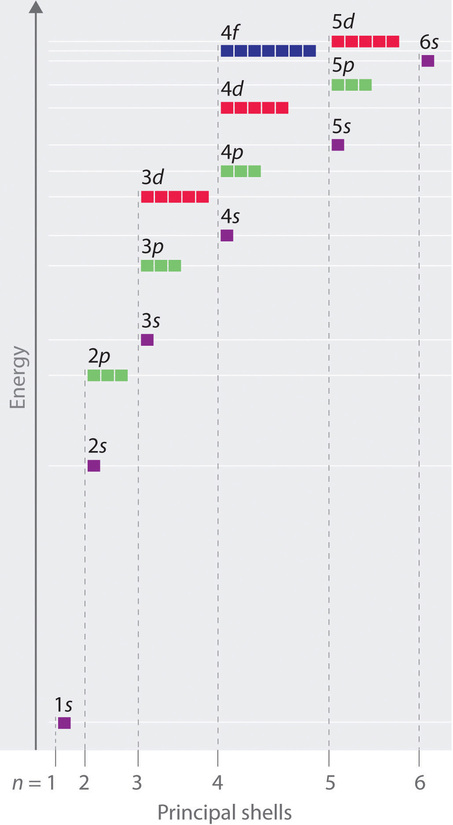
These energy differences are caused by the effects of shielding and penetration, the extent to which a given orbital lies inside other filled orbitals. For example, an electron in the 2s orbital penetrates inside a filled 1s orbital more than an electron in a 2p orbital does. Since electrons, all being negatively charged, repel each other, an electron closer to the nucleus partially shields an electron farther from the nucleus from the attractive effect of the positively charged nucleus. Hence in an atom with a filled 1s orbital, the effective nuclear charge (Zeff) experienced by a 2s electron is greater than the Zeff experienced by a 2p electron. Consequently, the 2s electron is more tightly bound to the nucleus and has a lower energy, consistent with the order of energies shown in Figure \(\PageIndex{1}\).
Due to electron shielding, \(Z_{eff}\) increases more rapidly going across a row of the periodic table than going down a column.
Notice in Figure \(\PageIndex{1}\) that the difference in energies between subshells can be so large that the energies of orbitals from different principal shells can become approximately equal. For example, the energy of the 3d orbitals in most atoms is actually between the energies of the 4s and the 4p orbitals.
The Pauli Exclusion Principle
The implications of electron spin for chemistry were recognized almost immediately by an Austrian physicist, Wolfgang Pauli (1900–1958; Nobel Prize in Physics, 1945), who determined that each orbital can contain no more than two electrons. He developed the Pauli exclusion principle: No two electrons in an atom can have the same values of all four quantum numbers (n, l, ml, ms).
By giving the values of n, l, and ml, we also specify a particular orbital (e.g., 1s with n = 1, l = 0, ml = 0). Because ms has only two possible values (+½ or −½), two electrons, and only two electrons, can occupy any given orbital, one with spin up and one with spin down. With this information, we can proceed to construct the entire periodic table, which was originally based on the physical and chemical properties of the known elements.
List all the allowed combinations of the four quantum numbers (n, l, ml, ms) for electrons in a 2p orbital and predict the maximum number of electrons the 2p subshell can accommodate.
Given: orbital
Asked for: allowed quantum numbers and maximum number of electrons in orbital
Strategy:
- List the quantum numbers (n, l, ml) that correspond to an n = 2p orbital. List all allowed combinations of (n, l, ml).
- Build on these combinations to list all the allowed combinations of (n, l, ml, ms).
- Add together the number of combinations to predict the maximum number of electrons the 2p subshell can accommodate.
Solution:
A For a 2p orbital, we know that n = 2, l = n − 1 = 1, and ml = −l, (−l +1),…, (l − 1), l. There are only three possible combinations of (n, l, ml): (2, 1, 1), (2, 1, 0), and (2, 1, −1).
B Because ms is independent of the other quantum numbers and can have values of only +½ and −½, there are six possible combinations of (n, l, ml, ms): (2, 1, 1, +½), (2, 1, 1, −½), (2, 1, 0, +½), (2, 1, 0, −½), (2, 1, −1, +½), and (2, 1, −1, −½).
C Hence the 2p subshell, which consists of three 2p orbitals (2px, 2py, and 2pz), can contain a total of six electrons, two in each orbital.
List all the allowed combinations of the four quantum numbers (n, l, ml, ms) for a 6s orbital, and predict the total number of electrons it can contain.
- Answer
-
(6, 0, 0, +½), (6, 0, 0, −½); two electrons
Summary
In many-electron atoms, orbital energy levels are affected by both shielding and penetration, unlike hydrogen, where energy depends only on the principal quantum number \( n \). Penetration refers to how close an electron can approach the nucleus; s orbitals penetrate more than p or d orbitals, leading to a stronger effective nuclear charge \(Z_{eff} \) . Shielding occurs when inner electrons block the attraction between the nucleus and outer electrons, reducing \(Z_{eff} \) for those farther out. As a result, subshells in the same principal level (e.g., 3s, 3p, 3d) have different energies. Radial probability density graphs show these effects visually—for example, 2s electrons are closer to the nucleus than 2p electrons. These concepts explain trends in atomic size and ionization energy across the periodic table. Additionally, the Pauli exclusion principle states that each orbital can hold a maximum of two electrons with opposite spins, which helps define the electron configurations of elements.
References
- Petrucci, Ralph H., William S. Harwood, F. Geoffrey Herring, and Jeffry D. Madura. General Chemistry: Principles and Modern Applications, Ninth Edition. Pearson Education Inc. Upper Saddle River, New Jersey: 2007.
- Raymond Chang. Physical Chemistry for Biological Sciences. Sausalito, California: University Science Books, 2005
- R. S. Mulliken, Electronic Structures of Molecules and Valence. II General Considerations, Physical Review, vol. 41, pp. 49-71 (1932)
- Anastopoulos, Charis (2008). Particle Or Wave: The Evolution of the Concept of Matter in Modern Physics. Princeton University Press. pp. 236–237. ISBN 0691135126. http://books.google.com/?id=rDEvQZhpltEC&pg=PA236.
Contributors and Attributions
- Sidra Ayub (UCD), Alan Chu (UCD)
This page titled 1.7: Many-Electron Atoms - Penetration and Shielding was last modified on Tue, 10 Jun 2025 05:26:56 GMT and is shared under a CC BY-NC-SA 4.0 license and was authored, remixed, and/or curated by Ta-Wei Li.
The book could not be loaded just now.