Opening the book…
- Use molar mass to convert between moles and mass.
Molar mass is defined as the mass of one mole of representative particles of a substance. By looking at a periodic table, we can conclude that the molar mass of lithium is \(6.94 \: \text{g}\), the molar mass of zinc is \(65.38 \: \text{g}\), and the molar mass of gold is \(196.97 \: \text{g}\). Each of these quantities contains \(6.02 \times 10^{23}\) atoms of that particular element. The units for molar mass are grams per mole, or \(\text{g/mol}\). The molar mass is listed on the periodic table for each element, typically underneath the symbol of the element.
Molar Masses of Compounds
The molecular formula of the compound carbon dioxide is \(\ce{CO_2}\). One molecule of carbon dioxide consists of 1 atom of carbon and 2 atoms of oxygen. We can calculate the mass of one molecule of carbon dioxide by adding together the masses of 1 atom of carbon and 2 atoms of oxygen:
\[12.01 \: \text{amu} + 2 \left( 16.00 \: \text{amu} \right) = 44.01 \: \text{amu}\nonumber \]
The molecular mass of a compound is the mass of one molecule of that compound. The molecular mass of carbon dioxide is \(44.01 \: \text{amu}\).
The molar mass of any compound is the mass in grams of one mole of that compound. One mole of carbon dioxide molecules has a mass of \(44.01 \: \text{g}\), while one mole of sodium sulfide formula units has a mass of \(78.04 \: \text{g}\). The molar masses are \(44.01 \: \text{g/mol}\) and \(78.04 \: \text{g/mol}\) respectively. In both cases, that is the mass of \(6.02 \times 10^{23}\) representative particles. The representative particle of \(\ce{CO_2}\) is the molecule, while for \(\ce{Na_2S}\) it is the formula unit.
Example \(\PageIndex{1}\): Molar Mass of a Compound
Calcium nitrate, \(\ce{Ca(NO_3)_2}\), is used as a component in fertilizer. Determine the molar mass of calcium nitrate.
Solution
Step 1: List the known and unknown quantities and plan the problem.
Known
- Formula \(= \ce{Ca(NO_3)_2}\)
- Molar mass \(\ce{Ca} = 40.08 \: \text{g/mol}\)
- Molar mass \(\ce{N} = 14.01 \: \text{g/mol}\)
- Molar mass \(\ce{O} = 16.00 \: \text{g/mol}\)
Unknown
- molar mass Ca(NO3)2
First we need to analyze the formula. Since the \(\ce{Ca}\) lacks a subscript, there is one \(\ce{Ca}\) atom per formula unit. The 2 outside the parentheses means that there are two nitrate ions per formula unit and each nitrate ion consists of one nitrogen atom and three oxygen atoms per formula unit. Thus, \(1 \: \text{mol}\) of calcium nitrate contains \(1 \: \text{mol}\) of \(\ce{Ca}\) atoms, \(2 \: \text{mol}\) of \(\ce{N}\) atoms, and \(6 \: \text{mol}\) of \(\ce{O}\) atoms.
Step 2: Calculate
Use the molar masses of each atom together with the number of atoms in the formula and add together.
\[1 \: \text{mol} \: \ce{Ca} \times \frac{40.08 \: \text{g} \: \ce{Ca}}{1 \: \text{mol} \: \ce{Ca}} = 40.08 \: \text{g} \: \ce{Ca}\nonumber \]
\[2 \: \text{mol} \: \ce{N} \times \frac{14.01 \: \text{g} \: \ce{N}}{1 \: \text{mol} \: \ce{N}} = 28.02 \: \text{g} \: \ce{N}\nonumber \]
\[6 \: \text{mol} \: \ce{O} \times \frac{16.00 \: \text{g} \: \ce{O}}{1 \: \text{mol} \: \ce{O}} = 96.00 \: \text{g} \: \ce{O}\nonumber \]
Molar mass of \(\ce{Ca(NO_3)_2} = 40.08 \: \text{g} + 28.02 \: \text{g} + 96.00 \: \text{g} = 164.10 \: \text{g/mol}\)
Conversions Between Moles and Mass
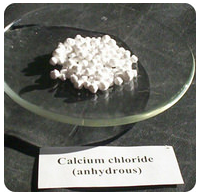
The molar mass of any substance is the mass in grams of one mole of representative particles of that substance. The representative particles can be atoms, molecules, or formula units of ionic compounds. This relationship is frequently used in the laboratory. Suppose that for a certain experiment, you need 3.00 moles of calcium chloride \(\left( \ce{CaCl_2} \right)\). Since calcium chloride is a solid, it would be convenient to use a balance to measure the mass that is needed. The molar mass of \(\ce{CaCl_2}\) is \(110.98 \: \text{g/mol}\). The conversion factor that can be used is then based on the equality that \(1 \: \text{mol} = 110.98 \: \text{g} \: \ce{CaCl_2}\). Dimensional analysis will allow you to calculate the mass of \(\ce{CaCl_2}\) that you should measure.
\[3.00 \: \text{mol} \: \ce{CaCl_2} \times \frac{110.98 \: \text{g} \: \ce{CaCl_2}}{1 \: \text{mol} \: \ce{CaCl_2}} = 333 \: \text{g} \: \ce{CaCl_2}\nonumber \]
When you measure the mass of \(333 \: \text{g}\) of \(\ce{CaCl_2}\), you are measuring 3.00 moles of \(\ce{CaCl_2}\).

Example \(\PageIndex{1}\): Converting Moles to Mass
Chromium metal is used for decorative electroplating of car bumpers and other surfaces. Find the mass of 0.560 moles of chromium.
Solution
Step 1: List the known quantities and plan the problem.
Known
- Molar mass of \(\ce{Cr} = 52.00 \: \text{g/mol}\)
- \(0.560 \: \text{mol} \: \ce{Cr}\)
Unknown
- \(0.560 \: \text{mol} \: \ce{Cr}\) = ? g
One conversion factor will allow us to convert from the moles of \(\ce{Cr}\) to mass.
Step 2: Calculate.
\[0.560 \: \text{mol} \: \ce{Cr} \times \frac{52.00 \: \text{g} \: \ce{Cr}}{1 \: \text{mol} \: \ce{Cr}} = 29.1 \: \text{g} \: \ce{Cr}\nonumber \]
Step 3: Think about your result.
Since the desired amount was slightly more than one half of a mole, the mass should be slightly more than one half of the molar mass. The answer has three significant figures because of the \(0.560 \: \text{mol}\).
A similar conversion factor utilizing molar mass can be used to convert from the mass of a substance to moles. In a laboratory situation, you may perform a reaction and produce a certain amount of a product which can be massed. It will often then be necessary to determine the number of moles of the product that was formed. The next problem illustrates this situation.
Section Summary
- Calculations are described for the determination of molar mass of an atom or a compound.
- Calculations involving conversions between moles of a material and the mass of that material are described.
12.7.2: Moles and Mass is shared under a not declared license and was authored, remixed, and/or curated by LibreTexts.
The book could not be loaded just now.