Opening the book…
Problem 4-1
(a) 1,4-Dimethylcyclohexane
(b) 1-Methyl-3-propylcyclopentane
(c) 3-Cyclobutylpentane
(d) 1-Bromo-4-ethylcyclodecane
(e) 1-Isopropyl-2-methylcyclohexane
(f) 4-Bromo-1-tert-butyl-2-methylcycloheptane
(a)  (b)
 (c)
 (d)

3-Ethyl-1,1-dimethylcyclopentane
(a) trans-1-Chloro-4-methylcyclohexane
(b) cis-1-Ethyl-3-methylcycloheptane
(a)  (b)
 (c)
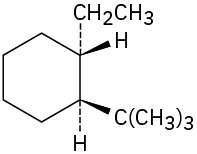
The two hydroxyl groups are cis. The two side chains are trans.
(a) cis-1,2-Dimethylcyclopentane
(b) cis-1-Bromo-3-methylcyclobutane
Problem 4-8 Six interactions; 21% of strain
Problem 4-9 The cis isomer is less stable because the methyl groups nearly eclipse each other.
Problem 4-10 Ten eclipsing interactions; 40 kJ/mol; 35% is relieved.
Problem 4-11 Conformation (a) is more stable because the methyl groups are farther apart.
Problem 4-14 Before the ring-flip, red and blue are equatorial and green is axial. After the ring-flip, red and blue are axial and green is equatorial.
Problem 4-15 4.2 kJ/mol
Problem 4-16 Cyano group points straight up.
Problem 4-17 Equatorial = 70%; axial = 30%
(a) 2.0 kJ/mol (axial Cl) (b) 11.4 kJ/mol (axial CH3)
(c) 2.0 kJ/mol (axial Br) (d) 8.0 kJ/mol (axial CH2CH3)
Problem 4-20 trans-Decalin is more stable because it has no 1,3-diaxial interactions.
Problem 4-21 Both ring-fusions are trans.
This page titled 32.4.3: Chapter 4 was last modified on Mon, 23 Sep 2024 01:41:03 GMT and is shared under a CC BY-NC-SA 4.0 license and was authored, remixed, and/or curated by OpenStax via source content that was edited to the style and standards of the LibreTexts platform.
The book could not be loaded just now.