32.4.9: Chapter 10

Organic Chemistry · LibreTexts

0%

Contents

    Text

    Size
    100%
    Theme
    Typeface
    Line length
    Spacing

    Read aloud

    How

    Speed: 1×
    Light up
    Highlight

    Symbols: Mulberry Symbols, © 2018–2026 Steve Lee, CC BY-SA 4.0 (licence, the set), the site's own copies.

    From LibreTexts, under CC BY-NC-SA 4.0, as the source states it; its equations are written in TeX, which the PDF shows typeset. This page at LibreTexts.

    32.4.9: Chapter 10
    Problem 10-1
    (a) 1-Iodobutane
    (b) 1-Chloro-3-methylbutane
    (c) 1,5-Dibromo-2,2-dimethylpentane
    (d) 1,3-Dichloro-3-methylbutane
    (e) 1-Chloro-3-ethyl-4-iodopentane
    (f) 2-Bromo-5-chlorohexane
    Problem 10-2
    (a) A six-carbon chain with a chlorine on C 2 and two methyl groups on C 3.
    (b) A six-carbon chain with a methyl group on C 2 and two chlorines on C 3.
    (c) A five-carbon chain with an ethyl group and a bromine on C 3.
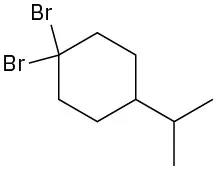
    (d) The structure of 1,1-dibromo-4-isopropylcyclohexane.
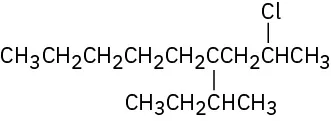
    (e) A nine-carbon chain with a chlorine on C 2 and a four-carbon chain, connected at the second carbon, on C 4.
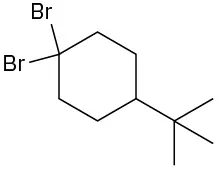
    (f) The structure of 1,1-dibromo-4-tert-butylcyclohexane.
    Problem 10-3 Chiral: 1-chloro-2-methylpentane, 3-chloro-2-methylpentane, 2-chloro-4-methylpentane Achiral: 2-chloro-2-methylpentane, 1-chloro-4-methylpentane
    A condensed formula for 1-chloro-2-methylpentane.
    A condensed formula for 2-chloro-2-methylpentane.
    A condensed formula for 3-chloro-2-methylpentane.
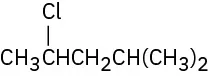
    A condensed formula for 2-chloro-4-methylpentane.
    A condensed formula for 1-chloro-4-methylpentane.
    Problem 10-4 1-Chloro-2-methylbutane (29%), 1-chloro-3-methylbutane (14%), 2-chloro-2-methylbutane (24%), 2-chloro-3-methylbutane (33%)
    Problem 10-5 Three resonance structures of cyclohexadienyl radical.
    Problem 10-6 The intermediate allylic radical reacts at the more accessible site and gives the more highly substituted double bond.
    Problem 10-7
    (a) 3-Bromo-5-methylcycloheptene and 3-bromo-6-methylcycloheptene
    (b) Four products
    Problem 10-8
    (a) 2-Methyl-2-propanol + HCl
    (b) 4-Methyl-2-pentanol + PBr3
    (c) 5-Methyl-1-pentanol + PBr3
    (d) 3,3-Dimethyl-cyclopentanol + HF, pyridine
    Problem 10-9 Both reactions occur.
    Problem 10-10 React Grignard reagent with D2O.
    Problem 10-11
    (a) 1. NBS; 2. (CH3)2CuLi
    (b) 1. Li; 2. CuI; 3. CH3CH2CH2CH2Br
    (c) 1. BH3; 2. H2O2, NaOH; 3. PBr3; 4. Li, then CuI; 5. CH3(CH2)4Br
    Problem 10-12
    (a) Four compounds arranged in order of increasing oxidation level: cyclohexane is lowest, cyclohexanone and 1-chloro-1-cyclohexene are equal and intermediate, and benzene is highest.

    (b) Three compounds arranged in order of increasing oxidation level: ethylamine is lowest, ethylenediamine intermediate, and acetonitrile is highest.
    Problem 10-13
    (a) Reduction
    (b) Neither

    This page titled 32.4.9: Chapter 10 was last modified on Thu, 28 Sep 2023 23:08:44 GMT and is shared under a CC BY-NC-SA 4.0 license and was authored, remixed, and/or curated by OpenStax via source content that was edited to the style and standards of the LibreTexts platform.