Opening the book…
Metal compounds with \(d^0\) electron count are able to activate C-H bonds through \(\sigma\) bond metathesis reactions. \(\sigma\)-bond metathesis is a chemical reaction wherein a metal-ligand \(\sigma\) bond undergoes metathesis (exchange of parts) with the sigma bond in some other reagent. The reaction is illustrated by the exchange of lutetium(III) methyl complex with a hydrocarbon (R-H) (Figure \(\PageIndex{1}\)). The oxidation state of the metal ion does not change during the reaction. This reactivity was first observed by Patricia L. Watson, a researcher at duPont.
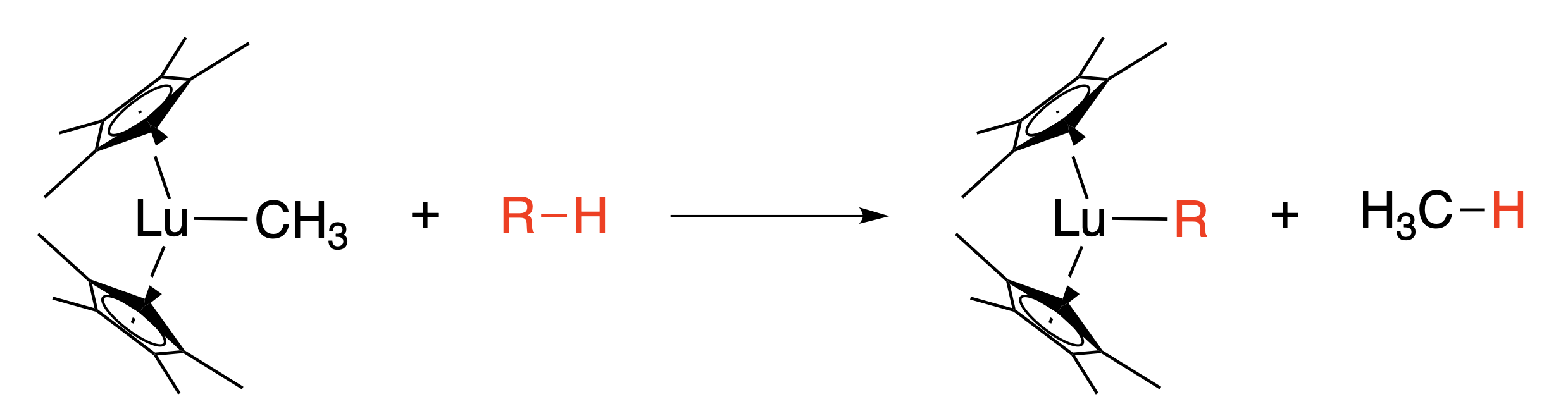
The reaction is mainly observed for complexes of metals with \(d^0\) electron configuration, e.g. complexes of Sc(III), Zr(IV), Nb(IV), Ta(V), etc. Complexes of the f-block elements also participate, regardless of the number of f-electrons. For metals unsuited for redox, sigma bond metathesis provides a pathway for introducing substituents.
The details of the reaction mechanism are somewhat a matter of debate, however a currently accepted model is that it precedes through a cycloaddition and via a "kite-shaped" transition state (Figure \(\PageIndex{2}\)). Indeed, the rate of the reaction is characterized by a highly negative entropy of activation, indicating an ordered transition state.

The reaction attracted much attention because hydrocarbons are normally unreactive substrates, whereas some sigma-bond metatheses are facile. Unfortunately the reaction does not readily allow the introduction of functional groups. It has been suggested that dehydrocoupling reactions proceed via sigma-bond metathesis.
Sources:
- https://en.Wikipedia.org/wiki/Sigma-bond_metathesis
- Waterman, Rory (2013). "σ-Bond Metathesis: A 30-Year Retrospective". Organometallics. 32: 7249–7263. doi:10.1021/om400760k.
This page titled Section 11.1.4: Sigma Bond Metathasis was last modified on Tue, 20 Jun 2023 15:55:40 GMT and is shared under a CC BY-NC-SA license and was authored, remixed, and/or curated by Kathryn Haas.
The book could not be loaded just now.