Opening the book…
Types of Solids
Solids are incompressible nonfluid substances that retain their shape. Being incompressible, solids have an essentially constant density. In this chapter we will look at crystaline and amorphous structures. We will not look a polymer based compounds, which are huge macromolecules comprised of repeating units of linked smaller monomers. Plastics are synthetic polymers and biological material like the lignin in plant cells, or proteins (chains of linked amino acids) are also polymeric in nature. In this class we will focus on inorganic structures like crystaline solids. At the simplest level you can break solids into crystalline and amorphous structures
- Crystalline Solids - have ordered atomic & molecular structure. Structures like table salt (NaCl), metals, diamonds and quartz form crystals. Table salt is an ionic crystal where the cation and anion form a lattice. Believe it or not, metals form simple crystal structures that we may not see on the macroscopic level. Diamonds and quartz are covalent crystals. In the case of diamond it is atomic carbon atoms that are linked in a tetrahedtral arrangement. In the case of quartz it is silicon dioxide units covalently bonded in repeating arrays.
- Amorphous Solids - have randomly arranged atomic and molecular structure, sort of like a fluid frozen in time. Glass and many stones are amorphous in nature.
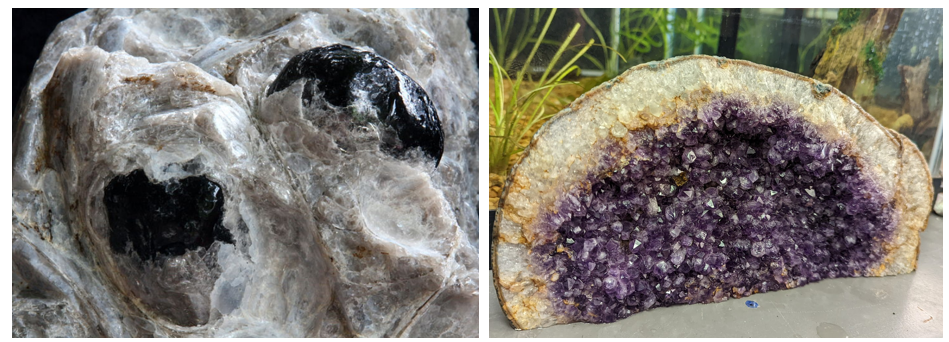

Types of Crystalline Solids
- Ionic Solid - cations and anions held together by coulombic forces (salts, section 12.2)
- Metallic solids - held together by metallic bonds (section 12.3).
- Covalent Network Solids (networks of covalent bonds, section 12.4)
- Molecular covalent network - held together by strong intermolecular forces or repeating covalent bonds between molecules (ice water, quartz, polymers)
- Atomic covalent network - held together by covalent bonds between atoms (diamond)
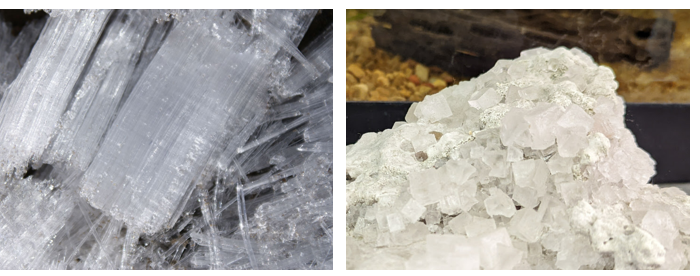 Figure \(\PageIndex{2}\): Left, Ice Crystal (CC0, Roert Kraft, publicdomainpictures.net. Right, NaCl Halite crystals (CC0 Bob Belford)
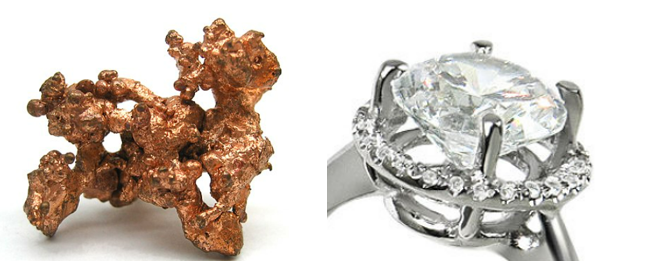 Figure \(\PageIndex{3}\): Left, Copper Ore (GNU 1.2, Jon Zander, wikimedia commons), right, 2 caret diamond on engagement ring (CC3.0, קוליברי טבעות אירוסין, wikimedia commons )


Phase Diagrams
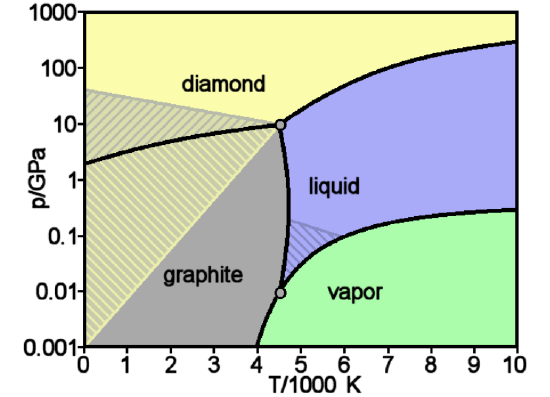
The final part of this chapter deals with Phase diagrams (section 12.5). These tell us which phases are stable at different Temperatures and Pressures. For example, the phase diagram below tells you the stable states of carbon at various temperatures and pressures.

Test Yourself
12.0: Prelude is shared under a not declared license and was authored, remixed, and/or curated by LibreTexts.
The book could not be loaded just now.