Opening the book…
- Understand the difference in the electrophilicity of \(\pi\)-bond of benzene and alkenes.
- Draw the electrophilic aromatic substitution mechanism with curly arrows showing the flow of electrons.
- Apply the electrophilic aromatic substitution to some reactions of benzene, including halogenation, nitration, sulfonation, alkylation, and acylation reactions.
Which electrophiles can react with an aromatic substrate?
The \(\pi\)-bonds in a benzene ring of aromatic compounds are weaker nucleophiles than the \(\pi\)-bonds in alkenes. This is because breaking a \(\pi\)-bond of alkene costs about 260 kJ/mole energy, but breaking a \(\pi\)-bond in an aromatic substrate costs an additional 208 kJ/mol because the aromatic stabilization is lost. Unlike alkenes, the aromatic substrates do not react with partial positive (\(\ce{\overset{\delta{+}}{A}{-}\overset{\delta{-}}{B}}\)) electrophiles. The aromatic substrates react with electrophiles in their most reactive cation \(\ce{E^{+}}\) form. The cation electrophiles are generated in situ by acid-base or Lewis acid-Lewis base reactions. For example, halogens (\(\ce{X-X}\) react as Lewis bases with Lewis acids like \(\ce{AlX3}\) or \(\ce{FeX3}\), where \(\ce{X}\) is a halogen atom (\(\ce{Cl}\) or \(\ce{Br}\)). The Lewis acid receives a lone pair from one halogen atom causing a heterolytic breaking of \(\ce{X-X}\). The other halogen leaves as \(\ce{X^{+}}\), as shown below.


Similar reaction happens when an alkylhalide (\(\ce{R-X}\) or an acyl halide ( \(\ce{R-\!\!{\overset{\overset{\Huge\enspace\!{\ce{O}}}|\!\!|\enspace}{\ce{C}}}\!\!-X}\)) reacts with Lewis acid, as shown below.


An \(\ce{-OH}\) bonded with a potential electrophile \(\ce{E^{+}}\) can be converted into a better leaving \(\ce{-\overset{+}{O}H2}\) group by adding a stronger acid to the substrate. The \(\ce{-{\overset{+}{O}}H2}\) leaves as neutral neucleophile \(\ce{H2O}\), leaving behind the \(\ce{E^{+}}\). For example, protonation of nitric acid with sulfuric acid generated nitronium ion (\(\ce{\overset{+}{N}O2}\)), as shown below.

Like the auto-ionization of water, the autoionization of sulfuric acid followed by elimination of \(\ce{H2O}\) generates protonated sulfur trioide (\(\ce{\overset{+}{S}O3H}\)), as shown below.

Electrophilic aromatic substitution mechanism
The nucleophilic \(\pi\)-bond of an aromatic compound attacks the cation electrophile (\(\ce{E^{+}}\)), as shown in step#1 in the mechanism illustrated below. Any base group in the medium removes the acidic proton that re-establishes the \(\pi\)-bond in Step#2.

Removal of the proton by a base is preferred over electrophile attacking the carbonation intermediate in step#2, because aromatic stabilization decreases the energy barrier for the former. It is called electrophilic aromatic substitution reaction because an electrophile \(\ce{E^{+}}\) substitutes another electrophile \(\ce{H^{+}}\) from an aromatic substrate.
Examples of electrophilic aromatic substitution reactions
Some fo the important electrophilic aromatic substitution reactions of benzene are listed below.
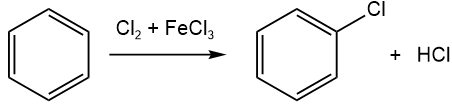
- Halogenation of benzene substitutes a \(\ce{-H}\) with a halogen (\(\ce{-Cl}\) or \(\ce{-Br}\)), as shown below.

- Nitration of benzene substitutes a \(\ce{-H}\) with nitro group (\(\ce{-NO2}\)) by the following reaction.

- Sulfonation of benzene substitutes a \(\ce{-H}\) with sulfonic acid group (\(\ce{-SO3H}\)) by the following reaction.

- Alkylation of benzene substitutes a \(\ce{-H}\) with alkyl acid group (\(\ce{-R}\)), e.g.,:

- Acylation of benzene substitutes a \(\ce{-H}\) with acyl group (\(\ce{-\!\!{\overset{\overset{\Huge\enspace\!{\ce{O}}}|\!\!|\enspace}{\ce{C}}}\!\!-R}\)), e.g.,:

This page titled 4.8: Electrophilic aromatic substitution reactions was last modified on Sat, 22 Aug 2026 20:14:11 GMT and is shared under a Public Domain license and was authored, remixed, and/or curated by Muhammad Arif Malik.
The book could not be loaded just now.