Opening the book…
Detection of ions is based up on their charge or momentum. For large signals a faraday cup is used to collect ions and measure the current. Older instruments used photographic plates to measure the ion abundance at each mass to charge ratio. Most detectors currently used amplify the ion signal using a collector similar to a photomultiplier tube. These amplifying detectors include: electron multipliers (shown in Figure \(\PageIndex{1}\)), channeltrons and multichannel plates. The gain is controlled by changing the high voltage applied to the detector. A detector is selected for it’s speed, dynamic range, gain, and geometry. Some detectors are sensitive enough to detect single ions.
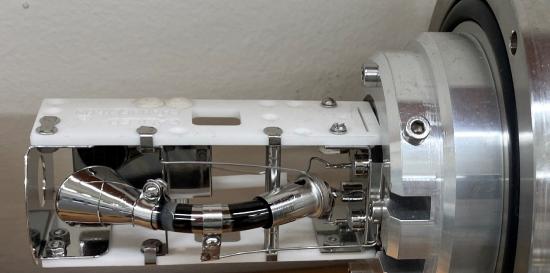
The mass spectrometer system will include controls for the gain of the detector. Typically, the gain is adjusted by changing the potential applied to the detector. These voltages are controlled by the software and care should be taken to balance the sensitivity required for the analysis. If the gain is set too low, signal will not be detected, if the gain is set too high the signal will include a lot of noise, the response may not be linear, and the detector life will be shortened.
For GC/MS systems it is typical to use a solvent delay so that the detector is turned off at the start of a run. After the solvent has gone through the system the detector is turned on. This protects the detector from being overloaded by the signal from the solvent but set the gain high enough to see analytes at very low concentration.
5.4: Detector Control is shared under a not declared license and was authored, remixed, and/or curated by LibreTexts.
The book could not be loaded just now.