Opening the book…
- Describe the structure and uses of some phenols.
- Generate the name of phenolic compounds.
Compounds in which an OH group is attached directly to an aromatic ring are designated ArOH and called phenols. Phenols differ from alcohols in that they are slightly acidic in water. They react with aqueous sodium hydroxide (NaOH) to form salts.
\[\ce{ArOH (aq) + NaOH (aq) \rightarrow ArONa (aq) + H_2O}\]
The parent compound, C6H5OH, is itself called phenol. (An old name, emphasizing its slight acidity, was carbolic acid.) Phenol is a white crystalline compound that has a distinctive (“hospital smell”) odor.
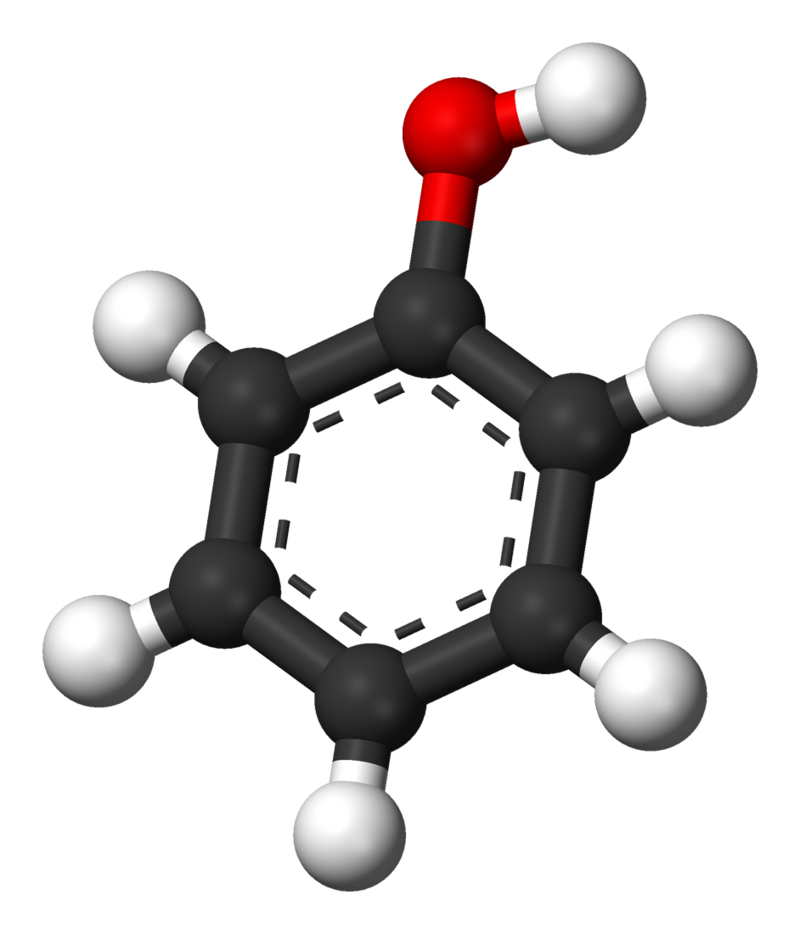
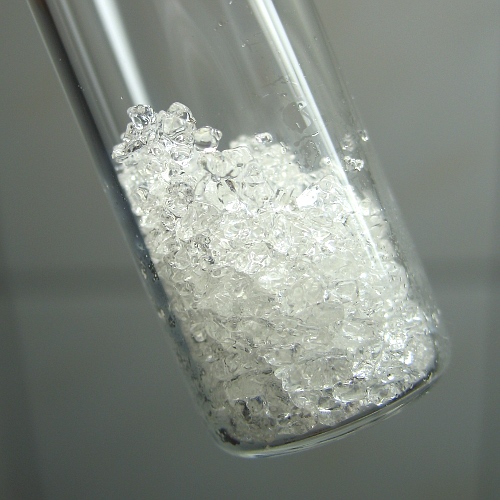
Phenols are widely used as antiseptics (substances that kill microorganisms on living tissue) and as disinfectants (substances intended to kill microorganisms on inanimate objects such as furniture or floors). The first widely used antiseptic was phenol. Joseph Lister used it for antiseptic surgery in 1867. Phenol is toxic to humans, however, and can cause severe burns when applied to the skin. In the bloodstream, it is a systemic poison—that is, one that is carried to and affects all parts of the body. Its severe side effects led to searches for safer antiseptics, a number of which have been found.

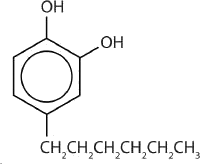
One safer phenolic antiseptic is 4-hexylresorcinol (4-hexyl-1,3-dihydroxybenzene; resorcinol is the common name for 1,3-dihydroxybenzene, and 4-hexylresorcinol has a hexyl group on the fourth carbon atom of the resorcinol ring). It is much more powerful than phenol as a germicide and has fewer undesirable side effects. Indeed, it is safe enough to be used as the active ingredient in some mouthwashes and throat lozenges.
Naming Phenols
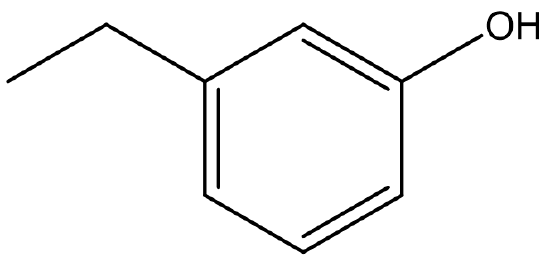
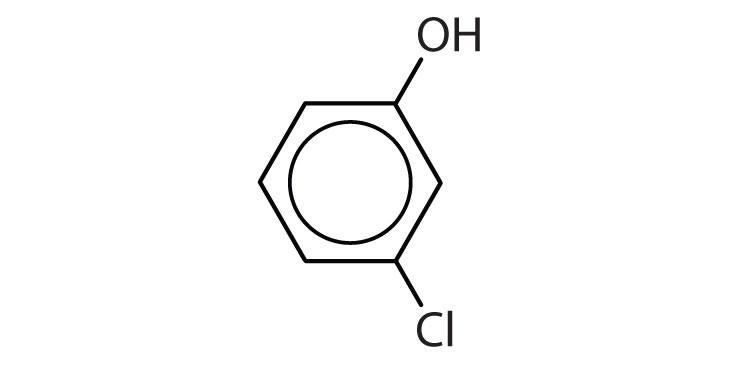
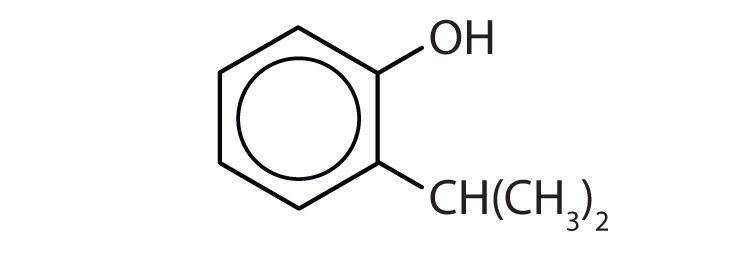
In the International Union of Pure and Applied Chemistry (IUPAC) system, the rules for naming phenols are similar to naming substituted aromatics. When naming phenols, the parent name is phenol. This accounts for the benzene ring and the hydroxyl attached to it. The carbon atom bearing the OH group is designated C1, but the 1 is not used in the name. The location of substituents is then determined using the shortest path. The location of all substituents (even if only one is present) must be shown. The name is then determine by indicating the location and identity of the substituents followed by the word phenol. According to these rules, the name of the molecule shown in Figure \(\PageIndex{4}\) would be 3-ethylphenol.
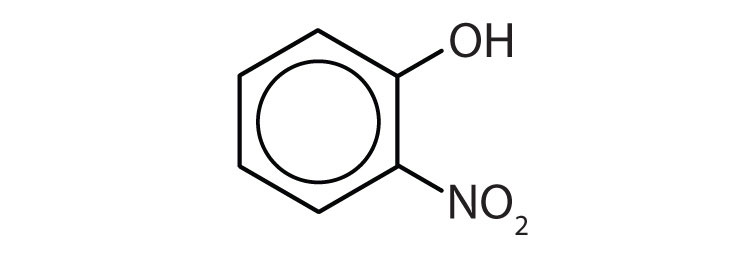
Name each compound.

Solution
- The parent chain is phenol and C1 would represent the carbon with the OH attached. There is one substituent present on the adjacent carbon, so the parent chain would be numbered clockwise to represent the shortest path. The substituent, which is identified as a nitro group, is on C2. Therefore, the name of the molecule is 2-nitrophenol (or o-nitrophenol).
- The parent chain is phenol and C1 would represent the carbon with the OH attached. There is one substituent present on the carbon oppositie C1. In this position, the same number is obtained regardless of the chosen path. Therefore, the bromo substituent, is on C4. This indicates that the name of the molecule is 4-bromophenol (or p-bromophenol)
Name the following compounds.
Summary
- Phenols are compounds in which an OH group is attached directly to an aromatic ring. Many phenols are used as antiseptics.
- IUPAC nomenclature of phenols: location and identity of substituents + phenol
This page titled 3.3: Phenols was last modified on Wed, 19 Mar 2025 05:25:03 GMT and is shared under a CC BY-NC-SA 4.0 license and was authored, remixed, and/or curated by Tanesha Osborne.
The book could not be loaded just now.