Opening the book…
Objectives
After completing this section, you should be able to identify the four types of reaction which a carboxylic acid can undergo.
You may wish to review Section 17.4 which discusses reduction of carbonyl compounds to form alcohols and Sections 20.2–20.4 which highlights the acidity of carboxylic acids, which is important to salt formation and substitution of the hydroxyl hydrogen. Nucleophilic acyl substitution (Chapter 21) and alpha substitutions (Chapter 22) are discussed later in more detail.
Four Categories of Carboxylic Acid Reactions
The scheme summarizes some of the general reactions that carboxylic acids undergo.
Four general reaction categories are represented here: (1) As carboxylic acid deprotonates quite readily, it is quite easy to form a carboxylate salt or to substitute the hydroxyl hydrogen. (2) The category of nucleophilic acyl substitution represents the substitution of the whole hydroxyl group, which we will see later in more detail leads to several carboxylic acid derivatives (e.g. acid halides, esters, amides, thioesters, acid anhydrides etc.). (3) Like other carbonyl compounds, carboxylic acids can be reduced by reagents like LiAlH4. (4) While the proton on the carbon alpha to the carbonyl group is not as acidic as the hydroxyl hydrogen, it can be removed leading to substitution at the alpha site.
Exercises
Show how the following transformation can be performed. Multiple steps may be required.

- Answer
-

Show how the following transformation can be performed. Multiple steps may be required.
- Answer
-
Contributors and Attributions
Dr. Dietmar Kennepohl FCIC (Professor of Chemistry, Athabasca University)
Prof. Steven Farmer (Sonoma State University)
Introduction
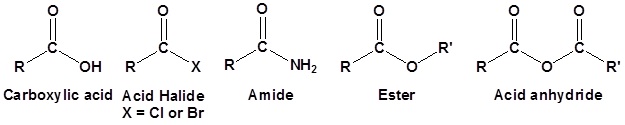
Carboxylic acid derivatives are functional groups whose chemistry is closely related. The main difference is the presence of an electronegative substituent that can act as a leaving group during a nucleophile substitution reaction. Although there are many types of carboxylic acid derivatives known, this article focuses on four: acid halides, acid anhydrides, esters, and amides.
General reaction
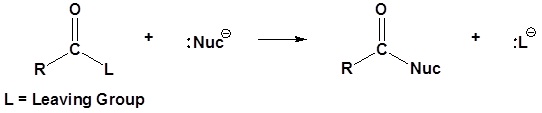
General mechanism
1) Nucleophilic attack on the carbonyl
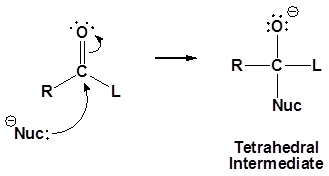
2) Leaving group is removed
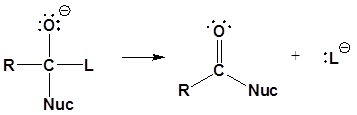
Although aldehydes and ketones also contain carbonyls, their chemistry is distinctly different because they do not contain suitable leaving groups. Once a tetrahedral intermediate is formed, aldehydes and ketones cannot reform their carbonyls. Because of this, aldehydes and ketones typically undergo nucleophilic additions and not substitutions.
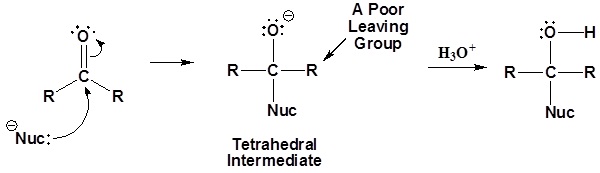
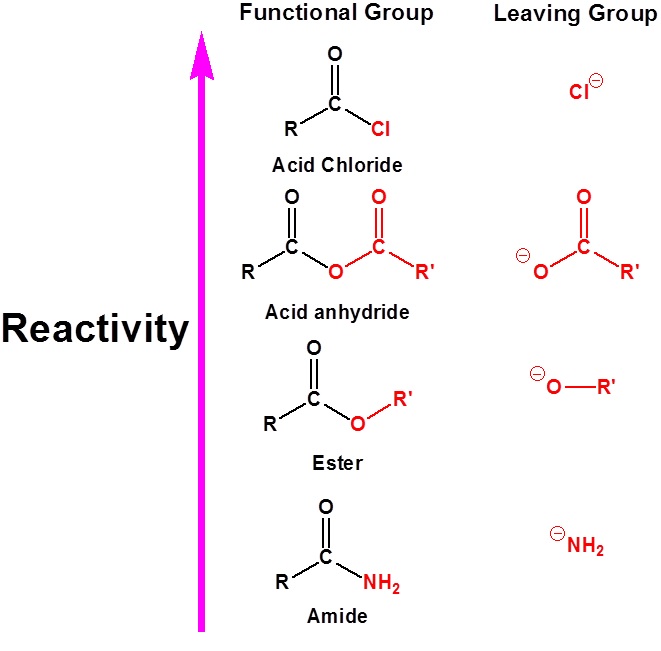
The relative reactivity of carboxylic acid derivatives toward nucleophile substitutions is related to the electronegative leaving group’s ability to activate the carbonyl. The more electronegative leaving groups withdraw electron density from the carbonyl, thereby increasing its electrophilicity.
Contributors
Prof. Steven Farmer (Sonoma State University)
19.7: Substitution at the Carboxy Carbon: The Addition-Elimination Mechanism is shared under a CC BY-NC-SA 4.0 license and was authored, remixed, and/or curated by LibreTexts.
The book could not be loaded just now.