Opening the book…
Introduction to Excretion
|
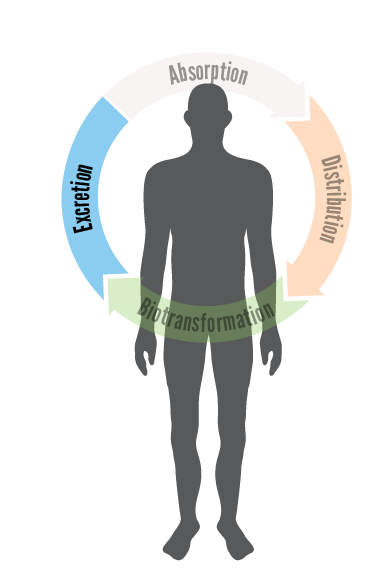
Elimination from the body is very important in determining the potential toxicity of a xenobiotic. When the body rapidly eliminates a toxic xenobiotic (or its metabolites), it is less likely that they will be able to concentrate in and damage critical cells. The terms excretion and elimination are frequently used to describe the same process in which a substance leaves the body. Elimination is sometimes used in a broader sense and includes the removal of the absorbed xenobiotic through metabolic pathways as well as through excretion. Excretion, as used here, pertains to the elimination of the xenobiotic and its metabolites by specific excretory organs. |
Figure \(\PageIndex{1}\). Processes of toxicokinetics |
Primary Routes of Excretion
The body uses several routes to eliminate toxicants or their metabolites. The main routes of excretion are via urine, feces, and exhaled air. Thus, the primary organ systems involved in excretion are the:
- Urinary system
- Gastrointestinal system
- Respiratory system
A few other avenues for elimination exist but they are relatively unimportant, except in exceptional circumstances.
1) The three major routes of excretion are:
a) Gastrointestinal tract, sweat, and saliva
b) Mother's milk, tears, and semen
c) Urinary excretion, fecal excretion, and exhaled air
- Answer
-
Urinary excretion, fecal excretion, and exhaled air - This is the correct answer.
The main routes of excretion are via urine, feces, and exhaled air.
This page titled 13.1: Introduction to Secretion was last modified on Fri, 11 Sep 2026 22:06:16 GMT and is shared under a CC BY-NC 4.0 license and was authored, remixed, and/or curated by ToxMSDT Online component via source content that was edited to the style and standards of the LibreTexts platform.
The book could not be loaded just now.