Opening the book…
Thus far two general reactions have been observed with carbonyls
Nucleophilic Addition to Aldehydes and Ketones
The result of carbonyl bond polarization, however it is depicted, is straightforward to predict. The carbon, because it is electron-poor, is an electrophile: it is a great target for attack by an electron-rich nucleophilic group. Because the oxygen end of the carbonyl double bond bears a partial negative charge, anything that can help to stabilize this charge by accepting some of the electron density will increase the bond’s polarity and make the carbon more electrophilic. Very often a general acid group serves this purpose, donating a proton to the carbonyl oxygen.
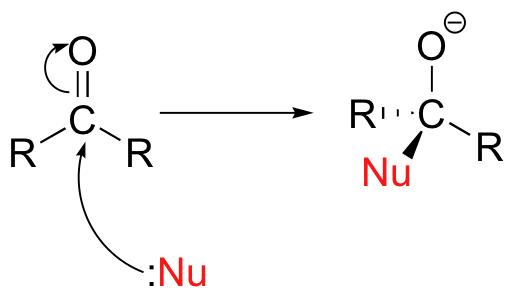
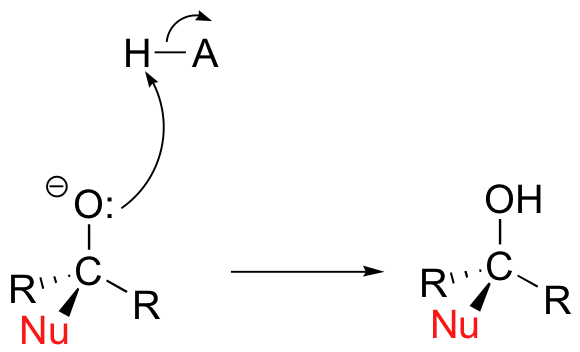
After the carbonyl is attacked by the nucleophile, the negatively charged oxygen has the capacity to act as a nucleophile. However, most commonly the oxygen acts instead as a base, abstracting a proton from a nearby acid group in the solvent or enzyme active site.
Nucleophilic Substitution of RCOZ (Z = Leaving Group)
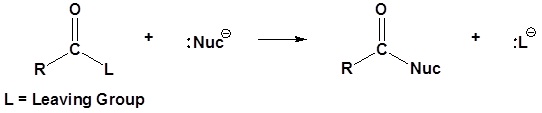
A new carbonyl reaction
Reactions at The Alpha Carbon
Now we will investigate reactions which occur a the carbon alpha to the carbonyl groups. These reactions involve two new neucleophilic species the enol and the enolate.
Note! The electrophile replaces the hydrogen on the alpha carbon.
Organic Chemistry With a Biological Emphasis by Tim Soderberg (University of Minnesota, Morris)
Prof. Steven Farmer (Sonoma State University)
21.2: Introduction is shared under a CC BY-NC-SA 4.0 license and was authored, remixed, and/or curated by LibreTexts.
The book could not be loaded just now.