Opening the book…
Objectives
After completing this section, you should be able to
- write an equation to illustrate the three‑step Stork enamine reaction.
- write a detailed mechanism for each of the three steps of the Stork enamine reaction.
- identify the product formed, and the various intermediates (i.e., the enamine, the Michael‑type adduct), in a given Stork enamine reaction.
- identify the reagents needed to synthesize a given compound by a Stork enamine reaction.
- Stork enamine reaction
If we try to use a monoketone as a donor molecule in a Michael reaction, we will obtain a poor yield. An alternative route to the product that would be expected from such a synthesis is via the Stork enamine reaction. You may wish to review the formation of enamines (from ketones and secondary amines) before you proceed with this section; if so, review Section 19.8.
Overview
As previously seen, aldehydes and ketones react with 2o amines to reversibly form enamines.
Example
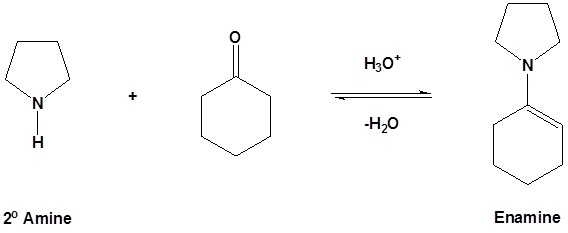
Reversible
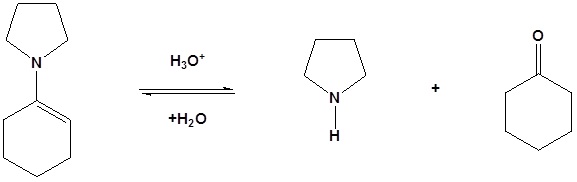
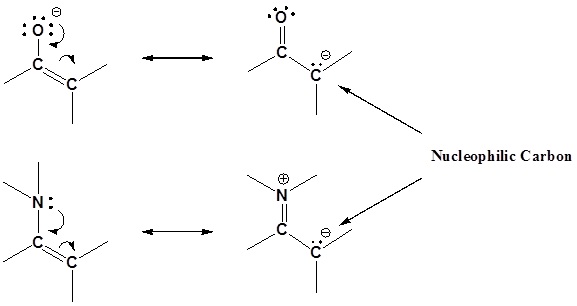
Enamines act as nucleophiles in a fashion similar to enolates. Because of this enamines can be used as synthetic equivalents as enolates in many reactions. This process requires a three steps: 1) Formation of the enamine, 2) Reaction with an eletrophile to form an iminium salt, 3) Hydrolysis of the iminium salt to reform the aldehyde or ketone. Some of the advantages of using an enamine over and enolate are enamines are neutral, easier to prepare, and usually prevent the overreaction problems plagued by enolates. These reactions are generally known as the Stork enamine reaction after Gilbert Stork of Columbia University who originated the work.
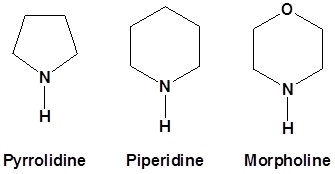
Typically we use the following 2o amines for enamine reactions
Alkylation of an Enamine
Enamined undergo an SN2 reaction with reactive alkyl halides to give the iminium salt. The iminium salt can be hydrolyzed back into the carbonyl.
Individual steps
1) Formation of an enamine
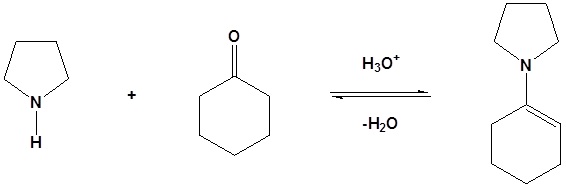
2) SN2 Alkylation
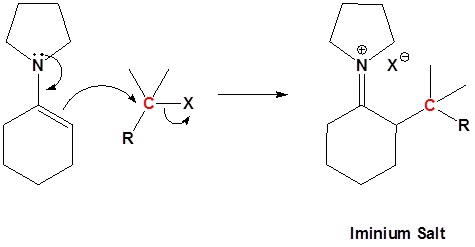
3) Reform the carbonyl by hydrolysis
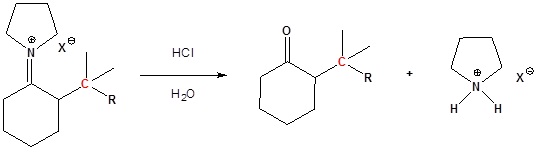
All three steps together:
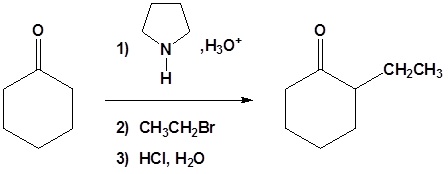
Acylation of Enamines
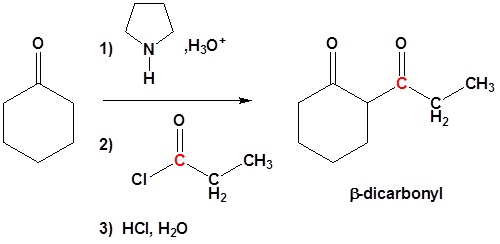
Enamine can react with acid halides to form β-dicarbonyls
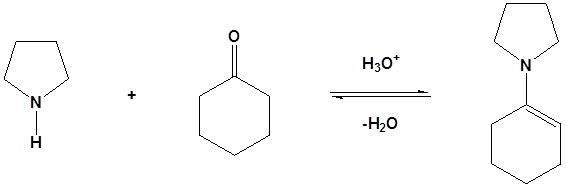
1) Formation of the enamine
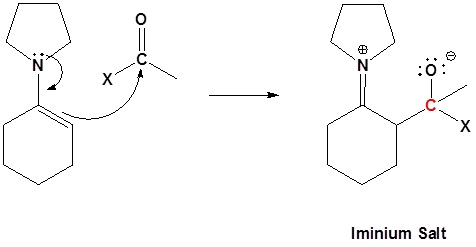
2) Nucleophilic attack
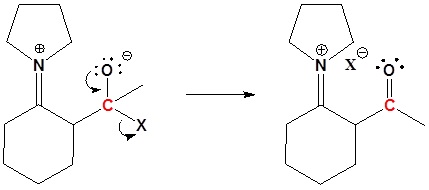
3) Leaving group removal
4) Reform the carbonyl by hydrolysis
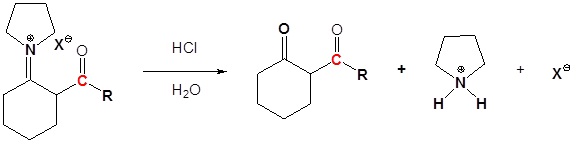
All three steps together:
Michael Addition using Enamines
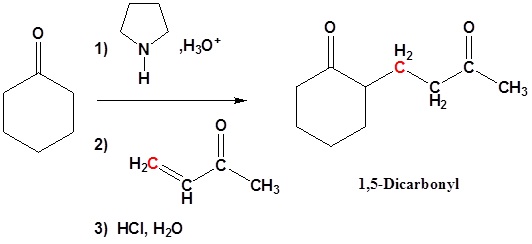
Enamines, like other weak bases, add 1,4 to enones. The end product is a 1,5 dicarbonyl compound.
Exercises
Draw the product of the reaction with the enamine prepared from cyclopentanone and pyrrolidine, and the following molecules.
a)
b)
c)
- Answer
-
a)
b)
c)
What would be the starting materials necessary to make the following molecules during a Stork enamine reaction?
a)
b)
- Answer
-
a)

b)
Contributors and Attributions
Dr. Dietmar Kennepohl FCIC (Professor of Chemistry, Athabasca University)
Prof. Steven Farmer (Sonoma State University)
23.11 Carbonyl Condensations with Enamines - The Stork Reaction is shared under a CC BY-NC-SA 4.0 license and was authored, remixed, and/or curated by LibreTexts.
The book could not be loaded just now.