Opening the book…
Objectives
After completing this section, you should be able to
- give a general description of the nucleophilic addition reactions of aldehydes and ketones, identifying the two possible courses (or variations) that such reactions can take after the initial attack by the nucleophile.
- explain why, in general, aldehydes undergo nucleophilic addition reactions more readily than do ketones, and determine which of two given aldehydes or ketones will react most readily in such reactions.
Make certain that you can define, and use in context, the key term below.
- nucleophilic addition reaction
We have already discussed electrophilic addition reactions at some length; now you will meet nucleophilic addition reactions for the first time. Nucleophilic addition reactions involve the initial attack of a nucleophile on the slightly positive carbon centre of the carbonyl group.
Before we consider in detail the reactivity of aldehydes and ketones, we need to look back and remind ourselves of what the bonding picture looks like in a carbonyl. Carbonyl carbons are sp2 hybridized, with the three sp2 orbitals forming soverlaps with orbitals on the oxygen and on the two carbon or hydrogen atoms. These three bonds adopt trigonal planar geometry. The remaining unhybridized 2p orbital on the central carbonyl carbon is perpendicular to this plane, and forms a ‘side-by-side’ pbond with a 2p orbital on the oxygen.
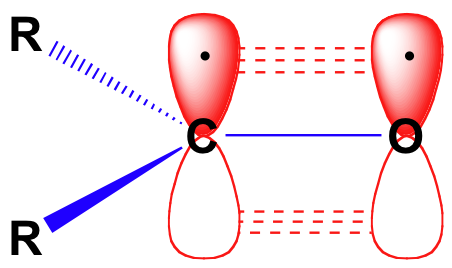
The carbon-oxygen double bond is polar: oxygen is more electronegative than carbon, so electron density is higher on the oxygen side of the bond and lower on the carbon side. Recall that bond polarity can be depicted with a dipole arrow, or by showing the oxygen as holding a partial negative charge and the carbonyl carbon a partial positive charge.

A third way to illustrate the carbon-oxygen dipole is to consider the two main resonance contributors of a carbonyl group: the major form, which is what you typically see drawn in Lewis structures, and a minor but very important contributor in which both electrons in the pbond are localized on the oxygen, giving it a full negative charge. The latter depiction shows the carbon with an empty 2p orbital and a full positive charge.
The result of carbonyl bond polarization, however it is depicted, is straightforward to predict. The carbon, because it is electron-poor, is an electrophile: it is a great target for attack by an electron-rich nucleophilic group. Because the oxygen end of the carbonyl double bond bears a partial negative charge, anything that can help to stabilize this charge by accepting some of the electron density will increase the bond’s polarity and make the carbon more electrophilic. Very often a general acid group serves this purpose, donating a proton to the carbonyl oxygen.
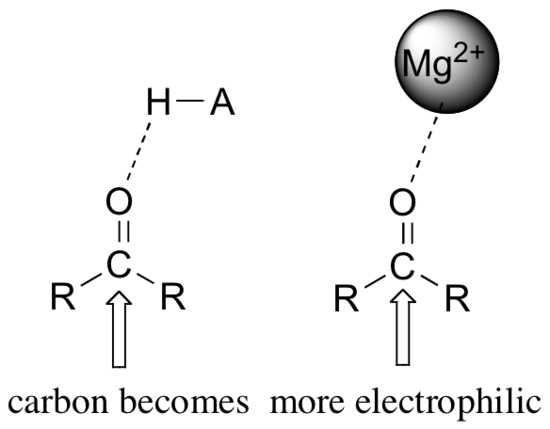
The same effect can also be achieved if a Lewis acid, such as a magnesium ion, is located near the carbonyl oxygen.
Unlike the situation in a nucleophilic substitution reaction, when a nucleophile attacks an aldehyde or ketone carbon there is no leaving group – the incoming nucleophile simply ‘pushes’ the electrons in the pi bond up to the oxygen.
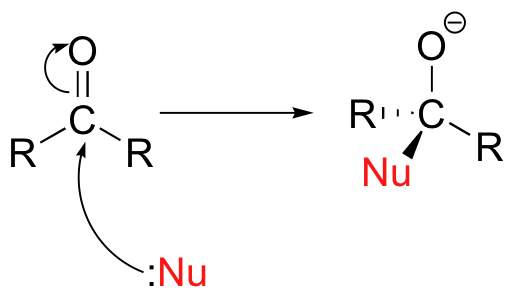
Alternatively, if you start with the minor resonance contributor, you can picture this as an attack by a nucleophile on a carbocation.
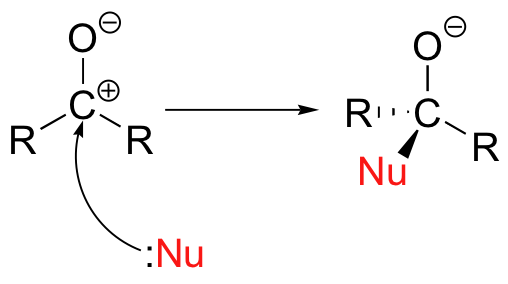
After the carbonyl is attacked by the nucleophile, the negatively charged oxygen has the capacity to act as a nucleophile. However, most commonly the oxygen acts instead as a base, abstracting a proton from a nearby acid group in the solvent or enzyme active site.
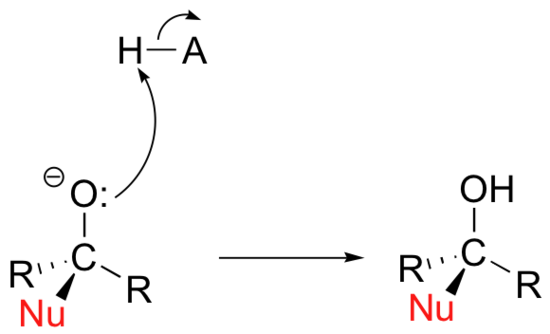
This very common type of reaction is called a nucleophilic addition.
Nucleophilic Addition of a Neutral Nucleophile
This second variatation of the general nucleophilic addition the carbonyl oxygen is completely removed as water to from a C=Nu bond.
Relative Reactivity of Carbonyl Compounds to Nucleophilic Addition
In general aldehydes are more reactive than ketones because of the lack of stabilizing alkly groups. The primary carbocation formed in the in the polarizing resonance structure of an aldehyde (discussed above) is less stable and therefore more reactive than the secondary carbocation formed by a ketone.
Contributors and Attributions
Dr. Dietmar Kennepohl FCIC (Professor of Chemistry, Athabasca University)
Prof. Steven Farmer (Sonoma State University)
19.4 Nucleophilic Addition Reactions of Aldehydes and Ketones is shared under a CC BY-NC-SA 4.0 license and was authored, remixed, and/or curated by LibreTexts.
The book could not be loaded just now.