Opening the book…
Crystallization works well as a purification technique if impurities are present in very small quantities (less than \(5 \: \text{mol}\%\) of the solid), or if the impurities have a very different solubility profile from the desired compound. Impurities can be easily removed if they are either much more soluble or much less soluble in the solvent than the compound of interest.
Figure 3.9 shows the procedural sequence used to remove a "soluble impurity" from an impure soled, meaning an impurity that is embedded in the crystalline matrix, but would be completely soluble in the crystallization solvent. The impure solid is first fully dissolved in the minimum amount of hot solvent to liberate impurities trapped in the solid's interior. Upon cooling, a completely soluble impurity will remain dissolved in the mother liquor while the desired compound crystallizes. The crystallized solid can then be collected by suction filtration.

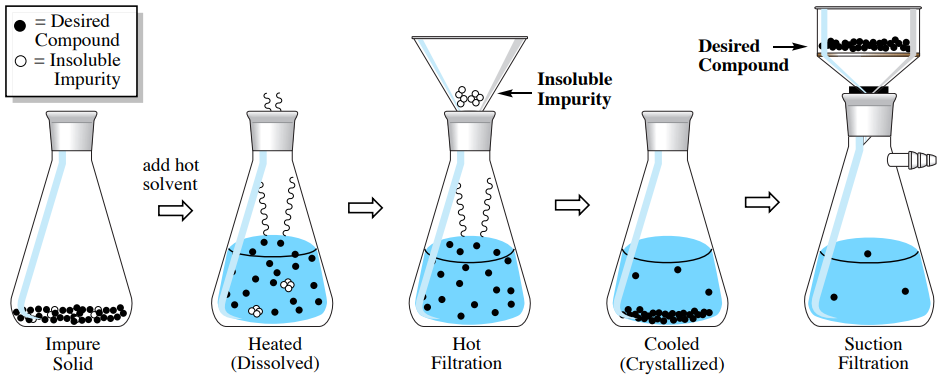
Figure 3.10 shows the procedural sequence used to remove an "insoluble impurity" from an impure solid, meaning an impurity that is embedded in the crystalline matrix, but would be insoluble in the crystallization solvent. The impure solid is heated in the minimum amount of hot solvent needed to dissolve the desired compound. The insoluble material is then filtered while the solution is kept hot (called "hot filtration"), and then the desired compound is crystallized and collected by suction filtration.
This page titled 3.3B: General Procedures for Removing Impurities was last modified on Tue, 11 Aug 2020 09:35:47 GMT and is shared under a CC BY-NC-ND license and was authored, remixed, and/or curated by Lisa Nichols via source content that was edited to the style and standards of the LibreTexts platform.
The book could not be loaded just now.