Opening the book…
- If the solvent fails to boil on the rotary evaporator even after one minute, consider whether a mistake may have been made. For example, it may be that you are trying to evaporate the aqueous layer from a separatory funnel step instead of the organic layer. Alternatively, the water bath may need to be heated to a higher temperature depending on the boiling point of the solvent.
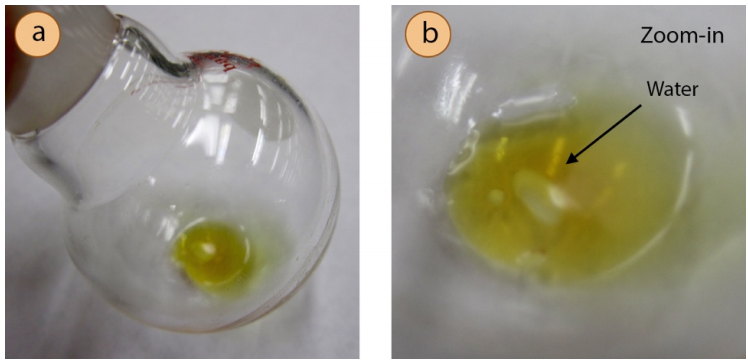
- If droplets are seen among the liquid residue in the flask after evaporation (Figure 5.73), most likely water was not effectively removed from the sample prior to evaporation. To remedy this problem, dissolve the sample is a portion of the previously used solvent, use a drying agent (e.g. anhydrous \(\ce{MgSO_4}\)), filter if necessary, and again evaporate the solvent.
This page titled 5.6C: Troubleshooting Rotary Evaporation was last modified on Tue, 11 Aug 2020 09:36:28 GMT and is shared under a CC BY-NC-ND license and was authored, remixed, and/or curated by Lisa Nichols via source content that was edited to the style and standards of the LibreTexts platform.
The book could not be loaded just now.