Opening the book…
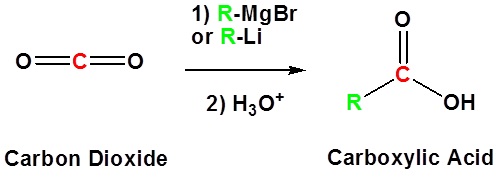
Because organometallic reagents react as their corresponding carbanion, they are excellent nucleophiles. The basic reaction involves the nucleophilic attack of the carbanionic carbon in the organometallic reagent with the electrophilic carbon in the carbonyl to form alcohols.
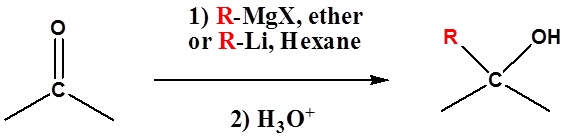
Both Grignard and Organolithium Reagents will perform these reactions
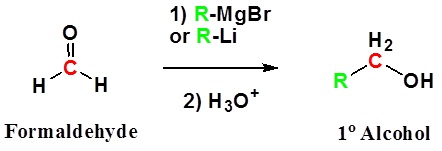
Addition to formaldehyde gives 1o alcohols
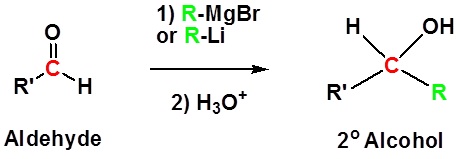
Addition to aldehydes gives 2o alcohols
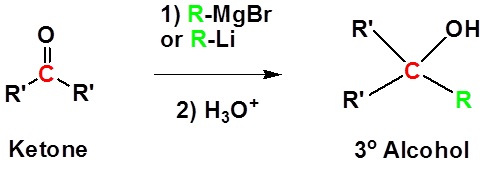
Addition to ketones gives 3o alcohols
Addition to carbon dioxide (CO2) forms a carboxylic acid
| Examples |
|---|
|
|
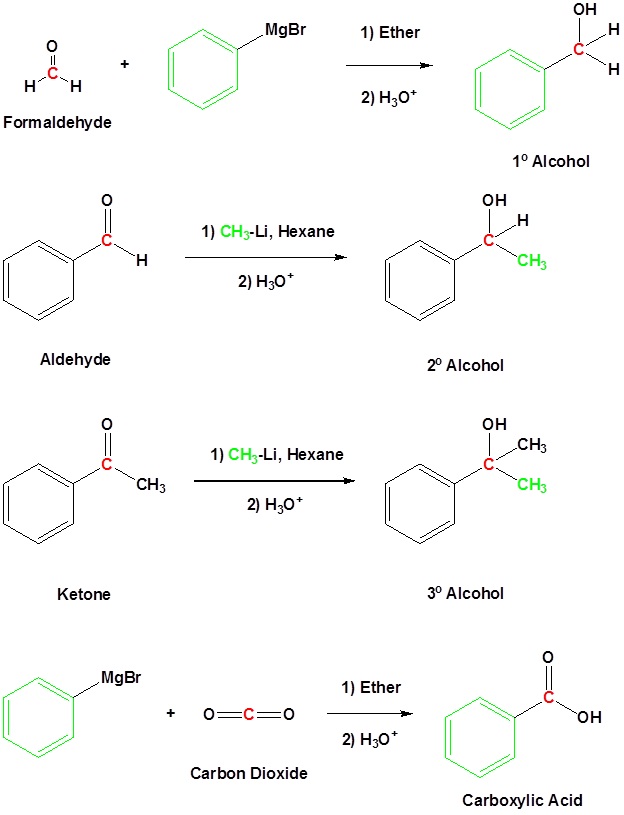
Going from Reactants to Products Simplified

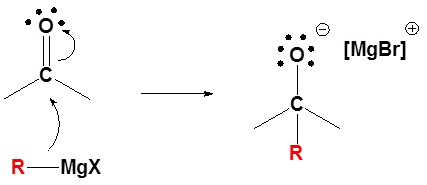
Mechanism for the Addition to Carbonyls
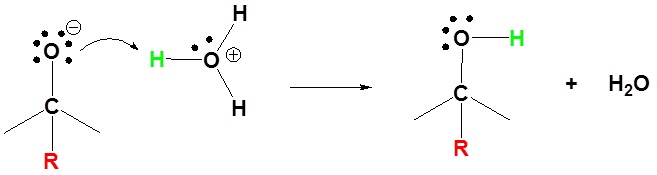
The mechanism for a Grignard agent is shown. The mechanism for an organometallic reagent is the same.
1) Nucleophilic attack
2) Protonation
Nucleophilic Addition of Acetylides to Carbonyls
Acetylide anions will add to aldehydes and ketones to form alkoxides, which, upon protonation, give propargyl alcohols.

With aldehydes and non-symmetric ketones, in the absence of chiral catalyst, the product will be a racemic mixture of the two enantiomers.
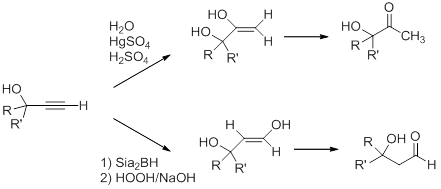
The triple bond in the propargyl alcohol can be modified by using the reactivity of the alkyne. For example, Markovnikov and anti-Markovnikov hydration of the triple bond leads to formation of the hydroxy-substituted ketone and aldehyde, respectively, after enol-keto tautomerization.
Contributors
- Layne A. Morsch - University of Illinois Springfield
This page titled 20.10 Reaction of Organometallic Reagents with Aldehydes and Ketones was last modified on Wed, 05 Jun 2019 18:45:44 GMT and is shared under a CC BY-NC-SA 4.0 license and was authored, remixed, and/or curated by Layne Morsch.
The book could not be loaded just now.