Opening the book…
Acidity of Alpha Hydrogens
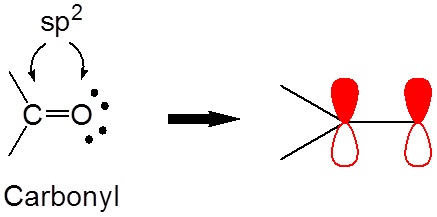
Functional groups, such as aldehydes, ketones and esters, contain a carbonyl group which is made up of a sp2 hybridized carbon and oxygen. Because they are sp2 hybridized the carbon and oxygen both have unhybridized p orbitals which can overlap to form the C=O \(\pi\) bond.
Keto-enol Tautomerism
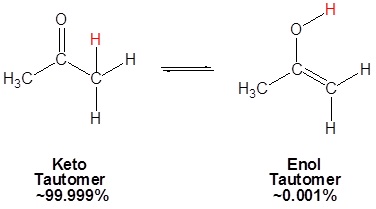
Because of the acidity of α hydrogens carbonyls undergo keto-enol tautomerism. Tautomers are rapidly interconverted constitutional isomers, usually distinguished by a different bonding location for a labile hydrogen atom and a differently located double bond. The equilibrium between tautomers is not only rapid under normal conditions, but it often strongly favors one of the isomers (acetone, for example, is 99.999% keto tautomer). Even in such one-sided equilibria, evidence for the presence of the minor tautomer comes from the chemical behavior of the compound. Tautomeric equilibria are catalyzed by traces of acids or bases that are generally present in most chemical samples.
Mechanism for Enol Formation
Under Acid conditions
1) Protonation of the Carbonyl
2) Enol formation
Under Basic conditions
1) Enolate formation
2) Protonation
How Enols React
base returns and removes the proton
Contributors
- William Reusch, Professor Emeritus (Michigan State U.), Virtual Textbook of Organic Chemistry
- Prof. Steven Farmer (Sonoma State University)
This page titled 23.2 Enols was last modified on Wed, 05 Jun 2019 18:45:45 GMT and is shared under a CC BY-NC-SA 4.0 license and was authored, remixed, and/or curated by Layne Morsch.
The book could not be loaded just now.