Opening the book…
Basic reaction of 1,4 addition

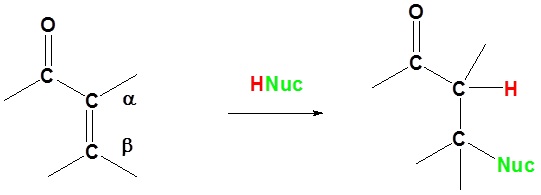
In 1,4 addition the Nucleophile is added to the carbon β to the carbonyl while the hydrogen is added to the carbon α to the carbonyl.
Mechanism for 1,4 addition
1) Nucleophilic attack on the carbon β to the carbonyl
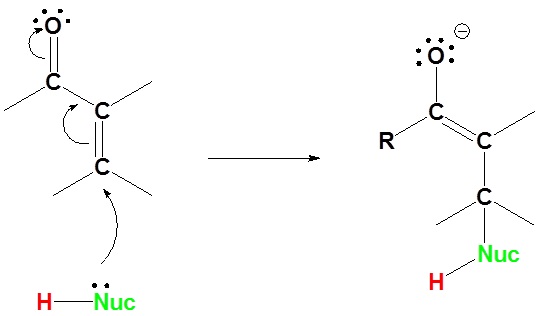
2) Proton Transfer
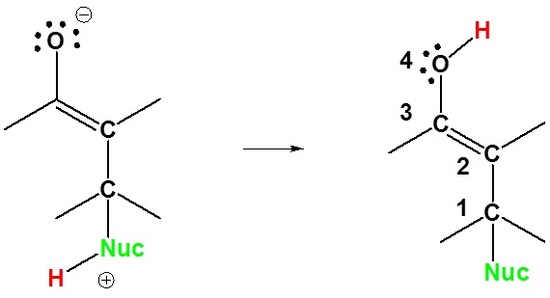
Here we can see why this addition is called 1,4. The nucleophile bonds to the carbon in the one position and the hydrogen adds to the oxygen in the four position.
3) Tautomerization
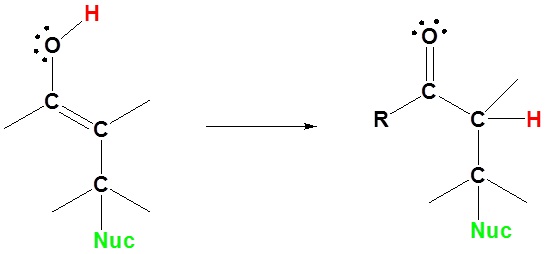
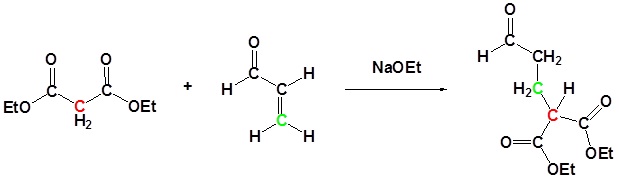
Enolates undergo 1,4 addition to α, β-unsaturated carbonyl compounds is a process called a Michael addition. The reaction is named after American chemist Arthur Michael (1853-1942).
Examples of Michael Additions

Contributors
Prof. Steven Farmer (Sonoma State University)
This page titled 24.8 The Michael Reaction was last modified on Wed, 05 Jun 2019 18:45:46 GMT and is shared under a CC BY-NC-SA 4.0 license and was authored, remixed, and/or curated by Layne Morsch.
The book could not be loaded just now.