Opening the book…
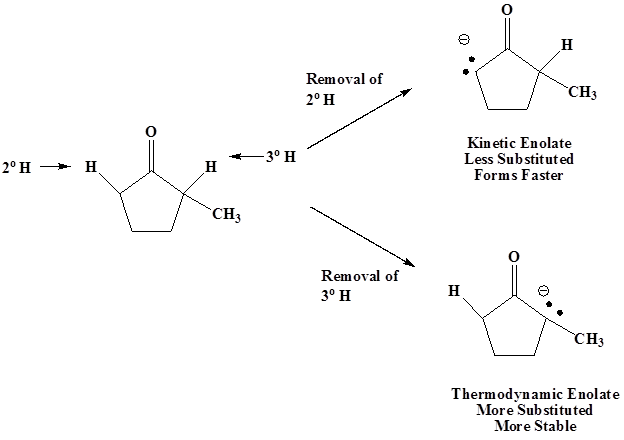
Now let’s consider what happens when an unsymmetrical carbonyl is treated with a base. In the case displayed below there are two possible enolates which can form. The removal of the 2o hydrogen forms the kinetic enolate and is formed faster because it is less substituted and thereby less sterically hindered. The removal of the 3o hydrogen forms the thermodynamic enolate which is more stable because it is more substituted.
Kinetic Enolates
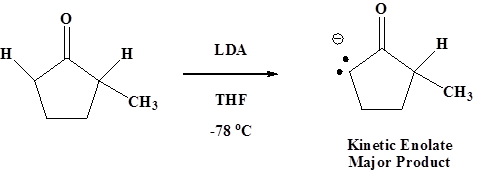
Kinetic enolates are formed when a strong bulky base like LDA is used. The bulky base finds the 2o hydrogen less sterically hindered and preferentially removes it.
Low temperature are typically used when forming the kinetic enolate to prevent equilibration to the more stable thermodynamic enolate. Typically a temperature of -78 oC is used.
Thermodynamic Enolates
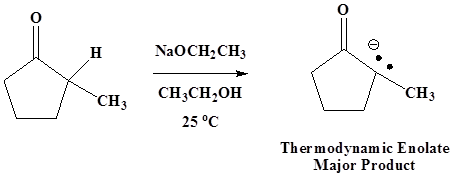
The thermodynamic enolate is favored by conditions which allow for equilibration. The thermodynamic enolate is usually formed by using a strong base at room temperature. At equilibrium the lower energy of the thermodynamic enolate is preferred, so that the more stable, more stubstituted enolate is formed.
Problems
Contributors
Prof. Steven Farmer (Sonoma State University)
- Layne A. Morsch - University of Illinois Springfield
This page titled 23.4 Enolates of Unsymmetrical Carbonyl Compounds was last modified on Wed, 05 Jun 2019 18:45:45 GMT and is shared under a CC BY-NC-SA 4.0 license and was authored, remixed, and/or curated by Layne Morsch.
The book could not be loaded just now.