Opening the book…
Nucleophilic Addition to Aldehydes and Ketones
The result of carbonyl bond polarization, however it is depicted, is straightforward to predict. The carbon, because it is electron-poor, is an electrophile: it is a great target for attack by an electron-rich nucleophilic group. Because the oxygen end of the carbonyl double bond bears a partial negative charge, anything that can help to stabilize this charge by accepting some of the electron density will increase the bond’s polarity and make the carbon more electrophilic. Very often a general acid group serves this purpose, donating a proton to the carbonyl oxygen.
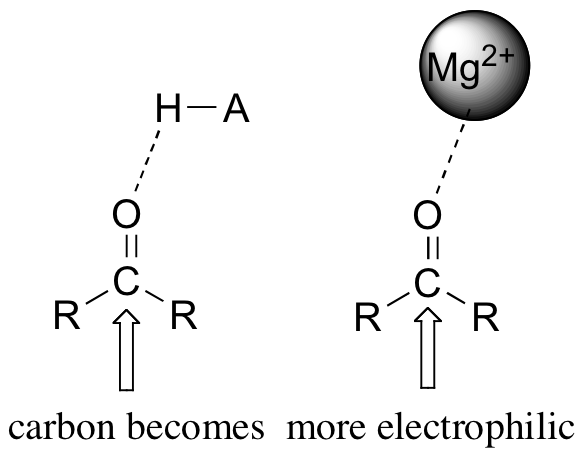
The same effect can also be achieved if a Lewis acid, such as a magnesium ion, is located near the carbonyl oxygen.
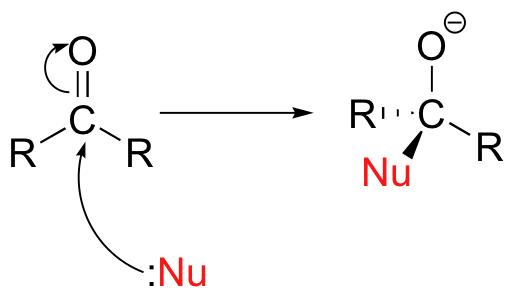
Unlike the situation in a nucleophilic substitution reaction, when a nucleophile attacks an aldehyde or ketone carbon there is no leaving group – the incoming nucleophile simply ‘pushes’ the electrons in the pi bond up to the oxygen.
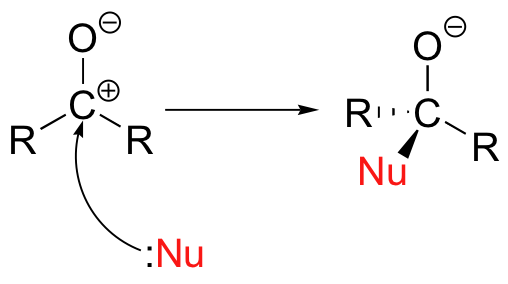
Alternatively, if you start with the minor resonance contributor, you can picture this as an attack by a nucleophile on a carbocation.
After the carbonyl is attacked by the nucleophile, the negatively charged oxygen has the capacity to act as a nucleophile. However, most commonly the oxygen acts instead as a base, abstracting a proton from a nearby acid group in the solvent or enzyme active site.
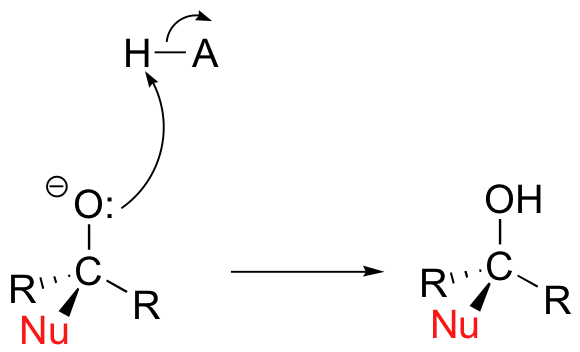
This very common type of reaction is called a nucleophilic addition. In many biologically relevant examples of nucleophilic addition to carbonyls, the nucleophile is an alcohol oxygen or an amine nitrogen, or occasionally a thiol sulfur. In one very important reaction type known as an aldol reaction (which we will learn about in section 13.3) the nucleophile attacking the carbonyl is a resonance-stabilized carbanion. In this chapter, we will concentrate on reactions where the nucleophile is an oxygen or nitrogen.
Nucleophilic Substitution of RCOZ (Z = Leaving Group)
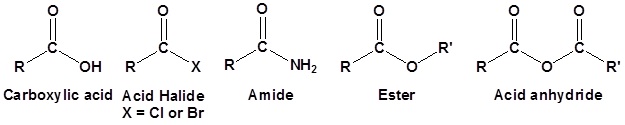
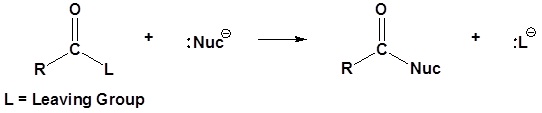
Carbonyl compounds with leaving groups have reactions similar to aldehydes and ketones. The main difference is the presence of an electronegative substituent that can act as a leaving group during a nucleophile substitution reaction. Although there are many types of carboxylic acid derivatives known, this article focuses on four: acid halides, acid anhydrides, esters, and amides.
General reaction
Organic Chemistry With a Biological Emphasis by Tim Soderberg (University of Minnesota, Morris)
Prof. Steven Farmer (Sonoma State University)
This page titled 20.16: Summary—The Reactions of Organometallic Reagents was last modified on Wed, 05 Jun 2019 18:45:43 GMT and is shared under a CC BY-NC-SA 4.0 license and was authored, remixed, and/or curated by Layne Morsch.
The book could not be loaded just now.