Opening the book…
Addition of a hydride anion (H:-) to an aldehyde or ketone gives an alkoxide anion, which on protonation yields the corresponding alcohol. Aldehydes produce 1º-alcohols and ketones produce 2º-alcohols.
In metal hydrides reductions the resulting alkoxide salts are insoluble and need to be hydrolyzed (with care) before the alcohol product can be isolated. In the sodium borohydride reduction the methanol solvent system achieves this hydrolysis automatically. In the lithium aluminum hydride reduction water is usually added in a second step. The lithium, sodium, boron and aluminum end up as soluble inorganic salts at the end of either reaction. Note! LiAlH4 and NaBH4 are both capable of reducing aldehydes and ketones to the corresponding alcohol.
Mechanism

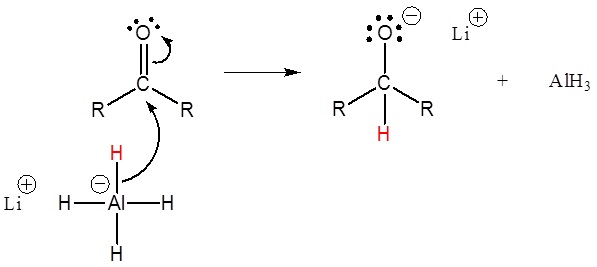
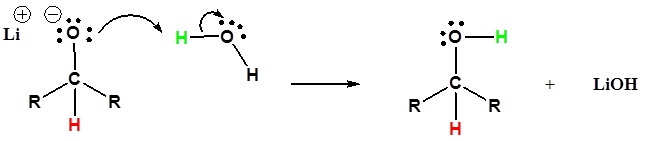
This mechanism is for a LiAlH4 reduction. The mechanism for a NaBH4 reduction is the same except methanol is the proton source used in the second step.
1) Nucleopilic attack by the hydride anion
2) The alkoxide is protonated
Addition of a organometallic reagent to an aldehyde or ketone gives an alkoxide anion, which on protonation yields the corresponding alcohol. Aldehydes produce 2º-alcohols and ketones produce 3º-alcohols.
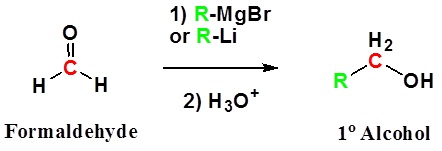
Addition to formaldehyde gives 1o alcohols
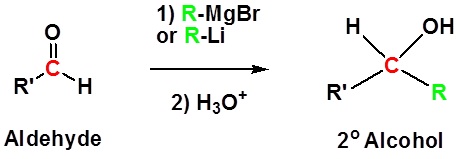
Addition to aldehydes gives 2o alcohols
Addition to ketones gives 3o alcohols
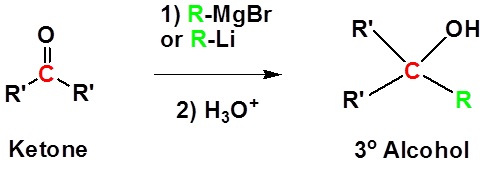
Mechanism
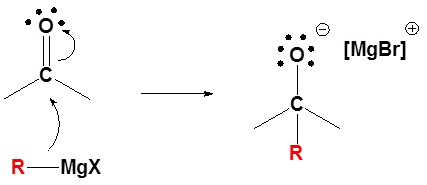
1) Nucleophilic attack
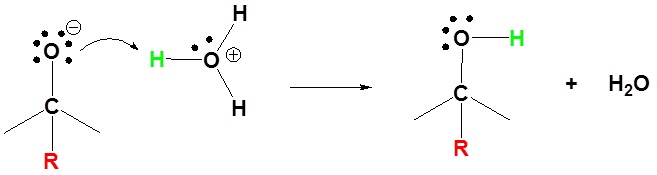
2) Protonation
Contributors
Prof. Steven Farmer (Sonoma State University)
This page titled 21.8: Nucleophilic Addition of H– and R–—A Review was last modified on Wed, 05 Jun 2019 18:45:43 GMT and is shared under a CC BY-NC-SA 4.0 license and was authored, remixed, and/or curated by Layne Morsch.
The book could not be loaded just now.