Opening the book…
Carbohydrates are the most abundant class of organic compounds found in living organisms. They originate as products of photosynthesis, an endothermic reductive condensation of carbon dioxide requiring light energy and the pigment chlorophyll.
\[ nCO_2 + n H_2O + \text{Energy} \rightarrow C_nH_{2n}O_n + nO_2\]
As noted here, the formulas of many carbohydrates can be written as carbon hydrates, \(C_n(H_2O)_n\), hence their name. The carbohydrates are a major source of metabolic energy, both for plants and for animals that depend on plants for food. Aside from the sugars and starches that meet this vital nutritional role, carbohydrates also serve as a structural material (cellulose), a component of the energy transport compound ATP/ADP, recognition sites on cell surfaces, and one of three essential components of DNA and RNA.
The most useful carbohydrate classification scheme divides the carbohydrates into groups according to the number of individual simple sugar units. Monosaccharides contain a single unit; disaccharides contain two sugar units; and polysaccharides contain many sugar units as in polymers - most contain glucose as the monosaccharide unit.
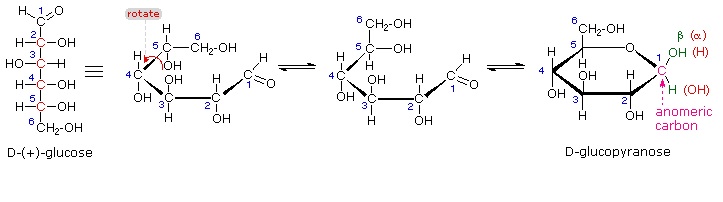
Some sugars can undergo a intermolecular cyclization to form a hemi-acetal. The hemiacetal carbon atom (C-1) becomes a new stereogenic center, commonly referred to as the anomeric carbon, and the α and β-isomers are called anomers.
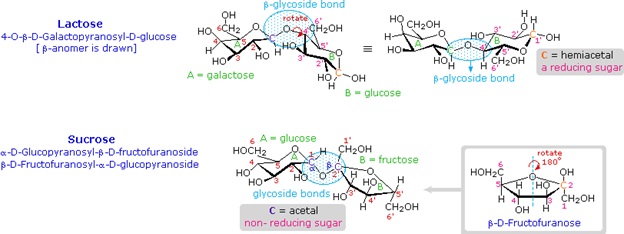
Disaccharides made up of other sugars are known, but glucose is often one of the components. Two important examples of such mixed disaccharides are displayed above. Lactose, also known as milk sugar, is a galactose-glucose compound joined as a beta-glycoside. It is a reducing sugar because of the hemiacetal function remaining in the glucose moiety. Many adults, particularly those from regions where milk is not a dietary staple, have a metabolic intolerance for lactose. Infants have a digestive enzyme which cleaves the beta-glycoside bond in lactose, but production of this enzyme stops with weaning. Sucrose, or cane sugar, is our most commonly used sweetening agent. It is a non-reducing disaccharide composed of glucose and fructose joined at the anomeric carbon of each by glycoside bonds (one alpha and one beta). In the formula shown here the fructose ring has been rotated 180º from its conventional perspective.
Contributors
William Reusch, Professor Emeritus (Michigan State U.), Virtual Textbook of Organic Chemistry
This page titled 21.17: An Introduction to Carbohydrates was last modified on Wed, 05 Jun 2019 18:45:43 GMT and is shared under a CC BY-NC-SA 4.0 license and was authored, remixed, and/or curated by Layne Morsch.
The book could not be loaded just now.