Opening the book…
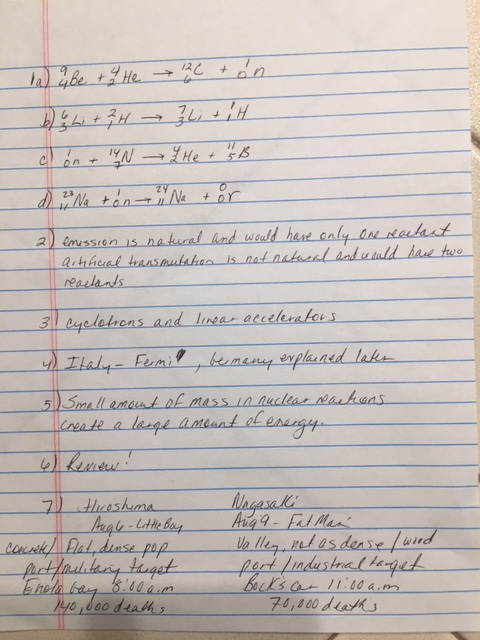
1) Translate the following artificial transmutation reactions into nuclear symbols and balance:
- Be-9 is hit with an alpha particle to produce C-12 and ?
- Li-6 is bombarded with deuterium to form ? and Li-7
- A neutron hits N-14 to produce an alpha particle and ?
- Na-23 combines a neutron to form Na-24 and ?
2) What is the difference between emission/decay and transmutation?
3) Which of the following instruments can artificially transmute elements: cyclotron, electromagnetic separation, gaseous diffusion, and/or linear accelerator?
4) Which country split the atom first?
5) What is the significance of E = mc2?
6) Review the Manhattan questions from the Modern Marvel movie.
7) Compare/contrast the bombings of Hiroshima and Nagasaki.
8) Did the same plane drop both of the bombs over Japan? Did the crew of the airplane(s) perish during the bombing?
9) Review basic bomb drawings illustrated on 6.4.3
10) Review questions from video in section 6.6.1 (Exploring 24 hours after Hiroshima).
11) Who was the father of the atomic bomb? Who was the father of the H-bomb?
12) What are the basic materials that are used in a fusion weapon? Who dropped the largest H-bomb? Was this bomb a gadget/device?
13) What is the destruction tonnage range of a fission bomb versus a thermonuclear bomb?
14) What is the difference between a tactical and strategic nuclear weapon? Was the Trinity bomb a strategic or tactical weapon?
15) What is an ICBM? Do all ICBM's contain a nuclear component?
16) Name the countries that have fusion technology.
17) At this time, which country has the most nuclear warheads? Does Japan and Germany possess any nuclear weapons?
18) What types of nuclear secrets were passed by the Rosenbergs and Fuchs?
19) What is START and who does this treaty involve?
20) How does a blend down of HEU reduce the chances of a rogue nation producting IND?
21) Which type of weapon produces more fallout: fission bomb or a H-bomb?
22) Name the three fallout isotopes and how they impact the human body.
23) Review the questions regarding the fallout video in section 6.8.
24) Know one antidote to radiation poisoning (see highlighted region in 6.8)
25) What is the difference between the Nuclear Test Ban Treaty (1963) and Comprehensive Test Ban Treaty (1996).
26) Name some of the countries that have not ratified the CTBT. Why do you think they have not done this?
27) Does Duck and Cover help to protect you in any way from nuclear annihilation?
28) What does Godzilla represent in Japanese culture?


This page titled 6.E: Nuclear Weapons- Fission and Fusion (Exercises) was last modified on Mon, 13 Jan 2020 23:37:40 GMT and is shared under a CC BY-NC-SA 4.0 license and was authored, remixed, and/or curated by Elizabeth Gordon.
The book could not be loaded just now.