Opening the book…
Metal alkoxides can undergo 1,2-elimination (or beta-elimination) to give organic carbonyl compounds. This reaction is the reverse of a nucleophilic addition of a metal hydride to an organic carbonyl.
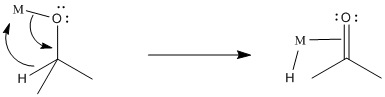
Metal alkyls can also undergo 1,2-elimination. In this case, an alkene is formed. Like the carbonyl compounds formed from 1,2-elimination, the alkene usually remains bound to the metal. It can dissociate to form the free alkene, though. For more information on alkene binding, take a look at this page.
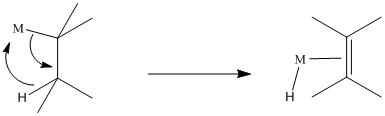
These reactions are sometimes called "beta hydride eliminations", emphasizing that the hydrogen attached to the metal usually acts as a nucleophile. Thus, when the hydrogen transfers to the metal, it is forming a hydride.
- Alkyl groups that are coordinated to metals can also undergo elimination.
- In order to undergo elimination, an alkyl group must have a hydrogen.
- When a metal alkyl undergoes elimination, it forms an alkene.
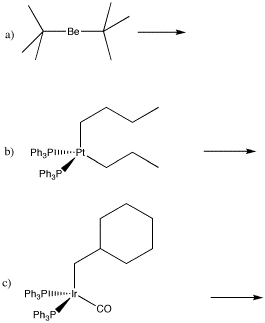
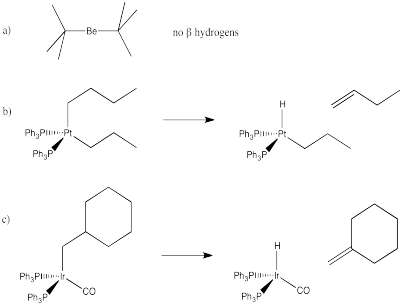
Draw the elimination products in the following cases.
- Answer
-
The reverse of a 1,2-elimination is a 1,2-insertion. Just like aldehydes and ketones, alkenes can undergo 1,2-insertions (also called beta hydride insertions). In terms of electrophiles and nucleophiles, this reaction is a little harder to imagine. However, we can still think of the hydride as a nucleophile. Maybe the alkene is an electrophile. Given that it is donating its pi electrons to the metal, we can think of it as "activated", a little bit like an activated carbonyl.
The formalisms of drawing a beta alkene insertion are tricky. If we use the metallacycle drawing of a bound alkene, it might look like this:
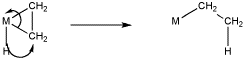
More often, bound alkenes are drawn as shown as in the picture below. In that case, we could try to show the pi bond forming a new carbon-metal bond. The bond between the metal and alkene on the picture to the left does not really stand for a separate pair of electrons in this case; it just stands for the pi bond donating to the metal.
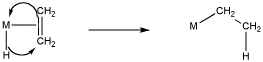
- The reverse of elimination is insertion.
- A coordinated alkene is sometimes considered electrophilic because it is giving electrons to the metal.
- A coordinated alkene is activated, like a coordinated carbonyl compound.
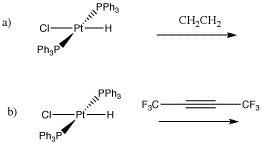
Draw the insertion products in the following cases.
- Answer
-
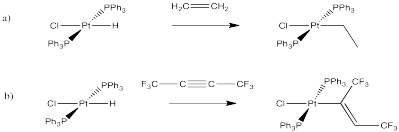
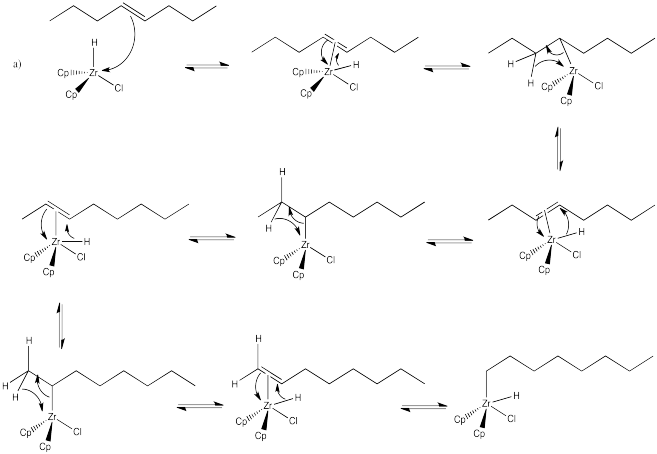
Alkenes can be converted into other compounds through the use of organometallic reagents, such as "Schwartz's reagent" (below). In this case, the resulting alkyl compound can easily be converted into a long-chain alkyl halide or alcohol through the addition of appropriate reagents. Provide a mechanism for the reaction shown below.
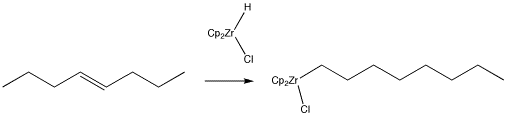
- Answer
-
1,2-alkyl insertions and -eliminations are also known in a few cases, although they are much slower than 1,2-hydride insertions and -eliminations. Show the 1,2-insertion products for the following cases.
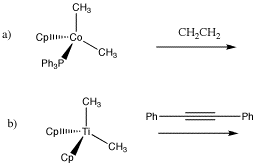
- Answer
-

- Answer
-
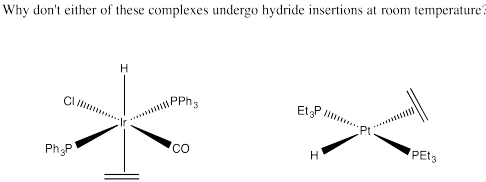
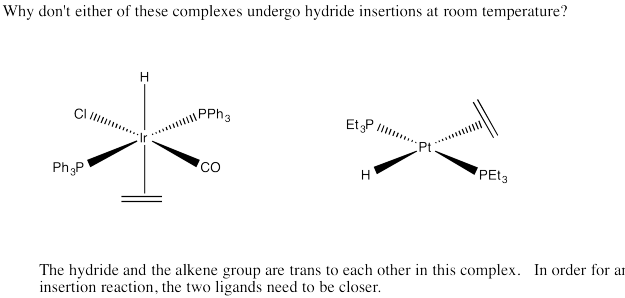
- Answer
-
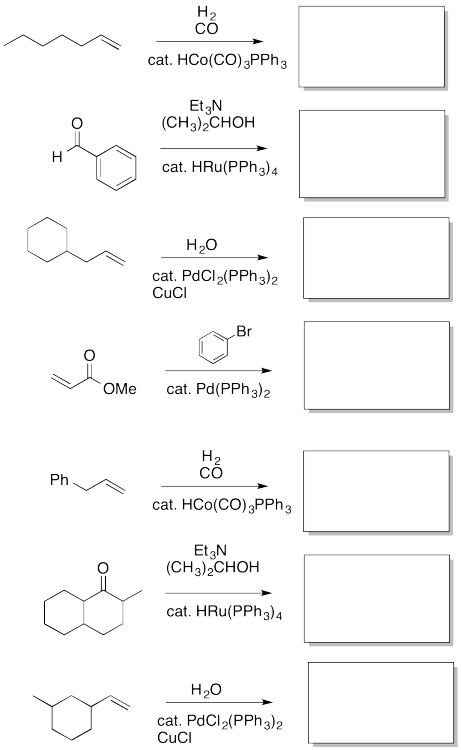
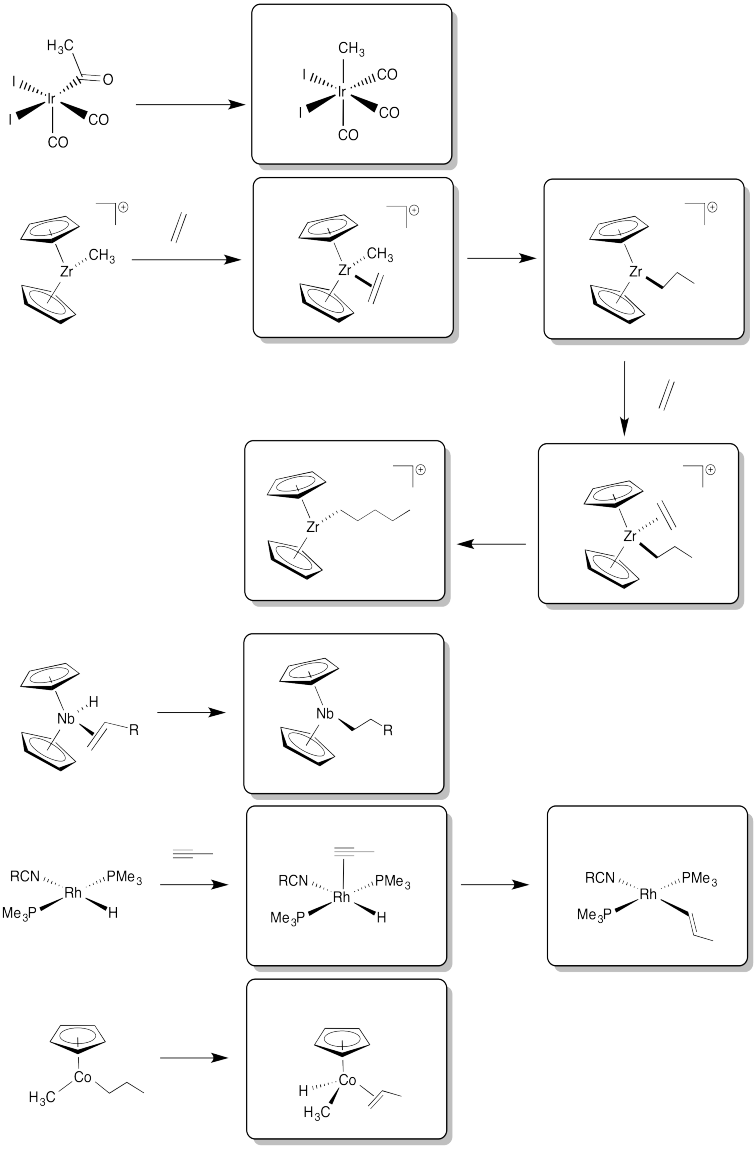
Fill in the missing insertion / elimination products.
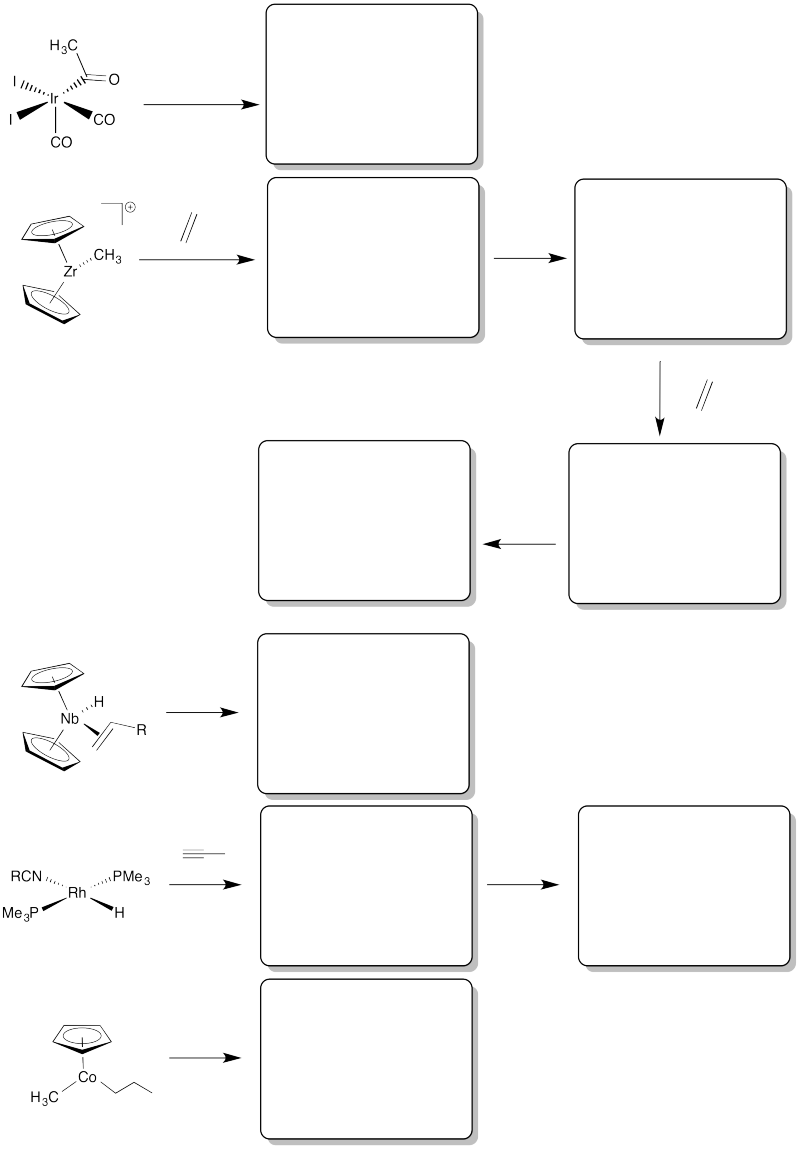
- Answer
-
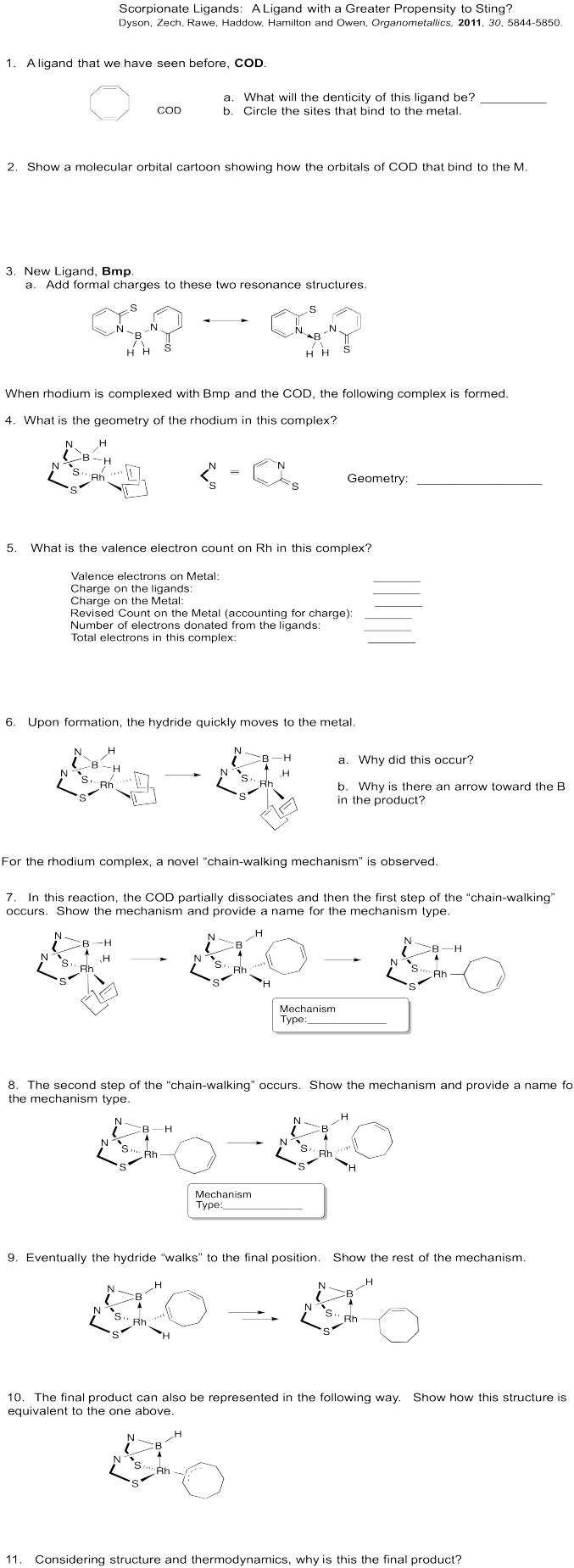
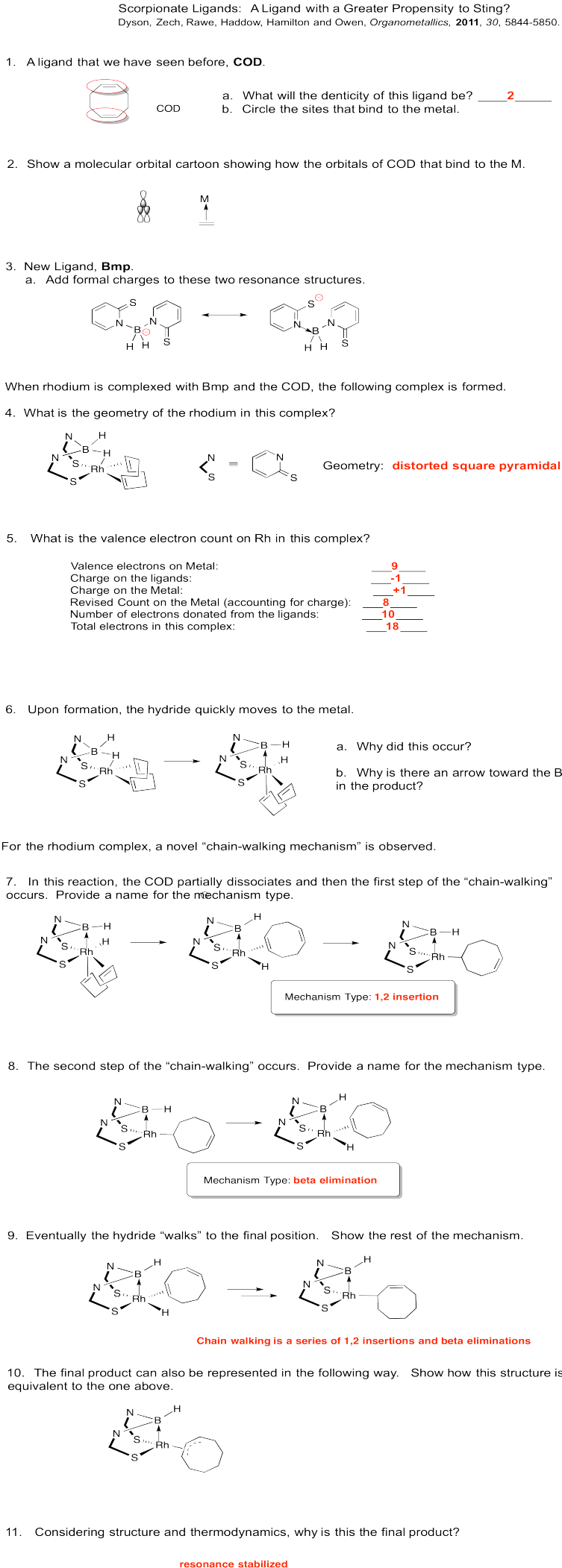
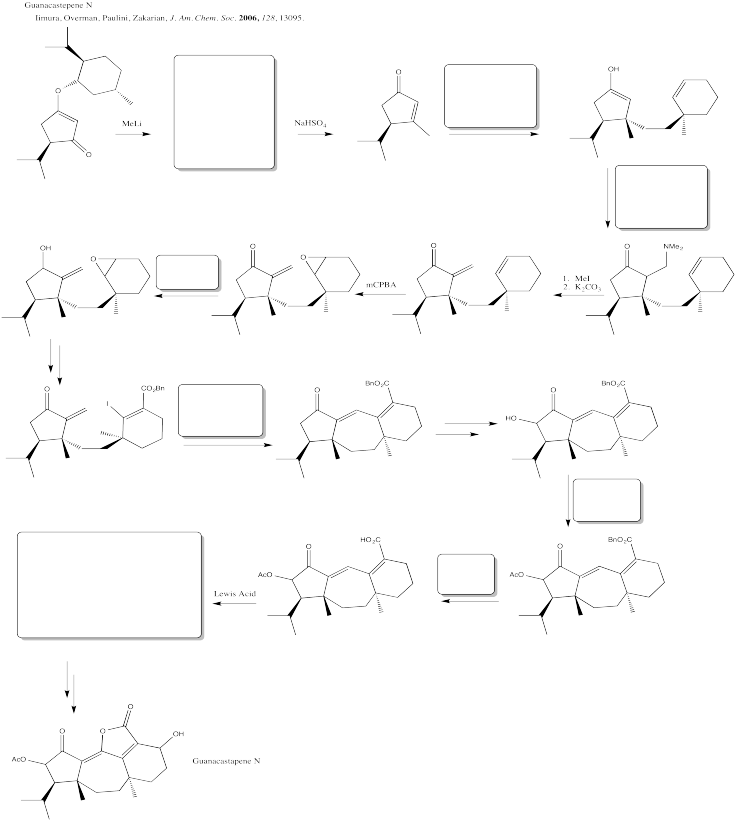
The following multi-part problem is based on an article in the primary research literature.
- Answer
-
- Answer
-
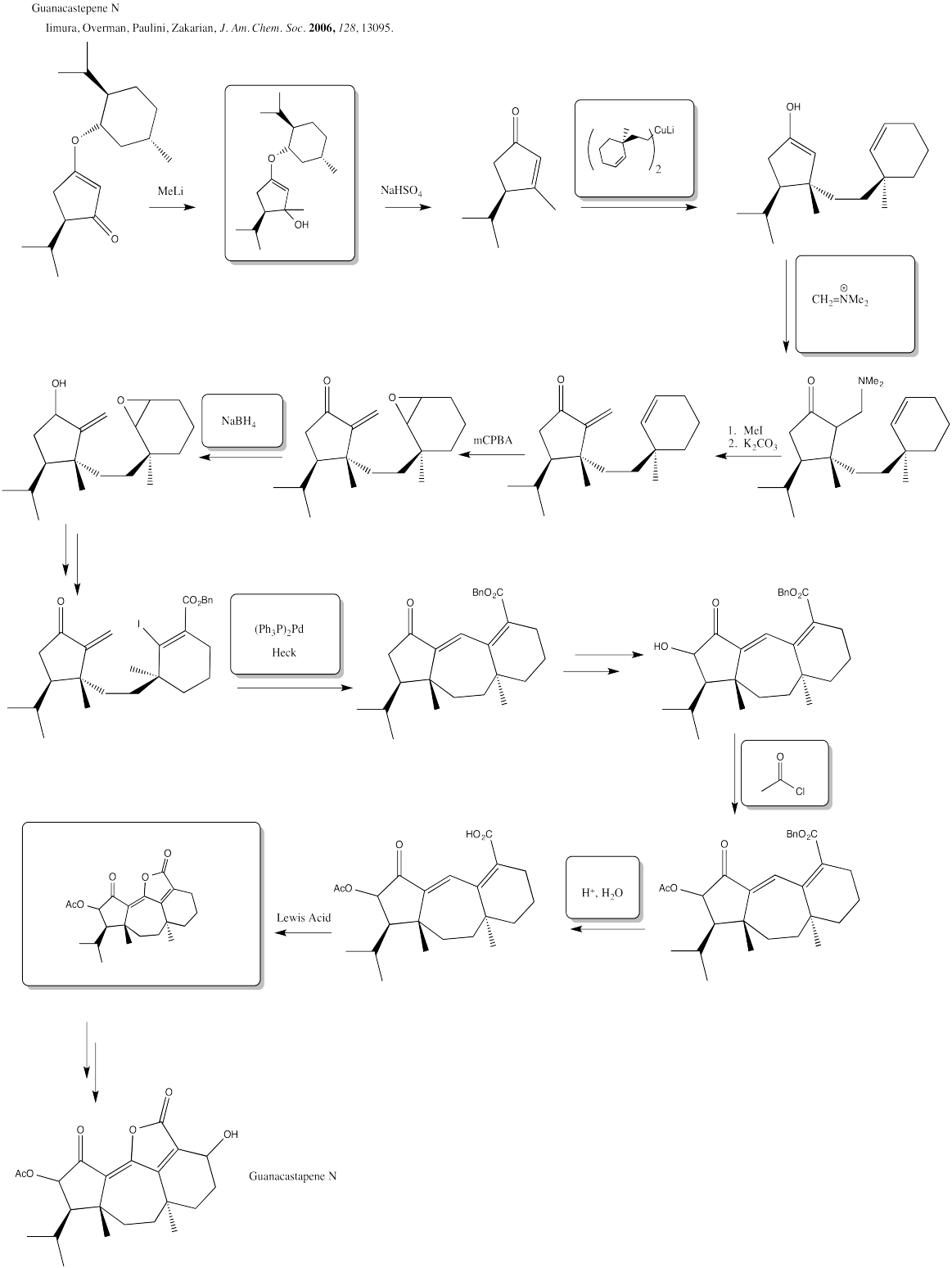
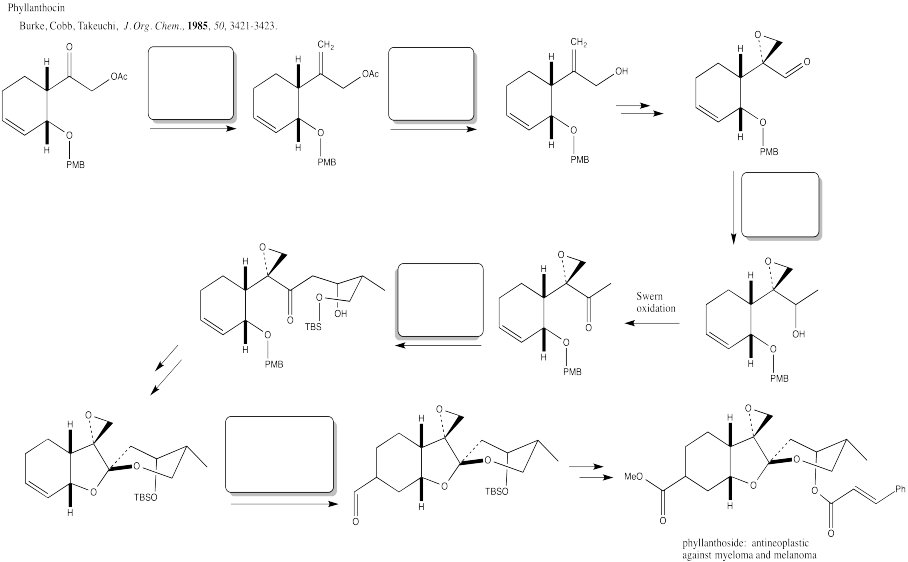
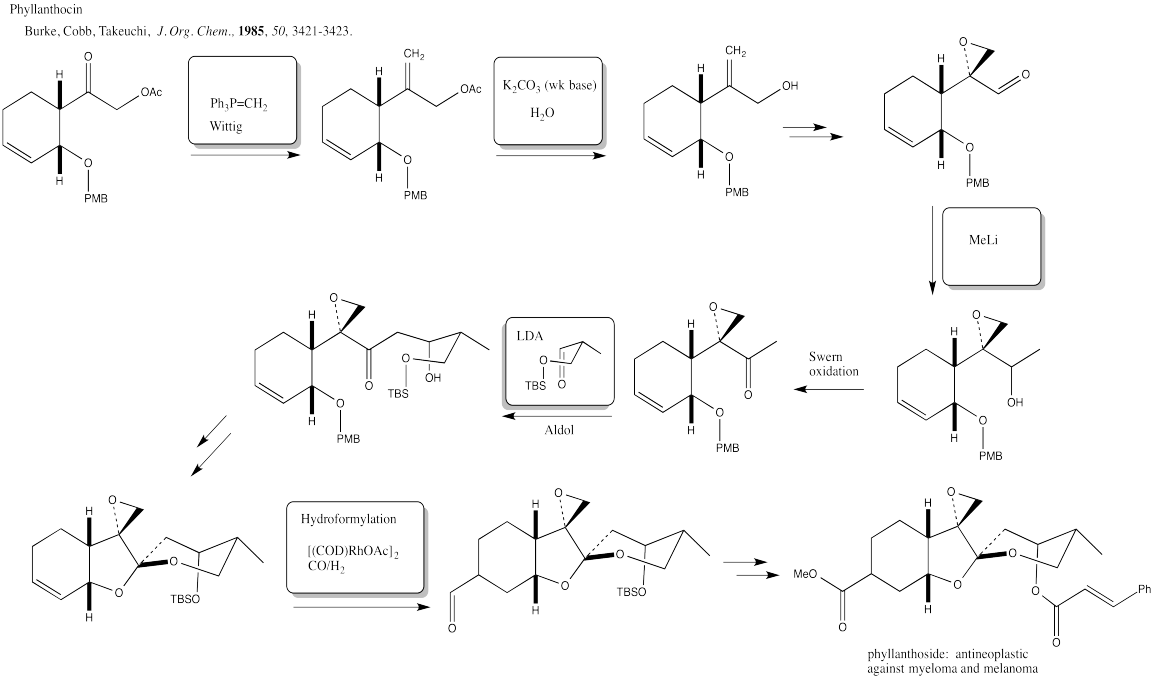
- Answer
-
This page titled 6.6: Insertion at Coordinated Alkenes was last modified on Tue, 04 Oct 2022 14:53:35 GMT and is shared under a CC BY-NC 3.0 license and was authored, remixed, and/or curated by Chris Schaller via source content that was edited to the style and standards of the LibreTexts platform.
The book could not be loaded just now.