Opening the book…
Optical rotation
Exercise \(\PageIndex{1}\)
The (+) enantiomer of compound A has an optical rotation of 125o. If a pure sample of compound A has an optical rotation of 100o, what is the composition of the sample?
- Answer
-
Pure = 125o
Optical purity = \(\frac{100}{125} = 0.80\)
\[\% Major = 80 + \frac{20}{2} = 90 \% \nonumber\]
\[\% Minor = 100-90 = 10 \nonumber\]
Exercise \(\PageIndex{2}\)
The (+) enantiomer of compound B has an optical rotation of 100o. If a pure sample of compound B has an optical rotation of 95o, what is the composition of the sample?
- Answer
-
Pure = 100o
Optical purity = \(\frac{95}{100} = 0.95\)
\[\% Major = 95 + \frac{5}{2} = 97.5\% \nonumber\]
\[\% Minor = 100 -97.5 = 2.5 \% \nonumber\]
Exercise \(\PageIndex{3}\)
The (+) enantiomer of compound C has an optical rotation of 18o. If a pure sample of C contains 30% of the (+) enantiomer and 60% of the (-) enantiomer, what is the optical rotation value?
- Answer
-
Pure = 18o
\[\% Major = 60 \% \nonumber\]
\[\% Minor = 40 \% \nonumber\]
Optical purity \(= \frac{X}{18} = 20 \%\)
Solve for X:
\[X = 3.6^{o} \nonumber\]
Exercise \(\PageIndex{4}\)
The (+) enantiomer of compound D has an optical rotation of 25o. If a pure sample of D contains 80% of the (+) enantiomer and 20% of the (-) enantiomer, what is the optical rotation value?
- Answer
-
Pure = 25o
\[ \% Major = 80 \% \nonumber\]
\[ \% Minor = 20 \% \nonumber\]
Optical purity \( = \frac{X}{25} = 80-20 = 60 \%\)
Solve for X:
\[X = 15^{o} \nonumber\]
The polarimetry experiment
Exercise \(\PageIndex{5}\)
A pure sample of the naturally-occurring, chiral compound A (0.050 g) is dissolved in water (2.0 mL) and the solution is placed in a 0.5 dm cell. Three polarimetry readings are recorded with the sample: 0.625o, 0.706o, 0.682o. What is [a]?
- Answer
-
\[[a] = \frac{observed \: rotation}{(l)(c)} \nonumber\]
\[c = \frac{0.050 g}{2.0mL} = 0.025 \frac{g}{mL} \nonumber\]
Average observed rotation \(= \frac{0.625 + 0.706 + 0.682}{3} = 0.671^{o}\)
\[[a] = \frac{0.671^{o}}{(0.025 \frac{g}{mL})(0.5 dm)} = 53.68^{o} \nonumber\]
Exercise \(\PageIndex{6}\)
A pure sample of the chiral compound B (0.540 g) is dissolved in ether (2.0 mL) and the solution is placed in a 1.0 dm cell. Three polarimetry readings are recorded with the sample: 1.225o, 1.106o, 1.182o. What is [a]?
- Answer
-
\[[a] = \frac{observed \: rotation}{(l)(c)} \nonumber\]
\[c = \frac{0.540g}{2.0 mL} = 0.27 \frac{g}{mL} \nonumber\]
Average observed rotation \(= \frac{1.225 + 1.106 + 1.182}{3} = 1.171^{o}\)
\[[a] = \frac{1.171^{o}}{(0.27 \frac{g}{mL})(1.0 dm)} = 4.34^{o} \nonumber\]
Exercise \(\PageIndex{7}\)
A pure sample of the (+) enantiomer of compound C shows [a] = 42o. What would be the observed a if a solution of the sample was made by dissolving 0.250 g in 2.0 mL of acetontirile and was then placed in a 0.5 dm cell?
- Answer
-
\[[a] = \frac{observed \: rotation}{(l)(c)} \nonumber\]
\[c = \frac{0.250g}{2.0 mL} = 0.125 \frac{g}{mL} \nonumber\]
\[42^{o} = \frac{observed \: rotation}{(0.125 \frac{g}{mL})(0.5dm)} \nonumber\]
observed rotation = 2.625o
Exercise \(\PageIndex{8}\)
A student has prepared compound D in lab. She is sure the compound contains no impurities; a number of physical analyses have confirmed the structure and purity of the compound. A sample of compound D (0.10 g) is dissolved in methanol (2.0 mL) and the solution is placed in a 1.0 dm cell. Three polarimetry readings are recorded with the sample: 0.995o, 0.904o, 0.936o.
- What is [a]?
- The optical rotation of D has previously been reported as 25o. What is the optical purity of this sample?
- What is the enantiomeric excess of this sample?
- What is the composition of this sample?
- Why did the previous analyses show that there was only one compound present?
- Answer a
-
\[[a] = \frac{observed \: rotation}{(l)(c)} \nonumber\]
\[c = \frac{0.10g}{2.0 mL} = 0.05 \frac{g}{mL} \nonumber\]
Average observed rotation = \(frac{0.995 + 0.904 + 0.936}{3} = 0.945^{o}\)
\[[a] = \frac{0.945^{o}}{(0.05 \frac{g}{mL})(1.0 dm)} = 18.9^{o} \nonumber\]
- Answer b
-
% optical purity \(= \frac{(100)(18.9)}{25} = 75.6 \% \)
- Answer c
-
enantiomeric excess = 75.6%
- Answer d
-
\[\frac{100-75.6}{2} = 12.2 \% \nonumber\]
12.2% one enantiomer
87.8% other enantiomer
- Answer e
-
Enantiomers differ in how they interact with plane polarized light, but not in other physical analyses.
Exercise \(\PageIndex{9}\)
Suppose a student prepared a sample of a compound with known [a] = 40. The student did not realize that her sample contained 10% (by mass) of a non-chiral impurity. After correcting for c and l, what did she measure for [a]?
- Answer
-
\[[a] = \frac{observed \: rotation}{(l)(c)} \nonumber\]
\[40^{o} = \frac{observed \: rotation}{(l)(c)} \nonumber\]
\[40^{o} = \frac{observed \: rotation}{(l)(1.1c)} \nonumber\]
Observed rotation = 44o
diastereomers and physical properties
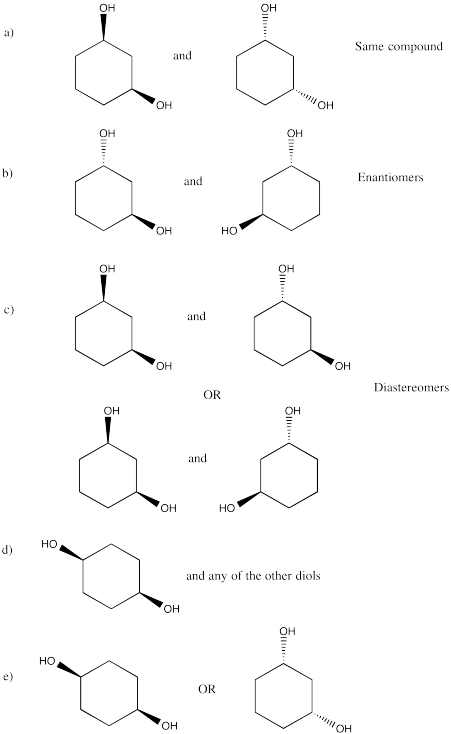
Exercise \(\PageIndex{10}\)
From the following group of molecules, select:
- a pair that are the same compound.
- a pair that would have the same physical properties but opposite optical activities.
- a pair that have different physical properties but the same connectivity.
- a pair that have different connectivity.
- a compound that contains chiral centers but has no optical activity.

- Answer
Exercise \(\PageIndex{11}\)
From the following group of molecules, select:
- a pair that are the same compound.
- a pair that would have the same physical properties but opposite optical activities.
- a pair that have different physical properties but the same connectivity.
- a pair that have different connectivity.

- Answer

Exercise \(\PageIndex{12}\)
From the following group of molecules, select:
- a pair that are the same compound.
- a pair that would have the same physical properties but opposite optical activities.
- a pair that have different physical properties but the same connectivity.

- Answer

This page titled 5.3: Stereochemistry - Extra Problems was last modified on Tue, 04 Oct 2022 15:17:57 GMT and is shared under a CC BY-NC 3.0 license and was authored, remixed, and/or curated by Chris Schaller via source content that was edited to the style and standards of the LibreTexts platform.
The book could not be loaded just now.