Opening the book…
Maraging steel is an alloy, Fe3Ni, that forms a face-centered cubic unit cell. It is used for high-strength applications such as in the forging of fencing swords (epées).
- Draw a cube.
- Add circles to denote atoms in a face-centered cubic array.
- Calculate the number of atoms in the unit cell (always show work).
- Shade in selected atoms in the unit cell to give a 3:1 ratio of iron:nickel in the unit cell.
- Add a legend with shaded and non-shaded circles so that it is clear which circle represents which atom.
- Face centered cubic can also be thought of as forming hexagonal layers. The layers alternate to give which pattern? ABABAB or ABCABCABC
- In the cubic diagram you made, put a letter beside each atom to indicate which of those layers (A or B or C) it is found in.
- Why does the addition of nickel to the steel make the material more difficult to bend or break?
- Answer a), b
-
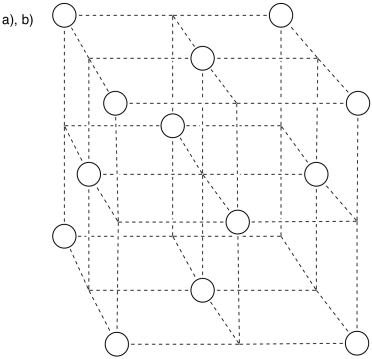
- Answer c
-
There are eight atoms in the corner; each is shared by eight neighbouring cubes. There are six atoms on the faces; each is shared by two neighbouring cubes.
# atoms = \(8 (\frac{1}{8}) + 6 (\frac{1}{2}) = 1 + 3 = 4\) atoms
- Answer d), e), g
-
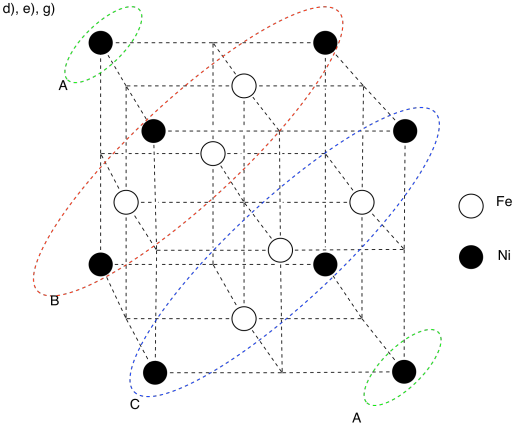
- Answer h
-
Nickel is a little smaller than iron. A row of atoms rolling along in the layer above would fall into the "pothole" caused by the smaller nickel atom and get stuck.
This page titled 2.4: Application Problems with Metals was last modified on Tue, 04 Oct 2022 14:53:37 GMT and is shared under a CC BY-NC 3.0 license and was authored, remixed, and/or curated by Chris Schaller via source content that was edited to the style and standards of the LibreTexts platform.
The book could not be loaded just now.