Opening the book…
In Chapter 8, we learned all about crystal structures of ionic compounds. A good question to ask is, what makes a compound choose a particular structure? In addressing this question, we will learn about the forces that hold crystals together and the relative energies of different structures. This will in turn help us understand in a more quantitative way some of the heuristic concepts we have learned about in earlier chapters, such as hard-soft acid-base theory.
|
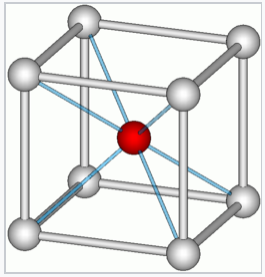
At ordinary pressures, the CsCl structure is adopted by only three of the alkali halides, CsCl, CsBr, and CsI. Under high pressure however, other alkali halides transform from the NaCl to the CsCl structure because of the higher Madelung constant of CsCl. |
This page titled 9.10: Prelude to Ionic and Covalent Solids - Energetics was last modified on Tue, 08 Jun 2021 03:37:22 GMT and is shared under a CC BY-SA 4.0 license and was authored, remixed, and/or curated by Chemistry 310 (Wikibook) via source content that was edited to the style and standards of the LibreTexts platform.
The book could not be loaded just now.