Opening the book…
Reductive Amination of Aldehydes and Ketones (Carbonyls)
Aldehydes and ketones can be converted into 1o, 2o and 3o amines using reductive amination. The reaction takes place in two parts. The first step is the nucleophiic addition of the carbonyl group to form an imine. The second step is the reduction of the imine to an amine using an reducing agent. A reducing agent commonly used for this reaction is sodium cyanoborohydride (NaBH3CN).
The nitrogen gains a bond to carbon during this reaction sequence. When carbonyls react with ammonia, a primary amine is produced. The reaction pattern continues for each amine classification. For example, pyrrolidine reacts with 2-butanone to produce the imine, which can be reduced by LiAlH4, sodium cyanoborohydride (NaBH3CN), or H2 with an active metal catalyst to produce a tertiary amine.

Amide Reduction to 1°, 2° or 3° Amines using LiAlH4
There is a direct correlation between the structure of the amide and the structure of the amine produced. Primary amides are reduced to primary amines. Secondary amides are reduced to secondary amines. Tertiary amides are reduced to tertiary amines. Lithium aluminum hydride is a stronger reducing agent than sodium borohydride, which is not strong enough for this reaction.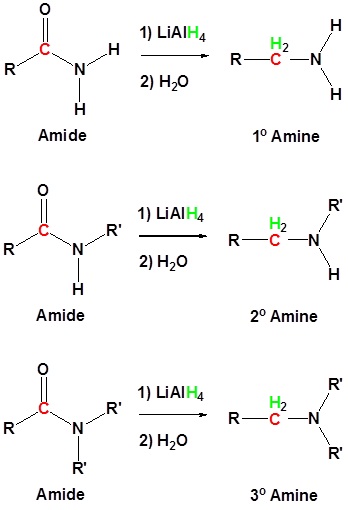
Exercise
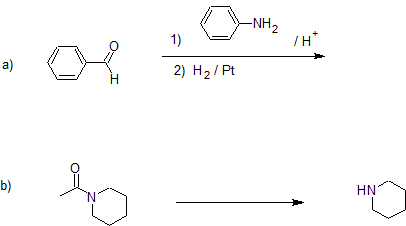
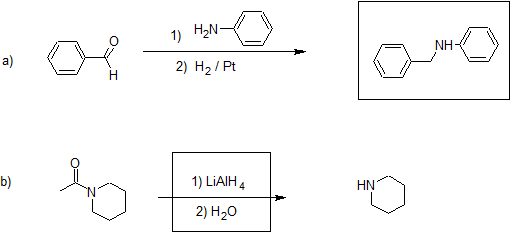
8. Add the missing reactants/products to the following reactions.
- Answer
-
8.
Contributors and Attributions
Dr. Dietmar Kennepohl FCIC (Professor of Chemistry, Athabasca University)
Prof. Steven Farmer (Sonoma State University)
William Reusch, Professor Emeritus (Michigan State U.), Virtual Textbook of Organic Chemistry
Organic Chemistry With a Biological Emphasis by Tim Soderberg (University of Minnesota, Morris)
Jim Clark (Chemguide.co.uk)
- Gamini Gunawardena from the OChemPal site (Utah Valley University)
22.4: Synthesis of Amines is shared under a CC BY-NC-SA 4.0 license and was authored, remixed, and/or curated by LibreTexts.
The book could not be loaded just now.