Opening the book…
Diazomethane, CH2N2, is a yellow, poisonous, potentially explosive compound, which is a gas at room temperature. The structure of diazomethane is explained using three resonance forms.

Conversion of carboxylic acids to methyl esters
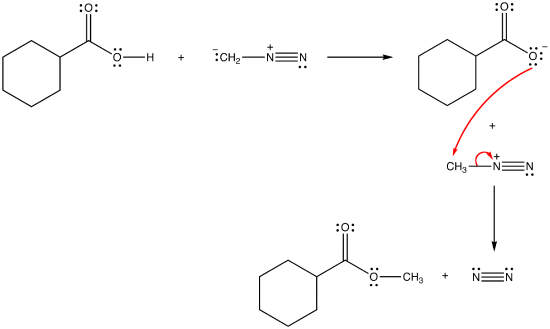
Carboxylic acids react with diazomethane to produce methyl esters. Because of the high reactivity of diazomethane, it is produced in-situ and then immediately reacted with the carboxylic acid to produce the methyl ester.

The first step of the mechanism is a simple acid-base reaction to deprotonate the carboxylic acid. The carboxylate is then the nucleophile of an SN2 reaction with protonated diazomethane to produce the methyl ester with nitrogen gas as a leaving group. It is important to keep reaction vessels vented when gases are produced to avoid explosions.
Contributors and Attributions
- Gamini Gunawardena from the OChemPal site (Utah Valley University)
19.7: Methyl Ester Synthesis Using Diazomethane is shared under a CC BY-NC-SA 4.0 license and was authored, remixed, and/or curated by LibreTexts.
The book could not be loaded just now.