Opening the book…
Restriction Enzymes or restriction endonucleases are part of a bacterial defense system against foreign DNA, such as an infectious bacteriophage and viruses. The bacterial enzyme called methyltransferase methylates its own DNA with methyl groups (-CH3) in a process called DNA Methylation. This process allows the bacteria to recognize its own DNA and destroy any foreign DNA ( unmethylated viral DNA) with the help of restriction enzyme. The combined activities of the restriction endonuclease and methyltransferase are referred to as a Restriction Modification System. Today, most commercially available REs are not purified from their natural sources. Instead, REs are usually isolated from bacteria that overexpress large quantities of REs from plasmids. These recombinant REs have often been engineered by molecular biologists to include amino acid changes that increase the catalytic activity or stability of the RE.
To be able to sequence DNA, it is first necessary to cut it into smaller fragments. Many DNA-digesting enzymes (like those in your pancreatic fluid) can do this, but most of them are no use for sequence work because they cut each molecule randomly. This produces a heterogeneous collection of fragments of varying sizes. What is needed is a way to cleave the DNA molecule at a few precisely-located sites so that a small set of homogeneous fragments are produced. The tools for this are the restriction endonucleases. The rarer the site it recognizes, the smaller the number of pieces produced by a given restriction endonuclease.
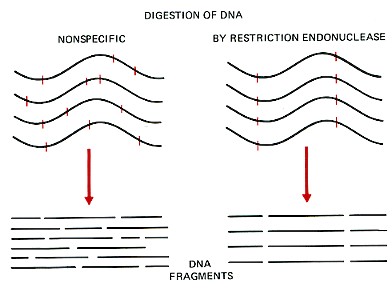
A restriction enzyme recognizes and cuts DNA only at a particular sequence of nucleotides. For example, the bacterium Hemophilus aegypticus produces an enzyme named HaeIII that cuts DNA wherever it encounters the sequence
5'GGCC3'
3'CCGG5'
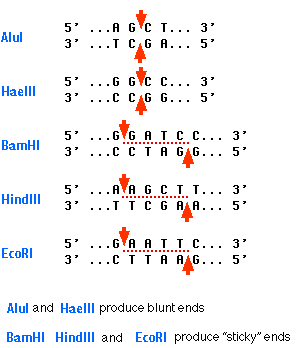
Restriction enzymes hydrolyze covalent phosphodiester bonds of the DNA to leave either “sticky/cohesive” ends or “blunt” ends.This distinction in cutting is important because an EcoRI sticky end can be used to match up a piece of DNA cut with the same enzyme in order to glue or ligate them back together. While endonucleases cut DNA, DNA ligases join them back together. DNA digested with EcoRI can be ligated back together with another piece of DNA digested with EcoRI, but not to a piece digested with SmaI. Another blunt cutter is EcoRV with a recognition sequence of GAT | ATC.


EcoRI generates sticky of cohesive ends SmaI generates blunt ends
Contributors
Contributed by Clare M. O’Connor, Associate Professor Emeritus (Biology) at Boston Collegehttp://www.biology-pages.info/This content is distributed under a Creative Commons Attribution 3.0 Unported (CC BY 3.0) license and made possible by funding from The Saylor Foundation.
Dr. Todd Nickle and Isabelle Barrette-Ng (Mount Royal University) The content on this page is licensed under CC SA 3.0 licensing guidelines
6.3: Restriction Endonuclease is shared under a CC BY-NC-SA 4.0 license and was authored, remixed, and/or curated by LibreTexts.
The book could not be loaded just now.