Opening the book…
Because we are focusing in this textbook on biologically relevant organic chemistry, we will frequently be alluding to important classes of biological molecules such as lipids, carbohydrates, proteins, and nucleic acids (DNA and RNA). Now is a good time to go through a quick overview of what these molecules look like. These are large, complex molecules and there is a lot of information here: you are not expected to memorize these structures or even, at this point, to fully understand everything presented in this section. For now, just read through the section and get what you can out of it, and work on recognizing the fundamental things you have just learned: common bonding patterns, formal charges, functional groups, and so forth. Later, you can come back to this section for review when these biomolecules are referred to in different contexts throughout the remainder of the book.
Many of the biomolecules that we will be talking in this section are polymers. To understand what a polymer is, simply picture a long chain made by connecting lots of individual beads, each of which is equipped with two hooks. In chemical terminology, each bead is a monomer compound, the hooks are linking groups, and the whole chain is a polymer.
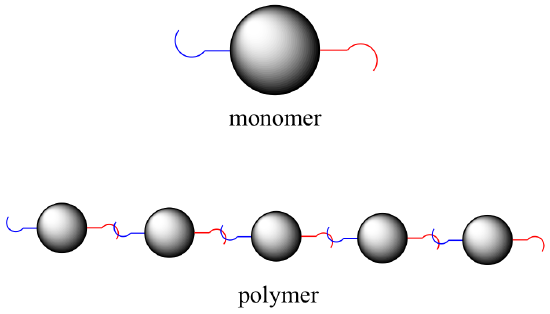
Although lipids can be described as biopolymers, we will use the monomer-linking group terminology in particular when we talk about carbohydrates, protein, and nucleic acids.
Click on the links below to learn about each of these important types of biological molecules:
- Lipids
- Carbohydrates
- Amino acids and proteins
- Nucleic acids
Contributors and Attributions
- Organic Chemistry With a Biological Emphasis by Tim Soderberg (University of Minnesota, Morris)
This page titled 1.3: Structures of some important biomolecules was last modified on Wed, 20 Jul 2022 18:34:12 GMT and is shared under a CC BY-NC-SA 4.0 license and was authored, remixed, and/or curated by Tim Soderberg via source content that was edited to the style and standards of the LibreTexts platform.
The book could not be loaded just now.