Opening the book…
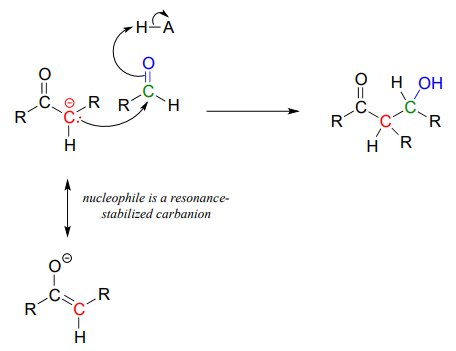
We have seen in this chapter a number of reactions in which oxygen and nitrogen nucleophiles add to carbonyl groups. Other nucleophiles are possible in carbonyl addition mechanisms: in chapters 12 and 13, for example, we will examine in detail some enzyme-catalyzed reactions where the attacking nucleophile is a resonance stabilized carbanion (usually an enolate ion):
Then in chapter 15, we will see how the carbonyl groups on aldehydes and ketones can be converted to alcohols through the nucleophilic addition of what is essentially a hydride (\(H^-\)) ion.
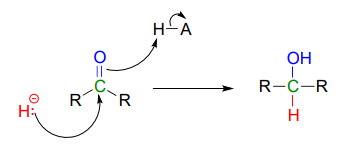
fig 29
This page titled 10.6: A Look Ahead - Addition of Carbon and Hydride Nucleophiles to Carbonyls was last modified on Wed, 20 Jul 2022 18:36:24 GMT and is shared under a CC BY-NC-SA 4.0 license and was authored, remixed, and/or curated by Tim Soderberg via source content that was edited to the style and standards of the LibreTexts platform.
The book could not be loaded just now.