Opening the book…
Student authors: Jason Stott & Victoria Bublin 2020
Describing crystal structures
Unit cells and lattice types
To understand the properties of a crystalline solid, one must first understand the structure. The most useful way to describe the structure of a crystalline solid is by breaking it down into its smallest repeating unit, known as the unit cell. The unit cell is repeated infinitely in all directions in the theoretical bulk crystal solid. A unit cell is described by lattice points, which together make up various lattice types. A unit cell can also be described using dimensions of length, width, and height. The different lattice types can be differentiated by their dimensions as well as the placement of atoms within the cell. There are 14 different lattice types.
https://chemed.chem.purdue.edu/genchem/topicreview/bp/ch13/unitcell.php
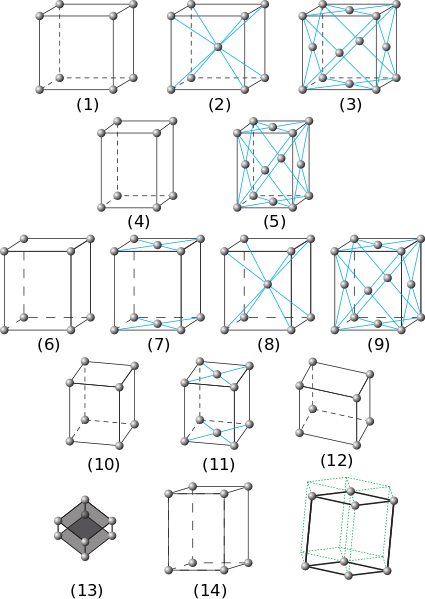
Napy1kenobi / CC BY-SA (https://creativecommons.org/licenses/by-sa/3.0)

- Cubic P
- Cubic I
- Cubic F
- Tetragonal P
- Tetragonal I
- Orthorhombic P
- Orthorhombic C
- Orthorhombic I
- Orthorhombic F
- Monoclinic P
- Monoclinic C
- Triclinic
- Rhomboedral
- Hexagonal
Ions within the crystal lattice can be located using a three number coordinate system. For example, (0,0,0) indicates an ion on the origin, and (1,1,1) indicates an ion that is one unit away from the origin in the x, y, and z directions. Edge cells must be equivalent, so an ion on the origin implies one at each corner. Different lattice types have different efficiencies or densities. This means that some unit cells contain more “full molecules” than others. Those containing more full ions are considered more efficient.
Miller indices
Wyckoff positions
- Where atoms can be found in a general structure. Often paired with space groups these are the gaps in the crystal structure that can be occupied. This gives vital information to the structure and the kind of arrangements
- This gives more information about the and how other atoms fit in the nanostructure. Knowing this can tell a lot about the reactivity as well as other properties such as photoluminescence.
- https://pubs.acs.org/doi/10.1021/acs.inorgchem.5b01510
- https://www.cryst.ehu.es/cryst/get_wp.html
Space groups
- This tells us the general form of the crystal and how we can categorize its symmetry and shape. A given spacegroup gives all information about the surfaces
- Reading this tells us the morphology of the structure which could effect reactivity as well as other properties.
- https://pubs.acs.org/doi/10.1021/acsomega.9b04012
- https://www.britannica.com/science/space-group,http://img.chem.ucl.ac.uk/sgp/large/sgp.htm,https://journals.aps.org/pr/abstract/10.1103/PhysRev.96.280
Good literature examples
Crystal structure basics is shared under a not declared license and was authored, remixed, and/or curated by LibreTexts.
The book could not be loaded just now.